Sabio Tarot · Card combinations
Death and the Tower: Two Ways of Talking About an Ending Without Frightening
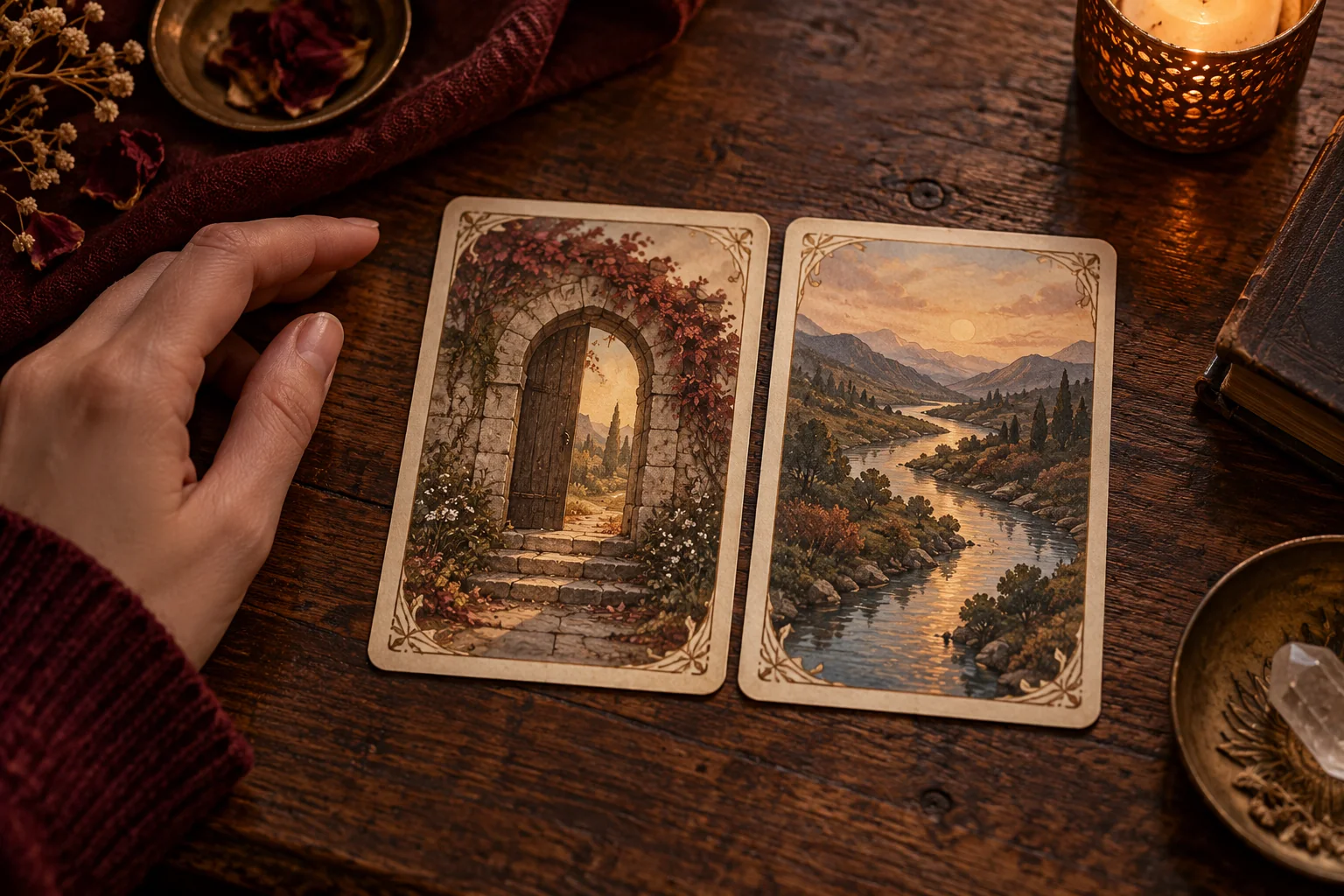
Death and the Tower together can unsettle someone seeing tarot for the first time. The mistake would be to turn unease into spectacle: 'disaster is coming,' 'everything will collapse.' The cards do not confirm accidents, deaths, or illnesses. In an everyday reading, we can use them as images of two kinds of change: a stage that ends and a structure that stops supporting what it promised. The difference matters because it invites different actions. A closure may need a farewell and reorganization; an unstable structure may require reviewing concrete conditions.
Fictitious case: a small association decided to stop publishing a monthly newsletter. The team is exhausted and the sending platform has become expensive. The question is 'what should be closed and what should be redesigned?' Death appears in 'cycle that ends' and the Tower in 'structure that fails.' The synthesis may be to suspend the monthly newsletter and review the communication system, perhaps with lighter quarterly updates. It does not predict the association's closure or blame anyone for the exhaustion. Cost and work-hour figures must be measured outside the spread.
Do not treat two intense images as equivalent
The name Death can function as a metaphor for the irreversible end of a way of doing things; the Tower can indicate that a support, an expectation, or a plan deserves inspection. They are possible interpretations, not facts inherent in each question. If we add 'ending + collapse' and conclude 'catastrophe,' we have jumped from symbol to a claim about the world without evidence. Responsible reading separates what we know from what we fear.
In the newsletter, we know there is fatigue and cost. We do not know that the community will stop participating if the format changes. We can test an alternative and ask readers what information they value. If a member insists on keeping the frequency because of tradition, the pair can open a conversation about what function it served and whether there is another way. It is not useful for imposing a break against the group.
The order of the cards
Death → Tower, with positions 'decision → consequence to review,' could be read as 'closing a cycle forces a review of the infrastructure that sustained it.' For example, when suspending the newsletter, one must cancel a subscription and update links. Tower → Death, with positions 'problem detected → response,' may indicate that the system failure precipitates the decision to abandon that format. Do not declare that a card announces a dated future event. The order only acquires that function if the spread defined it, and even then it produces hypotheses, not guarantees.
In positions of 'risk' and 'resource,' Death could warn that the team is clinging to a concluded routine; the Tower could be an opportunity to see why a process failed. But before saying so, ask whether a real problem exists. If the newsletter fulfills its purpose and there was only an isolated technical error, do not force a narrative of total ending because the pair of cards seems dramatic.
Second fictitious context: a move
Inés is moving to a smaller apartment and has to sell some furniture. Question: 'How should I organize what I leave behind and what I need to set up again?' Death can help name the end of a stage in the previous home; the Tower can invite a review of measurements, storage, and service contracts in the new home. Neither card says the building is unsafe. If Inés needs to know that, she must consult reports and qualified professionals. A reading about logistics cannot become a structural inspection.
The emotional burden of leaving a home can be real. Do not trivialize it with 'it's just a change.' Make a concrete list: objects to keep, objects to donate or sell, procedures, and support needed. If there is grief, the conversation can leave room to feel it without predicting more loss. The pair works best when it allows naming two different tasks: saying goodbye and building a viable base.
How to speak if the person is frightened
Start by acknowledging the reaction: 'The names are strong; I will not use them to predict physical harm.' Ask what worries them in their real situation. If the fear concerns health, safety, or violence, direct them to appropriate sources and help. Do not turn the card into a diagnosis or into a false absolute reassurance. In everyday matters, return to the spread's framework and formulate non-alarmist hypotheses that can be checked.
Avoid fatalistic phrases: 'something bad has to happen,' 'you can't avoid it.' Replace them with questions: 'What part of this plan no longer works?', 'what closing decision are you postponing?', 'what support is needed to change it?' If the person does not recognize any connection with the pair, do not insist until you find a misfortune that fits. Tarot can produce an image that is not useful in that consultation; admitting it is better than fabricating a threat.
The edition and the concrete image
The so-called 'Death card' may carry different names or labels depending on the deck. The Tower also changes in drawing and visual context. In Marseille and Rider-Waite, you should not assume that every detail appears the same. Describe what you see and name the edition if you make an iconographic claim. The reading of closure and structure is a practical framework, not a claim that a symbol has a fixed translation across all decks.
If the person uses a contemporary illustrated edition, the visual intensity may be greater than in another. That affects the emotion of the reading; it is worth observing without exaggerating the forecast. How to interpret two cards together shows how to avoid a mechanical sum of keywords. This pair is a good test: the stronger the names, the more important it is to return to the question.
Close with small tasks
The association could decide on a two-month pause, publish a clear notice, cancel an expensive tool, and consult its readers. Inés could measure furniture, get a moving quote, and set aside a day to say goodbye to the old apartment. These are verifiable steps. Death and the Tower do not do those tasks or guarantee how each person will feel afterward. They help distinguish what is ending and what structure is being rebuilt.
A responsible reading leaves the person with more clarity and less alarm. If in the end only fear remains, the interpretation has not fulfilled its function. The strength of these images can open a difficult conversation, but it must not become a prediction of tragedy.
Method and limits
Original editorial interpretation by Sabio Tarot. The association and Inés are fictitious examples. The cards do not announce deaths, accidents, diagnoses, or building safety; those questions require evidence and professional help.