- Books
- Rider-Waite · go deeper
Rider-Waite Tarot Card Combinations
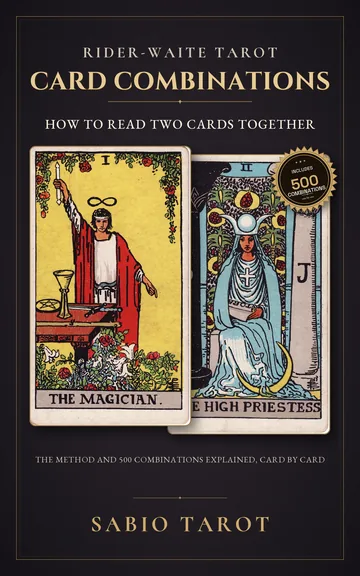
Rider-Waite Tarot Card Combinations: How to Read Two Cards Together: The Method and 500 Combinations Explained, Card by Card
Go beyond knowing each card's separate meaning and learn to interpret the conversation between two images.
- English
- 500 pairs
- Visual method
Shop by country and format
Each link uses the ASIN for that format. In Ireland, choose Amazon.co.uk for Kindle or Amazon.ie for print. Price, delivery and availability depend on the store.
This work in other languages
A dictionary that teaches a method
The method and lookup entries serve different purposes.
Ten chapters of method
Dominant card, support and conflict, suits, repeated numbers, gazes, reversals, a third card and common mistakes.
500 developed entries
Each pair includes a joint reading, love, work and advice. Card cross-references and the final index help you find either order.
Practice materials
A brief review of all 78 cards, suit and number matrices and eight small spreads centred on relationships.
What changes when two cards meet
You may understand the Magician and the Tower separately yet struggle when they appear side by side. This book focuses on that step, teaching a method for pairs and developing 500 combinations.
Rider-Waite-Smith's illustrated minors offer gestures, gazes and details. The method uses those clues alongside suit, number and question. It does not turn an image into a fixed answer: context still changes the reading.
Do not start with the dictionary's answer
Look at two cards in a spread. Which carries more weight? Where do they agree or create tension? Do the figures face each other, and what do the suits add? Make your own reading before opening the entry.
Compare your proposal with the book. This helps you recognise patterns and read pairs beyond the 500 selected. If your deck redraws the historical scenes, check its actual details before applying a rule about gazes.
Sabio Tarot · The book
What the 500 combinations are for
The aim is not to memorize 500 answers. The method first asks you to move from two separate meanings to a sentence about the relationship between the cards. Which card carries more weight? Do they reinforce, qualify or challenge each other? What do suits, numbers, reversals and the question contribute? The method also considers what changes when a third card appears.
The reference section develops 500 pairs. Each full entry offers a joint reading and applications to love, work and advice. Cross-references and an index in both orders let you start with either card. Tables and eight small spreads help you practise. The method is intended to remain useful for pairs outside the selected 500.
Try this extra website exercise before looking a pair up: write one sentence for each card and a third that explains their connection. Compare your reasoning with the entry. The goal is to articulate why a reading makes sense, not to repeat a fixed answer.
Reading Rider-Waite-Smith scenes
Even the numbered Minor Arcana carry scenes. A figure may face another character, hold an object or move across the card. Those details help you ask better questions, but they do not dictate a universal answer: the question and the position in the spread still matter.
Rider-Waite-Smith numbers Strength VIII and Justice XI. Pamela Colman Smith's historical illustrations provide the visual reference in these books. If your deck redraws the scenes, check its actual objects and gestures before applying an example that depends on them.
For a Rider-Waite-Smith deck
In this system Strength is VIII, Justice XI and numbered minors are illustrated. The visual method is adapted to those images, reproduced from Pamela Colman Smith's historical deck.
You should already recognise the cards, although the book contains a short review. If you are starting from scratch, choose the Rider-Waite beginner's guide. For Marseille, the matching combinations book works with unillustrated pips.
Frequently asked questions
Must I know all 78 cards already?
Recognising them helps. The short review does not replace the beginner's guide.
Are the 500 entries fixed answers?
No. They are examples in context; the method applies to other questions and pairs.
How do I find a combination?
Start from either card. Cross-references and the final index list both orders.
Does it cover reversals and spreads?
Yes. There is a chapter on reversed pairs and eight practice spreads.
More from the collection
 Marseille · Start
Marseille Tarot for Beginners
All 78 cards, unillustrated pips and your first spreads.
 Rider-Waite · Start
Rider-Waite Tarot for Beginners
Learn all 78 cards through their scenes and practise spreads.
 Marseille · Combine
Marseille Tarot Card Combinations
A method for reading pairs plus 500 card combinations.
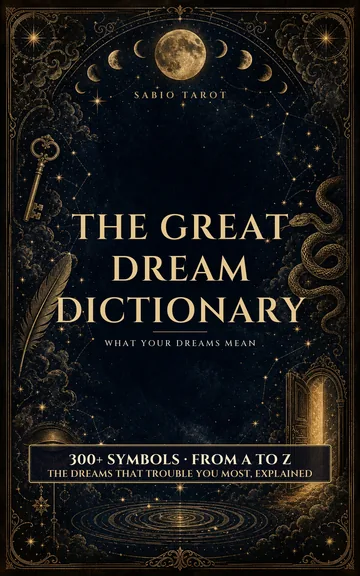 Dreams · Dreams
The Great Dream Dictionary
Hundreds of symbols, recurring dreams and a practical dream journal.