Sabio Tarot · Reading methods and spreads
Fictitious case: a clarifying card that does not clarify

This consultation is fictitious. Pablo is waiting for a response to an application to take part in a festival. He asks “Will they accept me?” and draws the Two of Swords. It seems ambiguous to him, and he decides to ask for a clarifying card; after formulating a concrete question, the Seven of Cups comes out. Now he has more possibilities on the table and less clarity. He thinks about drawing a third, a fourth, and a fifth. The case shows when an additional card helps, when it only expands uncertainty, and how to close without fabricating an answer.
The original question asks for information that belongs to someone else
The selection is decided by a committee that Pablo does not control. He knows that the response deadline expires in ten days and that his application is complete. He does not know how many places there are or what criteria they will use to break ties. A spread can help him manage the wait or prepare scenarios, but it cannot give him access to the committee’s private deliberation. The question “Will they accept me?” invites using any symbol as a forecast of someone else’s decision.
Pablo is not wrong for wanting to know. Uncertainty can be difficult. The point is to distinguish the desire for certainty from available information. If tarot is used to draw more and more cards until obtaining a reassuring answer, the consultation can become circular. Before drawing a clarifying card, it is worth naming exactly which part of the first card is not understood and what type of additional answer would be useful.
Three positions, but the second is a question
The initial card and clarification diagram contains three places: 1) initial card, 2) formulated question, and 3) clarification. Place 2 does not necessarily require a card: it is a sentence written before drawing the third position. In the case, the initial card is the Two of Swords. Pablo writes: “What decision is really in my hands while I wait?” Only then does he draw the clarifying card, the Seven of Cups. The new card does not decide for the committee either; it can point to many imagined options and the need to separate real scenarios from fantasies.
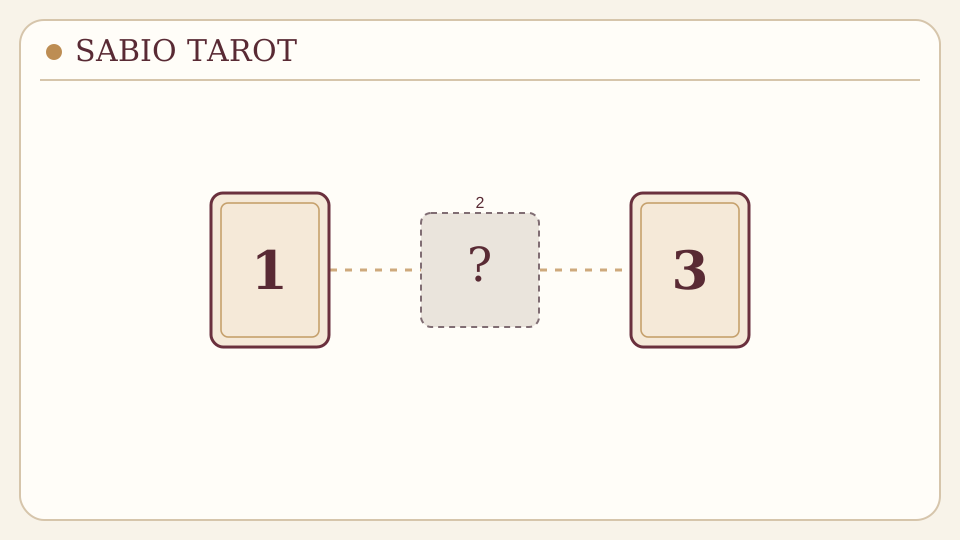
In Rider-Waite-Smith, the Two of Swords represents a blindfolded figure with two swords, and the Seven of Cups shows several possible images. These are observations of a specific edition. The V&A contextualizes the variety of decks and the visual work of Rider-Waite-Smith. If Pablo uses Marseille, he must describe the number, suit, and arrangement of the symbols he sees, without relying on Rider-Waite-Smith scenes. In both cases, the “clarification” position does not grant access to confidential information.
Two hypotheses that do not require another card
First hypothesis: the Two of Swords reflects the lack of information, and the Seven of Cups, the scenarios Pablo imagines while he waits. Second: the cards indicate that Pablo does have a choice of his own —which other festivals to apply to or how to use the ten days— and that his attention is scattered among options. Both hypotheses can be useful. Neither provides information about the committee’s response. To discriminate between them, it is enough to ask what Pablo needs now, not to draw more cards.
Pablo responds that he has another registration deadline in five days and has postponed it while waiting for the first festival. That fact favors the second hypothesis as a guide to action. He must read the guidelines to check whether they allow participation in both processes, and only then decide whether to submit the second application. The new question is now verifiable: “What conditions do the calls for applications have and what decision can I make before Friday?” A guidelines document can clarify more than five additional cards.
How the consultation is closed
The prudent synthesis would be: “We do not know if they will accept you. What you can do is review the compatibility of the calls for applications and decide whether to submit another application. The rest belongs to the committee and the announced deadline.” Pablo writes down the sentence, puts the deck away, and sets an alarm to check the guidelines. He decides not to consult again about the same answer before new information arrives. That pause prevents a sequence of symbols from replacing the real calendar.
It does not mean there is a universal rule of “only two cards.” A clarifying card can help when the first card points to a specific aspect and the new question delimits something different. For example, “what resource do I have to prepare for the interview?” is different from “will they choose me, yes or no?” The difference is in the quality of the question, not in a magic number of allowed cards.
Signs that the clarifying card is making the reading worse
The reader changes the question after seeing each card; looks for an image that contradicts an uncomfortable answer; attributes increasingly specific thoughts to a third party; or can no longer summarize the consultation in one sentence. In those situations, it is best to stop, drink water, record what is known, and decide what external data might arrive. Continuing out of anxiety can give a false sense of activity without increasing knowledge.
If the uncertainty relates to health, finances, or a legal situation, there are additional reasons not to use clarifying cards as a substitute for advice. The next step may be to call the relevant professional, read a notification, or seek a qualified second opinion. The deck does not diagnose or interpret clauses. A responsible consultation knows how to recognize when another source has more authority.
Review exercise for another day
Keep the original question, cards, positions, and synthesis with a date. When the festival’s response arrives, review what action of your own you took during the wait and whether you attributed to the cards information you did not have. Do not retrospectively rewrite the Seven of Cups to claim that it “always pointed to” the outcome. If the decision is delayed, you can formulate a new question about your work plan, not repeat the same expectation in a loop.
Expand with comparing two cards, useful questions for tarot, and Rider-Waite Tarot Combinations. Pablo’s achievement is not getting a private answer right: it is leaving a consultation that no longer clarifies and recovering a real action under his control.