Sabio Tarot · Responsible readings
Fictitious case: a worry about money and the limit of tarot

This case is fictitious and does not provide financial advice. Rosa is worried about an unexpected car bill; she needs the car to get to work. She arrives with the question “Will I be ruined?”. She reframes it as “What information and support should I check before deciding how to pay for the repair?”. Tarot can help organize anxiety and avoid overlooking options. The amount, the contract, and the ability to pay are calculated outside the deck.
Case details that no card reveals
The provisional bill is 680 euros. Rosa has 400 in available savings and expects to be paid for a job within three weeks. The repair might have a warranty, but she has not read the document. These figures belong only to the example; they are not a guideline applicable to other people. To decide, she needs to know the final price, whether the repair is essential, whether there is another transport option, and what payment period the garage allows. Without those answers, any announcement of “abundance” or “ruin” would be imaginary.
Rosa distinguishes two types of question. The symbolic: “What happens to me when I see an expense that exceeds my reserve?” The practical: “How much do I owe, when is it due, and what contractual options do I have?” Both matter, but they are answered with different means. A reading can accompany the first and motivate a list for the second. It cannot replace the budget or reliably interpret the terms of a warranty.
If Rosa shares expenses with another person, she will also have to talk with them before committing shared money. That conversation is a source of information and consent, not a detail that a card can omit.
Two positions and cards
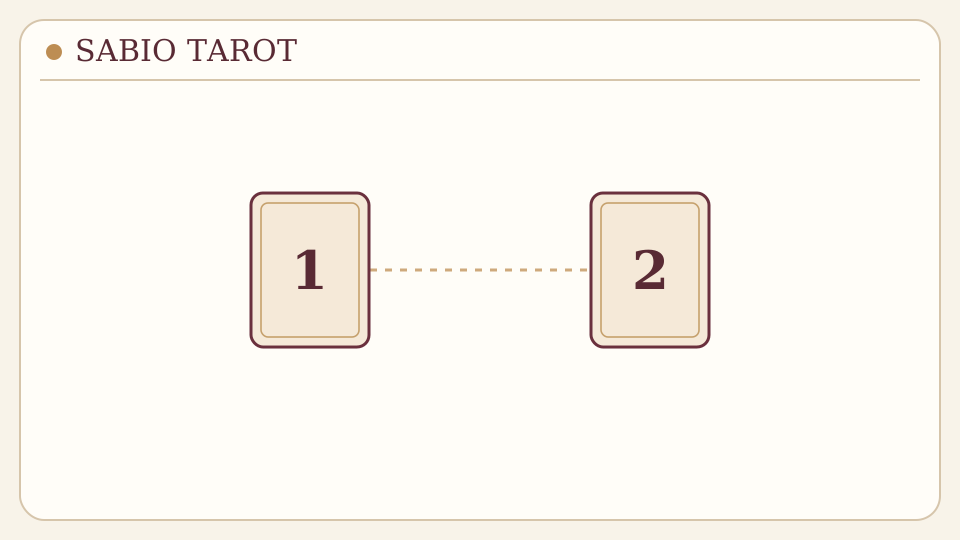
The situation and possible response diagram sets out 1) the situation requiring attention and 2) the response Rosa can explore. In the example, Five of Pentacles and Two of Pentacles appear. The five does not announce bankruptcy; it relates to worry and to the difference between bill and savings. The two does not guarantee that she will be able to balance payments; it can invite her to compare dates and demands. The reading remains in the realm of questions, not calculations.
In a Marseille edition, Rosa sees coin numerals. She does not necessarily see the people in the snow or the juggling figure typical of Rider-Waite-Smith. The V&A helps situate the variety of decks. This detail is not merely academic: if the reader attributes to their card a scene that does not exist, they may make a dramatic interpretation that Rosa does not need.
Two hypotheses and how to test them
The first hypothesis is that the repair is necessary, but can be paid through a combination of savings and an agreement without excessive costs. The second is that the initial estimate includes non-urgent work and that Rosa can handle only the essential part while comparing garages. The cards do not select an option. Rosa asks for an itemized estimate and an explanation of the risk of postponing each repair. She also reviews the warranty and seeks a second technical opinion if it is accessible to her.
Suppose the bill is confirmed and the vehicle must be repaired to drive safely. Rosa will make a budget for the coming weeks with exact amounts and will seek appropriate financial or social advice if she cannot cover basic needs. If the garage offers financing, she will read fees, interest, and terms before accepting. None of that comes from the Two of Pentacles. These are decisions with real consequences that deserve verifiable information.
A synthesis with two columns
The symbolic part could be summarized: “The expense worries you and may make you feel you have no margin. You can move from a global threat to delimited questions.” The practical part would be a list: final budget, warranty, urgency of the repair, payment date, and support resources. The first sentence does not replace the second list. A responsible reader can recognize their limit: “I cannot tell you whether you will be able to pay it, nor recommend a loan based on these cards.”
Rosa could include a contingency scenario: if the repair takes longer, how will she get to work during those days? The cost of alternative transport belongs in the full budget. Asking in time prevents an apparently cheap solution from creating another unexpected difficulty.
Rosa decides to ask for the breakdown today and to postpone any signature until she has read the terms. That decision is hers. If the result were a larger expense, she would seek competent help. If it were smaller, she would review her plan without attributing to the card a prediction of the amount. The reading has served to create a pause between fear and a hasty decision.
Phrases to avoid
“The Five of Pentacles announces poverty,” “the Two of Pentacles says everything will work out,” and “if you trust, money will appear” are dangerous formulations. They can frighten, create false security, or blame someone going through a material problem. Better to ask “what data is missing?” and “who can advise you on the contract or payment?”. If the person is at risk of not covering housing, food, or medication, the priority is to seek real resources as soon as possible, not an additional reading.
Tarot should not be used either to recommend investments, debt, or giving up rights. Even a card with shining pentacles does not express an interest rate. In a helping conversation, the reader can provide emotional support and point out that there are relevant professionals and services; they should avoid inventing organizations or conditions they have not verified.
Repeating the method with another worry
Make two columns: “what I feel and fear” and “data I need.” Formulate a bounded symbolic question and an external practical step for the same day. If you draw two cards, set the situation and possible response in advance; avoid asking them for amounts and dates. Afterwards, note what you discovered outside the reading and whether that changed your hypothesis. If uncertainty persists, seek someone who has the appropriate information or competence.
You can expand with Pentacles and resources, useful questions for tarot, and Marseille Tarot from Scratch. Rosa's case teaches a fertile limit: a card can help you think calmly, while the financial answer depends on numbers, documents, and real support.