Sabio Tarot · Minor Arcana
Ten of Cups: Harmony and Everyday Life
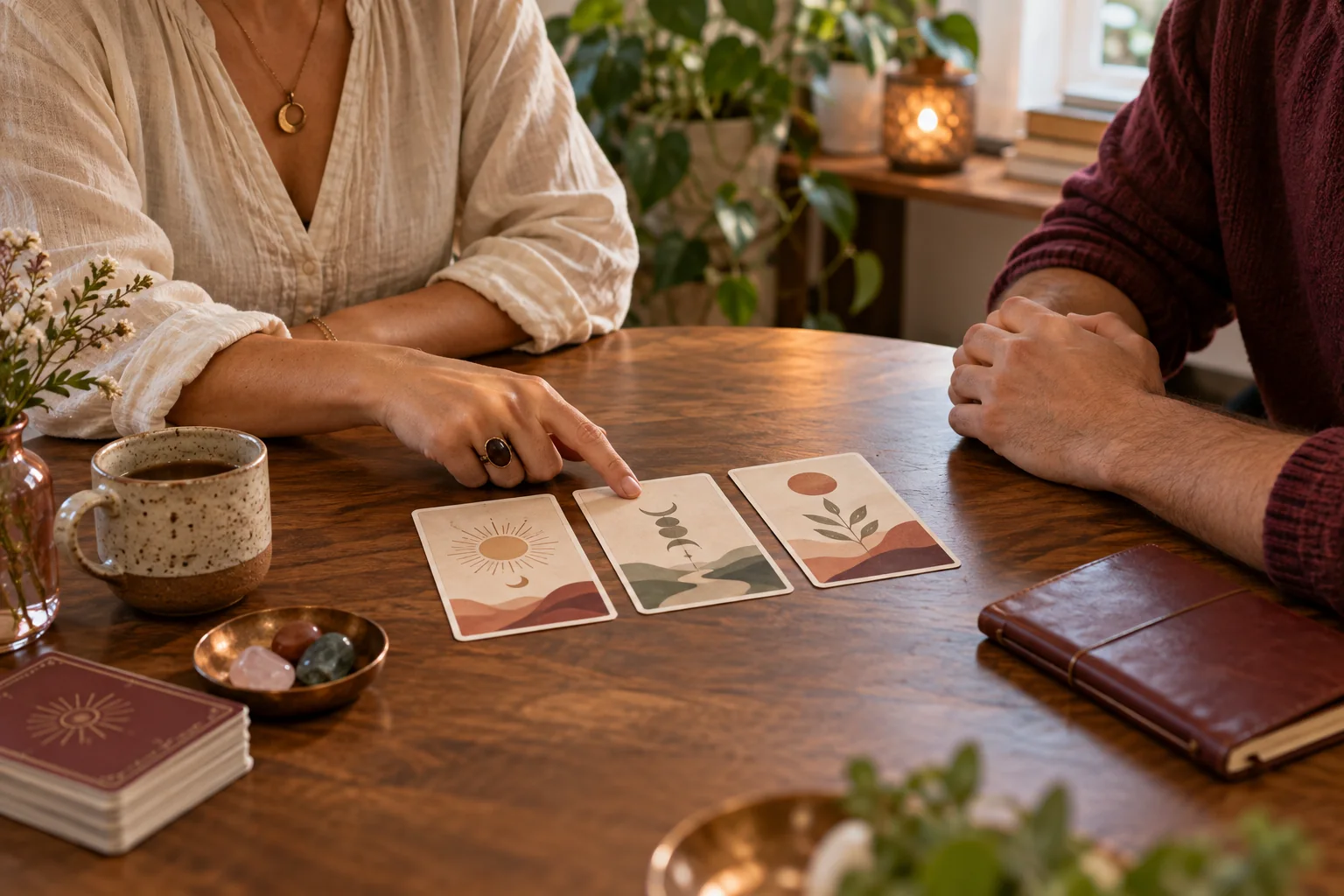
The Ten of Cups can look like a postcard of complete happiness. Precisely for that reason, it should be read carefully: an image of a couple, children, and a house does not describe every valuable form of bond, nor does it promise that a real family will have no conflicts. The card can be used to ask what it means for this person to feel at home with others, what agreements sustain that well-being, and what ideal may weigh on them. Harmony is not measured by resembling an illustration.
- 19
- 210
Waite’s scene is a scene, not a norm
A. E. Waite describes cups in a rainbow, two adults, two children, and a domestic scene in the background. Waite proposes ideas of contentment, love, and friendship. This description corresponds to Rider-Waite-Smith and its era. It does not turn heterosexual marriage with children into a requirement for a full life, nor does it mean that every person who sees the card will form that family. A Marseille deck can represent ten cups without characters; the V&A contextualizes the historical variety of tarot images. Name the edition before describing its figures.
When you study the drawing, separate the visual fact from the cultural ideal and from the personal question. Visual fact: certain characters and a domestic landscape appear. Cultural ideal: one edition presents that scene as an expression of happiness. Personal question: what bonds, spaces, and commitments do good for the person seeking guidance? The third is not answered by copying the second. A person can find home in friendships, chosen family, a couple without children, intergenerational living, or time alone accompanied by community. The symbol can open a conversation about belonging without demanding a mold.
Visible harmony and invisible work
A still image does not show caregiving tasks, negotiating money, schedules, disagreements, or repair after an argument. In everyday life, sustainable harmony usually depends on agreements and practices. If the card appears in a consultation about living together, ask what works today and what requires conversation. Do not conclude “everything will be fine” because the painted sky is beautiful. Nor should you ruin a happy experience by forcibly looking for a hidden problem. The image can invite you to recognize real support and to care for the conditions that make it possible.
Make two columns: “moments when I feel accompanied” and “actions that make those moments possible.” A weekly conversation, a distribution of tasks, a respected boundary, or the possibility of asking for help may appear. If the second column is empty, ask what part of the harmony depends on unspoken expectations. If it is full, perhaps a valuable network already exists that deserves attention. The card does not create that network; it helps you see and describe it.
Fictional example: a dinner that does not have to be perfect
Fictitious case. Laia wants to organize a family gathering after difficult months. She asks “What could a pleasant meeting be like?” and the Ten of Cups comes up in the “desire” position. Laia recognizes that she imagines a long dinner, without arguments, with everyone present. She reviews the facts: one person works that night, another prefers small gatherings, and two relatives have a pending issue that should not be forced in public. Instead of turning the card into a promise of reconciliation, she identifies what well-being means to her: eating together, listening, and respecting the possibility of withdrawing.
Laia proposes a short meal another day, confirms who wants to attend, and avoids using the gathering to demand an intimate conversation. If not everyone can come, there can be another moment. The visual ideal served to name a desire, but the real agreements defined the plan. The reading does not judge those who do not attend or declare that they “break the harmony.” It recognizes that a good bond includes limits and differences. If the Ten of Cups had come up as “obstacle,” it might have pointed to the weight of wanting the gathering to look like a postcard.
Another fictional case: Adrián lives alone and asks about his support network. It would be inappropriate to tell him that the card requires him to form a couple or have children. He can review friendships, neighbors, colleagues, and common spaces where he feels respected. The image of a collective home can inspire a question about belonging, not prescribe a biography. If he wants a partner, that can be part of his project; if not, the card does not invalidate his way of life.
Questions that respect different families
“Who can you share good news with?”, “What agreement makes living together easier?”, “What kind of time together do you enjoy?”, “What boundary helps the relationship remain safe?”. These questions work with diverse family structures. Avoid “When will you get married?” or “How many children will you have?” unless the person raises it and, even then, do not turn tarot into a predictor of fertility or reproductive health. Decisions about family involve will, circumstances, and professionals where appropriate.
Friendship appears even in Waite’s associations. Take advantage of that breadth instead of reducing the Ten of Cups to a single ideal couple. If a person is grieving or experiencing family conflict, do not impose a happy reading that minimizes what they feel. You can ask what support is available now and what they need to get through the moment. The card can show a legitimate aspiration even if current reality is different. That difference is not the fault of the person seeking guidance.
Position organizes the ideal
In “resource,” the Ten of Cups can point to an already existing network that should be recognized. In “goal,” it asks you to describe what well-being means for this person and how improvement would be known. In “risk,” it can invite you to review an image of perfection that prevents valuing real bonds. In “next step,” it may suggest a conversation or a small gesture of care. The guide to positions helps maintain the card’s role without changing it to confirm a desire.
If it appears next to a conflict card, do not declare that harmony is destroyed. A relationship can have arguments and retain support. Nor should you use the Ten of Cups to deny conflict. Try a synthesis: “There is an ideal of connection; what concrete conversation would allow moving closer without demanding perfection?” The final test will be what people agree on and do, not the combination of images.
An everyday-life exercise
Write three recent situations in which you felt support and one in which you found it difficult to ask for something you needed. Compare what gesture helped in the first three and what was missing in the fourth. What gesture can you repeat, and what request still needs to be expressed? Do not infer from an image of harmony that the real relationship is free of tensions.
When reviewing the journal, also ask what does not depend on you. You cannot guarantee that everyone is always happy. You can communicate needs, listen, propose agreements, and seek support. That boundary protects the reading from becoming an impossible demand. An ideal can guide without becoming a judgment. The happiness represented is an invitation to define your own bonds, not a list of universal obligations.
Closing
The Waite-Smith Ten of Cups shows a composition of domestic joy from a specific edition. Rider-Waite Tarot from Scratch allows you to study it with context. For your reading, ask what people and practices create belonging today, which require agreement, and what expectations are unnecessary. Harmony does not require resembling the card: it requires that real bonds can be cared for with respect.