Sabio Tarot · Card combinations
The High Priestess and The Empress: Reserve and Expression in One Reading
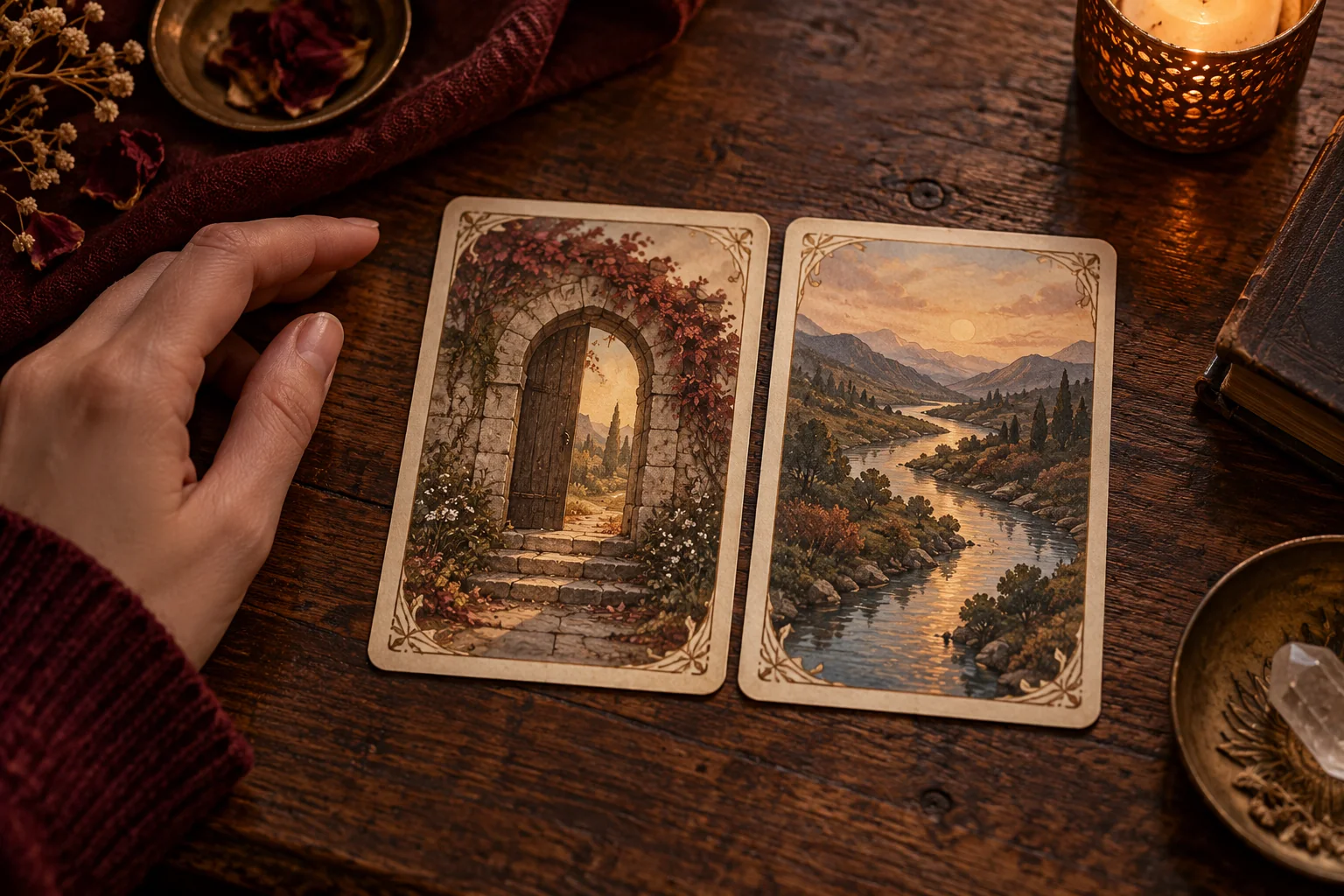
A person writes an idea in a notebook and does not yet want to show it. Another already needs to explain it in order to receive comments. The High Priestess and The Empress can serve as images of those two moments, without attributing to either the voice of “silent woman” or “productive woman.” That gender shortcut limits the reading and does not help in deciding. The more useful question is what information should mature in private and what part can already go out to meet other people. The order of the pair and the positions chosen before shuffling turn that general question into a concrete conversation.
Fictional example: Mateo has designed a reading club. He has a draft calendar and wants to invite neighbors, but he still has not checked whether a room is available. Question: “What should be prepared before announcing it?” The High Priestess falls in “what to keep” and The Empress in “what to show.” The reasonable synthesis is to keep the unconfirmed details for now and show a brief proposal to gauge interest. It is not a prediction of attendance. The room, the calendar, and participants’ consent remain external data.
Reading the Pair Without Assigning a Character to Each Card
Do not read The High Priestess as “a woman who hides something” or The Empress as “a mother who will make everything grow.” One card can point to a way of handling information; the other, to a way of communicating or developing. They are interpretive lenses, not diagnoses of people. In a spread about work, friendship, or artistic creation, those movements can belong to the same person at different moments. Asking “what do I keep and what do I share?” is more precise than looking for two characters in the querent’s life.
In Mateo’s case, The High Priestess does not demand total secrecy. It can represent the preparation space: checking schedules, cost, and responsibilities. The Empress also does not demand immediate and massive publicity. It can guide a pilot invitation to five people, with clear information and the possibility of correction. The relationship between the cards works as a regulation of the degree of exposure, not as an order to be silent followed by an order to publish.
When The Empress Appears First
If the order is The Empress → The High Priestess in an “action → review” position, the pair could suggest that an idea already communicated later needs listening and study. Imagine that Mateo launched the invitation and received questions he did not expect. The second card does not have to mean failure or shameful retreat; it can invite him to record comments before promising a second session. The sequence changes because the question and the positions change.
In a spread without positions, do not impose a chronology just by left and right. First describe the elements you choose as hypotheses: “there is a tension between elaborating internally and making visible.” Then ask the person where they recognize that tension. If they answer that they already shared it, the reading is oriented toward learning from the response. If they say they do not dare to show anything, perhaps it is worth designing a private rehearsal. A pair of cards does not know the real state of the project; the conversation clarifies it.
Second Fictional Context: A Difficult Conversation
Elena wants to talk with a friend about a recent annoyance. She wonders whether she should write a long message immediately or wait to sort out what she feels. The High Priestess appears in “need” and The Empress in “possible gesture.” The reading can propose two stages: write for herself three concrete facts, separate emotion from accusation, and then ask for an open conversation. It does not mean that the friend will acknowledge the problem or that the relationship will be fixed. That response depends on a real person who is not inside the card.
Here reserve protects clarity, not manipulation. If Elena uses the reading to postpone indefinitely a necessary conversation, the same combination can function as a warning about the cost of staying only in the notebook. The goal is not “always communicate” or “always keep,” but choosing which form of expression respects both parties. For that, it is worth reviewing safety, context, and the other person’s willingness.
A Difficult Position Changes the Focus
The High Priestess in “obstacle” could point to a lack of shared information, excessive waiting, or a question no one dares to ask. The Empress in “obstacle” could point to too many visible ideas without concrete commitment. These are not accusations; they are hypotheses that are checked against facts. If Mateo has already confirmed the room and has clear answers, do not keep saying that he “hides data” just because a card appears in a difficult position. Perhaps he simply needs a legible public calendar.
A good synthesis includes a condition that could change the reading: “If the logistical information is already confirmed, this pair speaks less about researching and more about choosing whom to invite first.” That sentence preserves the querent’s agency. It does not turn the cards into a source superior to their experience.
Look at Your Edition Before Using Visual Details
The Marseille and Rider-Waite cards present differences in composition, objects, and emphasis. The High Priestess may be called something else depending on edition or translation; The Empress may carry different attributes. Observe the deck that is on the table. If your hypothesis relies on a book, a posture, or a background, verify that it actually appears. The method of contrast between reserve and expression works as an interpretive proposal, but specific visual details are not imported from another deck out of habit.
Compare the pair with how to interpret two cards together: question, position, relationship, synthesis, and verification. Avoid a list where High Priestess + Empress always equals “pregnancy,” “secret,” or “creative success.” Such claims can invade intimate areas or announce facts that tarot cannot confirm. Here we work with visible decisions of information and communication.
Practical Closing
At the end of the reading, divide a sheet into two columns. In “keep in preparation,” write only data or ideas that still need verification. In “share now,” write a sentence that another person can understand without knowing your whole story. Add a date to review what is pending. Mateo could call the community center today and send a pilot invitation tomorrow if the room is confirmed. Elena could write three facts and ask for a conversation at a comfortable moment. These are observable actions; neither requires believing that the cards anticipate the other person’s reaction.
The High Priestess and The Empress offer a useful tension when they are not turned into labels for people. Keeping can be care or delay; showing can be connection or premature exposure. Context decides which hypothesis deserves exploring. The reading ends better with a small, reversible decision than with a sentence about what “should” happen.
Method and Limits
Original interpretation by Sabio Tarot. Mateo and Elena are fictional examples, not real clients. The cards do not verify other people’s thoughts, the availability of a room, or the results of a conversation.