Sabio Tarot · History and curiosities
Do You Have to “Clean” a Deck Before Using It?
A new deck arrives home and a doubt appears: should I “clean it” before the first spread? The answer depends on what that word means. It can refer to removing dust or caring for the material, to sorting the cards and checking that they are complete, or to doing a personal ritual to begin attentively. They are three distinct activities. No historical source consulted here establishes that a deck will not work if a ritual is omitted. You can begin learning with it just as it comes, following its manufacturer’s care instructions.
Three Senses of “Cleaning” to Keep Separate
Physical cleaning seeks to preserve cardboard, inks, and lamination. It can consist of keeping the cards dry and handling them with clean hands; if a card is stained, consult the publisher’s recommendation before applying products. The initial sorting makes it possible to check the number and condition of the cards, identify titles, and become familiar with the deck. The personal ritual can be a pause, a written intention, or a way of marking the beginning of a practice. If someone finds value in that gesture, they can do it. If another person does not share that custom, they do not have a “contaminated” deck because of it.
The V&A history of cards documents uses for games, divination, and design changes over time. The British Museum catalogs a Marseille deck as a material object with its own technique and condition. These sources allow discussion of the object’s history and conservation, but they do not prove a universal requirement of “energy purification.” If someone attributes a practice to a precise workshop or century, a period source describing it would be needed. It is not enough for a custom to be popular today.
A Minimal Routine Without Ritual
Open the box calmly, check that the package is complete according to its leaflet, look for printing defects, and review the names of the cards. Shuffle in a way that does not bend the edges. Store the deck where it will not get wet or receive direct heat. These actions protect the object and make study easier. They do not change supposed energies; they address material and organization. If the deck has a delicate finish, the publisher may give particular instructions. Following them is worth more for its useful life than a generic recipe found on social media.
To begin reading, you can ask a simple learning question: “What visual details do I recognize in this card?” Observe, write, and compare with the book from your edition. You do not need a special date or a ceremony. If you want a moment of silence before studying, use it as an aid to attention, just like preparing a clear table. The usefulness of that gesture is personal; it does not make the interpretation objectively more accurate.
Fictitious Example: Two Ways to Begin
Fictitious case. Mateo buys his first deck and reads that he should leave it one night under the moon. He does not feel like doing it and fears using it “wrong.” He reviews the booklet: he identifies cards and conservation suggestions, but not an obligation of ritual. He decides to sort the cards, describe three images, and store them in his box. He begins to learn. His friend Vera enjoys marking the beginning with an unlit candle, a notebook, and a sentence of intention. She does not put fire near the cardboard and does not claim that Mateo reads worse for not doing the same. Both can study seriously.
The important difference is the type of claim. “It helps me to spend ten minutes preparing the space” is a personal testimony. “If you don’t do it, the deck will give false answers” is a universal claim without the evidence provided here. The reader can ask where a rule comes from, whether it is in the manual of a specific edition, and what would happen if it is not followed. That investigation avoids buying objects or services out of fear.
Precautions with Smoke, Water, and Light
A ritual practice can include elements that damage the cards. Humidity, liquids, nearby flame, smoke, and prolonged exposure to light or heat can be a bad idea for paper, inks, or adhesives. There is no need to test it on a beloved deck. If incense is used out of personal preference, keep it away from the deck and pay attention to ventilation and safety. If a candle is used, place it in a stable holder and away from paper or fabrics. If someone proposes spraying the deck, first ask the manufacturer whether the material tolerates moisture; the prudent course is to avoid it.
It is also advisable to avoid health claims associated with the ritual. A pleasant scent can create an atmosphere for a person, but it does not replace ventilation, hygiene, or health measures. Some people are sensitive to fragrances or smoke; a shared reading must take their comfort into account. Do not impose an environmental object on a querent. The most important preparation is consent about the session, clarity of the question, and adequate privacy.
Ritual of Attention Without Obligation
If you want a personal gesture, you can choose a low-risk one: tidy the table, breathe comfortably for a minute, write the question, and shuffle slowly. When you finish, note what you observed and what decision you will make outside the cards. That small frame can help prevent asking repeated questions when there is anxiety about an answer. If the gesture stops helping you or becomes a distressing obligation, change it or eliminate it. A personal practice should be at the service of the person, not govern them.
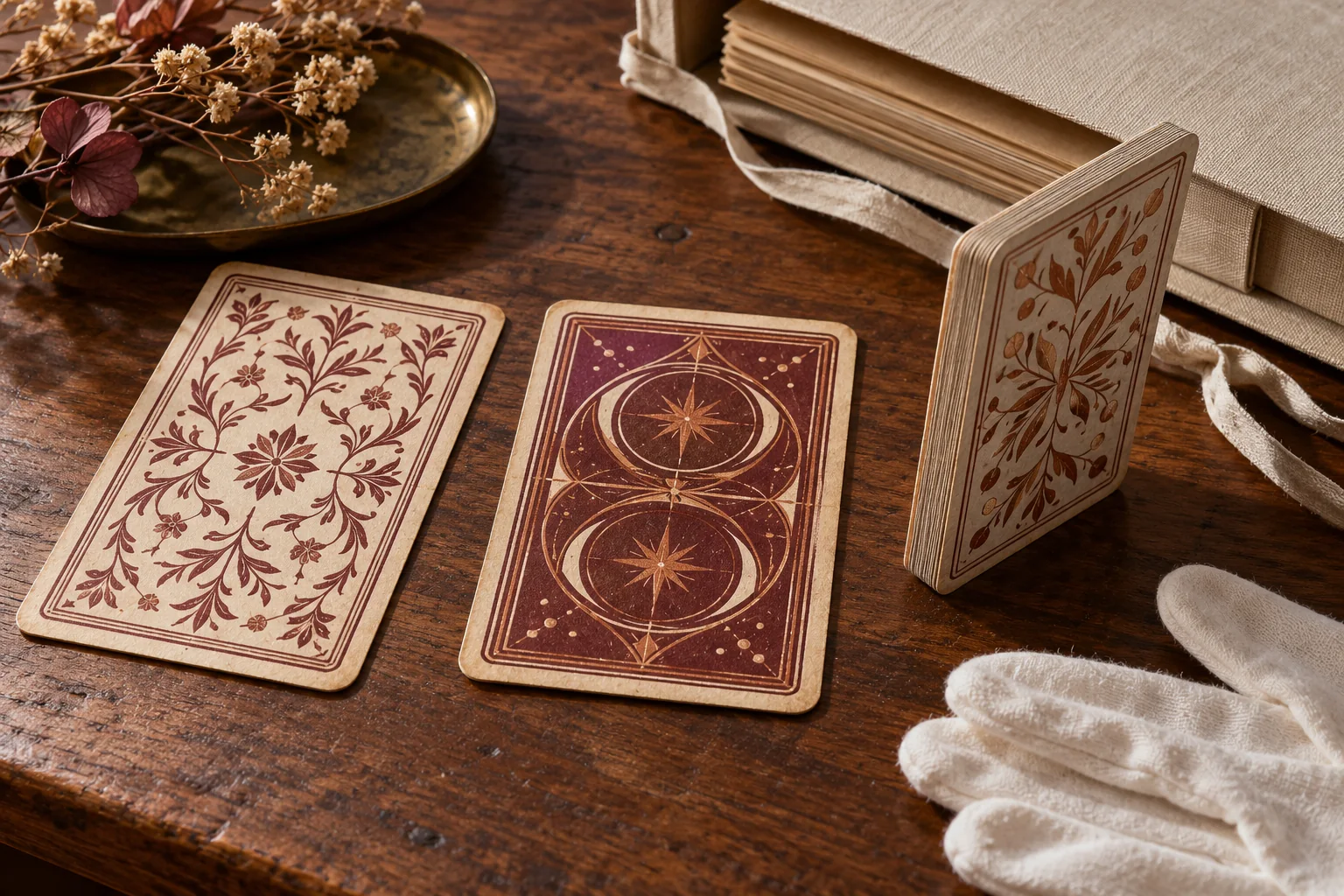
The decorative backs in the illustration are imagined designs: they serve to make you notice the physical condition of the deck, not to authenticate a historical cleaning technique. Check the edges, moisture, and dirt of the actual copy before deciding how to care for it.
When the Doubt Is About Another Person Touching the Deck
Some people call a routine after someone else touches the cards “cleaning.” There are two matters there: social agreement and physical care. You can decide that only you handle your deck, ask for dry hands, or use a different pack for workshops. It is a rule of use, not proof that another person’s contact has altered an invisible property. If you share a table, explain the preference before the reading and allow the other person to participate in another way. Do not turn a material or personal boundary into an accusation of someone’s “bad energy.”
Closing
To use a deck, you do not need to pass a universal cleaning rite. You can care for it physically, check that it is complete, and choose a gesture of attention if it helps you. Marseille Tarot from Scratch can accompany the practice of the first cards. When you hear “you have to clean it,” ask what is to be cleaned, for what purpose, and with what evidence. That way you preserve the deck and the freedom to choose your customs without fear.