Sabio Tarot · Reading methods and spreads
Fictitious case: choosing between two courses with three cards

Everything that happens on this page is invented to teach a method. It does not describe a real consultation or the result of an existing course. Alba wants to learn bookbinding. She has two options: a school with in-person classes on Saturdays and an online program with videos and monthly tutoring. Asking “which one will make me succeed?” would place on the cards an outcome that will depend on price, time, teaching, and her own work. Alba formulates a more useful question: “What do I need to compare before enrolling?”.
Prepare the question without hiding the data
The school costs 240 euros, requires five trips, and offers access to tools. The online program costs 120 euros, allows videos to be rewatched, and requires buying some materials. Those amounts and conditions belong to this invented example; they are not real commercial information. Alba has two afternoons per week and one Saturday morning per month. Already with that data, a conflict appears: perhaps the in-person course is attractive, but its schedule does not fit. Symbolic reading must engage with that restriction, not erase it.
Before shuffling, Alba writes three criteria: being able to practice with supervision, bearing the total cost, and finishing an object of her own. She also notes what data is missing: whether the school allows making up classes and how much the online program’s materials cost. Defining criteria before seeing the cards reduces the temptation to change the rules to justify the option she likes most. A spread does not do the work of researching conditions.
Three positions and cards drawn
We use the option comparison diagram: 1) common context, 2) option A in person, and 3) option B online. In the fictitious story, Two of Pentacles appears in the context, Three of Pentacles for A, and Page of Swords for B. The cards are not a scoreboard where the prettiest image wins. Each one occupies a different function. The Two of Pentacles speaks of the ability to alternate study, employment, and travel; it is the same problem for both paths.
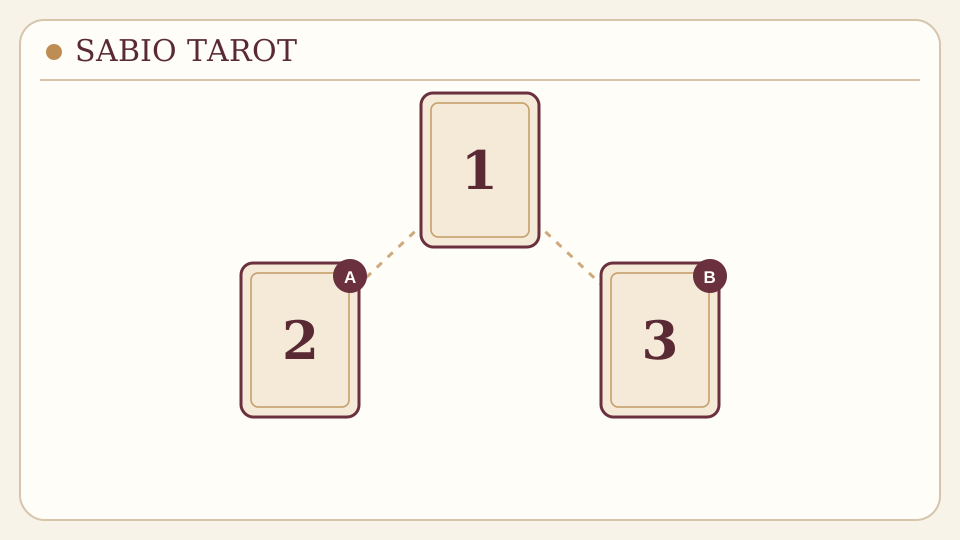
The Three of Pentacles in A can suggest learning with other hands nearby, comments on the quality of the piece, and access to the workshop. That interpretation fits the described offer, but it must be verified: how many people are there per teacher? Is there individual feedback? The Page of Swords in B suggests asking, reviewing instructions, and learning through well-formulated questions. It can be a strength if the tutoring truly responds; it can fall short if Alba needs physical correction of technique. No card reports the real number of students or the speed of the teaching staff’s response.
Two competing hypotheses
The first hypothesis is that the in-person option offers better practical learning and compensates for the higher expense if she can make up lost sessions. The second is that the online format, even if it demands more initiative, fits her schedule better and allows practice over months. Both are compatible with the cards; external data will decide which is more plausible. A responsible reading does not choose for Alba with a grandiose phrase. It helps her identify what questions to ask each center.
Alba writes to the school and asks about making up classes. She also requests from the online program a sample of the tutoring and a list of materials. In the story, the school confirms that she can make up one session, but not four; the online course offers correction of photographs of her work. Those fictitious facts tip the balance toward option B for the next quarter. If Alba’s schedule changed, the comparison could give another result. Tarot was not predicting a destiny; it was ordering criteria.
Prudent synthesis and one’s own decision
The reading can be closed like this: “The main limit is your time. The in-person option seems to offer direct contact with technique, but it requires attendance that today you cannot guarantee. The online option requires asking questions and practicing with autonomy. Confirm materials and quality of feedback before deciding.” Alba decides to book a trial class at the school for later and enroll online only after seeing the contract. The decision remains in her hands.
It would be different to say “the Three of Pentacles is a better card than the Page of Swords, therefore A.” Cards do not carry universal scoring. An excellent workshop can be unfeasible because of schedule; a flexible course may not provide enough correction. It also would not be honest to hide the price because “the energy” seems favorable. The information available outside the deck constitutes an essential part of this case.
What could go wrong in the interpretation
A reader could turn the Two of Pentacles into praise for multitasking and encourage Alba to sacrifice rest. Another could interpret the Page of Swords as distrust toward the online course without reading its conditions. They could also attribute to the Three of Pentacles a promise of future employment. None of those leaps is justified. The best protection is to ask for an observable fact for each statement: written schedule, tutoring sample, materials, and final budget.
If Alba cannot pay for any option without going into debt, that reality has priority. She can look for a library, community workshop, or free resources, or wait. The reading does not transform an economically unsafe decision into a “spiritual investment.” If she decides not to study now, she has not failed tarot. She has used the question to better understand her current limits.
Repeat the method with another choice
Write your question as a comparison of conditions, not as a demand for an outcome. Define the criteria and the three positions first; then note what is visible in each card, a hypothesis, and an alternative. Look for an external fact that could change the choice. Finally write who will make the decision and when they will review it. The V&A explains the visual diversity of decks: always observe the specific edition before describing a scene as if it were in all of them.
You can expand with how to choose a spread, useful questions for tarot and Marseille Tarot from scratch. Alba’s case does not teach how to guess which course “will win.” It teaches how to leave the table with verifiable questions and a decision that the person can take on.