Sabio Tarot · Reading methods and spreads
Fictitious case: starting a creative business without promising income

This case is invented from beginning to end. No client data have been used, nor is the future of a real business known. Marina draws custom maps and several friends have asked her if she sells commissions. Before investing in a complete shop, she wants to check whether she could produce and deliver ten pieces without becoming overwhelmed; she starts with a test of three. Her question is not “Will I get rich?”, but “What should I check to run a responsible first test?”. Tarot can help organize factors; sales, costs, and taxes require data and appropriate advice.
What Marina knows before drawing cards
In this fictitious example, Marina calculates that each map takes her between four and six hours and has ten hours per week. The materials for ten pieces cost 80 euros; she has not yet calculated packaging, taxes, or possible revisions requested by clients. She has an account where she shows drawings, but she has not sold any. It is important to say this before interpreting: praise from friends is not proven demand, and the desired price is not net profit.
Marina sets a limited test: offer three commissions with clear scope, measure actual hours, and ask for feedback on the buying experience. She decides not to pay for ads or buy a new machine during this phase. The reading will be done to review the design of the test. If the cards seemed “very favorable,” that limit would still stand. The deck does not authorize extra spending out of enthusiasm.
Five positions and a sequence of cards
We use the five-phase diagram: 1) motive, 2) barrier, 3) support, 4) test, and 5) review. In the story, Ace of Wands, Two of Pentacles, Three of Pentacles, Page of Pentacles, and Justice appear, respectively. This choice of positions avoids mixing a personal desire with an income forecast. It also allows a pleasant card to occupy “barrier” or a difficult one to occupy “review” without changing its function after seeing it.
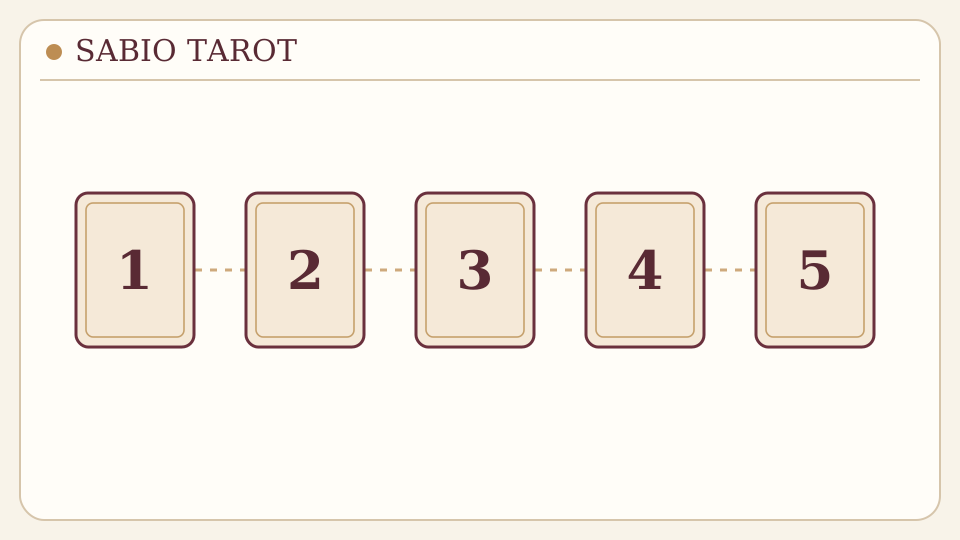
The Ace of Wands in “motive” represents the energy of starting and the interest in taking the drawings outside the circle of friends. The Two of Pentacles in “barrier” fits the limited time and the need to alternate stable work and commissions. The Three of Pentacles in “support” invites asking for a review of a process: photographs, clarity of the form, and printing standards. Page of Pentacles in “test” suggests learning with three small orders. Justice in “review” points toward written terms, full cost, and a documented decision.
Two hypotheses, no guarantee
The optimistic hypothesis is that the test will show sufficient interest and that Marina will be able to adjust the process before expanding. The prudent hypothesis is that the first three commissions will reveal too much time per piece or too many revisions for the planned price. The same cards allow both: the Ace of Wands does not eliminate the Two of Pentacles, and the Page of Pentacles speaks of learning, not scale. The criterion for continuing should not be “good cards came out,” but data on orders, satisfaction, hours, and margin.
Marina writes three prior thresholds: do not accept more than three orders at a time; record every hour; and do not promise delivery in under two weeks. She also writes what the price includes and how many free changes it allows. If demand exceeds three orders, she can create a waiting list. If none arrive, she can improve the sample, review her audience, or decide that she prefers to keep drawing for pleasure. Neither result turns the reading into a predictive success or failure.
A one-month-later review simulation
Let us suppose, always within the fictitious story, that Marina receives two orders, invests seven hours in each one—more than she had estimated—and discovers that packaging costs more than expected. The first test shows that she can deliver with quality, but not that the price is sustainable. Justice in “review” would not have predicted the cost overrun; it can serve as a reminder to record all terms and recalculate. Marina decides to raise the price for new orders or simplify personalization, and announces the changes before accepting more work.
If someone reads “Ace of Wands + Three of Pentacles = success,” they lose the most valuable information in the case: capacity limits. If they read “Two of Pentacles = you shouldn’t start a business,” they also do not hear the desire to test. The reasonable synthesis would be: “There is motivation and a skill you can show. Design a small test, measure time and cost, and then decide whether the model suits you.” The business decision remains Marina’s.
Limits of the reading when money is involved
A card does not calculate taxes, does not determine a legal form, and does not guarantee that a platform will attract clients. Marina should consult current tax and commercial rules in her location if she starts selling. Nor should she use the reading to take on debt or buy equipment without a budget. In financial matters, separating symbolic hypothesis from verifiable information is a quality condition, not a lack of trust in intuition.
The test can include well-being in addition to margin. If every map produces exhaustion, perhaps the product does not fit the pace Marina wants. If she enjoys doing it and earns modest income, she can choose to keep it small. “Creative business” does not require continuous growth. The question that really matters may be what form of work she wants to sustain and what she needs to earn for it to make sense.
How to repeat this case with your project
Write motive, barrier, support, test, and review before seeing the cards. For each position, add a verifiable fact and an interpretive alternative. Limit the test by time and cost. At the end, compare what you wrote down with actual orders, hours, and expenses, without rewriting the reading afterward. The V&A shows that decks have different visual traditions; observe your specific edition and avoid calling a symbolic association “data.”
Expand with useful questions for tarot, Pentacles and resources, and Rider-Waite Tarot from scratch. This example does not promise that Marina will sell. It teaches how to use a reading to formulate a test whose result you will actually be able to observe.