Sabio Tarot · Responsible readings
Fictitious case: reviewing a reading one month later

This journal is entirely invented; the dates and people only serve to explain the method. On May 1, Elisa consulted the tarot about a workshop proposal. On June 1, she reviews her notes. She is not trying to prove that the deck “was right” by selecting phrases that fit; she wants to know whether the reading helped her make a better decision, what she assumed without basis, and what she learned from the facts. Reviewing a reading can be an exercise in honesty, not an automatic celebration of coincidences.
The original note from May 1
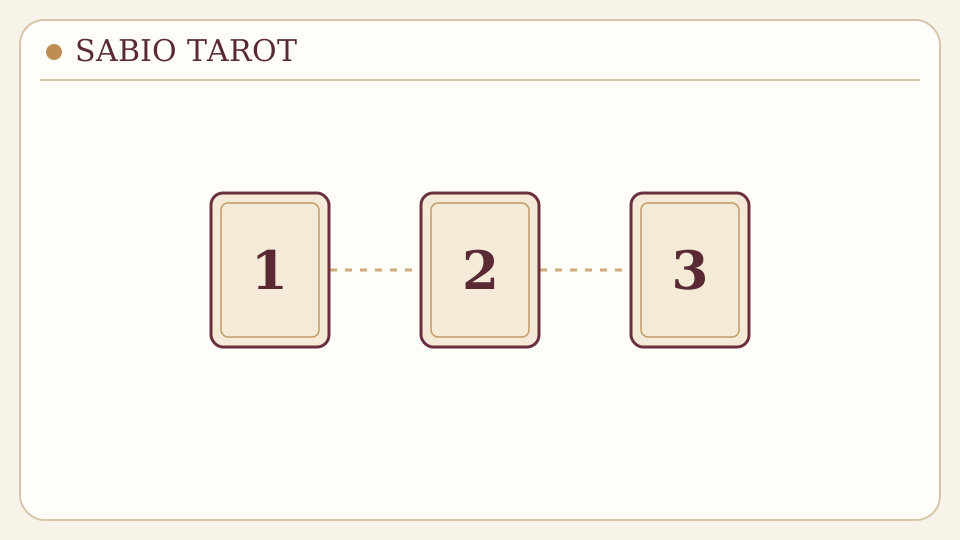
Elisa wrote this fictitious question: “What should I check before agreeing to teach a watercolor workshop?”. She set three positions: 1) prior interpretation of the opportunity, 2) a fact she would need to observe, and 3) a hypothesis she would review later. Ace of Wands, Two of Pentacles, and Three of Pentacles came up. She noted: “I’m excited to start. I need to check preparation hours and who provides materials. If the center helps with logistics, maybe I can try a session.” This sentence does not forecast number of attendees or profit.
The diagram for reviewing a previous reading can be used when returning a month later: prior interpretation, later events, and a new hypothesis. At the initial moment, Elisa saved a photo of her own notes, not of other people’s. She also noted the date, question, and known conditions. That record prevents reconstructing the interpretation according to the outcome. Without it, she might remember only “the Ace of Wands came up” and forget that she was worried about hours and materials.
What happened during the fictitious month
The center confirmed it would provide tables and water, but not paper or brushes. Elisa calculated six hours of preparation, taught a two-hour session, and seven people attended. Three asked for another class; two commented that the pace was too fast. Elisa enjoyed teaching, but the payment barely covered materials and time. These are facts from the story, not data drawn from the cards. The mix is important: there was a valuable beginning and an economic condition that requires review.
When rereading the note, Elisa sees that the Ace of Wands helped her recognize interest, but she mentally added “this could become a series” even though she did not write it. That later memory would have inflated the reading. The Two of Pentacles helped her ask about hours, although she underestimated the preparation. The Three of Pentacles encouraged her to clarify logistics; the center did help in part, but not in everything. No card anticipated seven attendees or two comments about pace.
Two new hypotheses
First: the workshop can be repeated if price, materials, and sequence of exercises are adjusted. Second: Elisa likes teaching, but this specific format does not compensate for the effort; she might prefer shorter sessions or a smaller group. The cards from May 1 do not decide which one. Elisa asks the center for a revised price and prepares a full cost calculation. She also reviews participants’ comments without keeping only the praise.
A good review preserves counterexamples. Three requests to continue do not prove that there are seven future clients. Two criticisms of pace do not invalidate the value of the entire workshop. Learning is more precise if both types of signal are recorded. Elisa could try a second session with less content, but only if the economic conditions improve. Again, the choice is hers.
What selective memory would have recounted
Without the original notes, Elisa could say “the Three of Pentacles predicted that the center would provide all the materials.” In reality, that was not the case. She could also say “the Two of Pentacles warned exactly that the payment would not cover my time,” although the note only said she should calculate hours. A retrospective interpretation can be more accurate than the original for the simple reason that we already know the outcome. That does not mean the initial reading had that precision.
There is another trap: counting any coincidence as a hit. If the number three from the Three of Pentacles appeared and three people asked for another class, the coincidence might seem significant, but Elisa did not formulate that prediction on May 1. Attributing it afterward does not help learning. The purpose of a journal is not to find unlimited correspondences, but to separate what was written before from what was known afterward.
Elisa can ask another person to read the original note without first telling them what happened. If that person does not find a prediction of three requests there, it is a sign that the supposed hit came afterward. The check does not turn the companion into an arbiter of tarot; it only helps detect an overly generous retrospective reading.
Prudent synthesis from June 1
Elisa can write: “The initial reading helped me ask two useful questions: time and logistical support. I did not calculate all the materials or the pace. The session showed interest and also a sustainability problem. My next action is to renegotiate conditions and design a less dense exercise.” This synthesis does not need to declare that tarot succeeded or failed as a whole. It evaluates its use as a reflection tool and the value of the concrete decisions it inspired.
The V&A offers context on visually distinct decks. If Elisa used Marseille, she should not later remember Rider-Waite-Smith scenes as if they had been on her table. Recording edition and visual observation makes the review more honest. When we change decks or read another manual later, it is easy to introduce new images into an old memory.
A record sheet for any review
Keep the date, question, positions, cards, observations, and literal synthesis. Add an action you decided to take and what data you expected to obtain. When reviewing, record favorable facts, facts that contradict the hypothesis, and data that remain unknown. Do not modify the initial note; write a new dated entry. If the reading did not lead to any action, ask yourself whether the question was too broad or depended on someone else’s decision.
You can expand with useful questions for tarot, how to choose a spread, and Marseille Tarot from scratch. Elisa’s case teaches that reviewing does not consist of forcing every result to confirm a belief, but in improving future questions, notes, and decisions.