Sabio Tarot · Responsible readings
Fictitious case: three pleasant cards and one uncomfortable one

This spread is invented to teach a method. Mario is asked to organize a small film series with an association. He draws four cards: three seem favorable to him and one makes him uncomfortable. He asks whether he can ignore the fourth because “the majority is positive.” He cannot resolve the reading that way: the cards are not votes of equal weight. Each one answers to a different position. A warning in “friction” does not cancel resources and support, but neither does it disappear because there are three friendly images.
Question and known facts
Mario asks: “What do I need to prepare before confirming that I will coordinate the series?”. The association offers a room and projector; exhibition permits, division of tasks, and a date are still missing. Mario has already coordinated two activities, but this one would be longer. We do not know whether the audience will attend. Those data are part of the case and should remain visible when the cards are interpreted. A reading that speaks only of “good energy” could overlook concrete obligations.
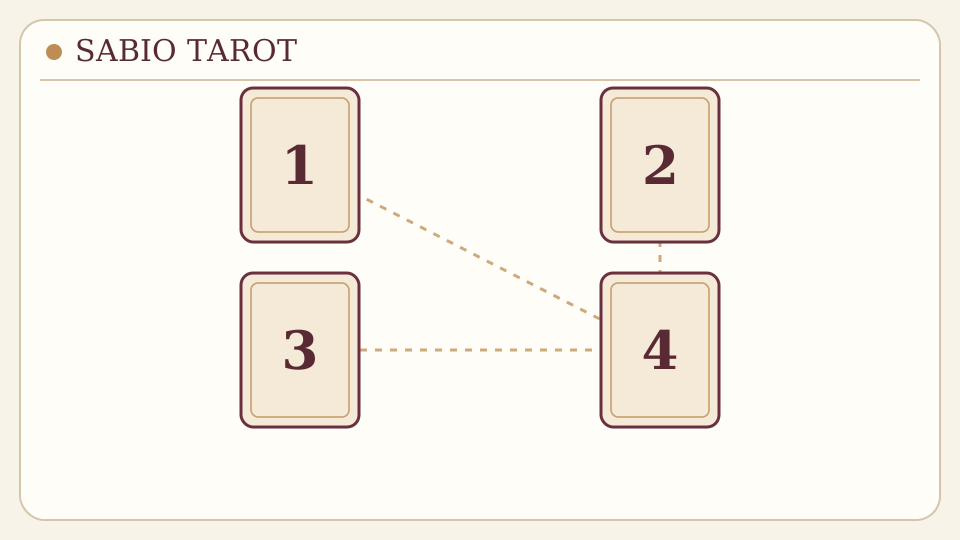
They use the four-position project diagram: 1) resources, 2) friction, 3) support, and 4) next step. Ace of Wands comes up in resources, Five of Swords in friction, Three of Pentacles in support, and The Star in next step. Mario classifies the first, third, and fourth as good. The second worries him because it reminds him of an earlier dispute. The positions were fixed before seeing the cards.
Observe and situate each card
The Ace of Wands can represent impulse and an initial opportunity: the room is available. It does not prove that the series can be executed. The Five of Swords in friction invites reviewing what happened in the earlier dispute and how to avoid a programming decision becoming a personal fight. The Three of Pentacles in support points to possibilities for division of labor and shared criteria. The Star in next step could inspire clear communication of the series' purpose, without promising success or reputation.
In Rider-Waite-Smith, the images offer scenes to observe; the V&A contextualizes that tradition. The interpretation of the Five of Swords does not automatically identify a “toxic” person or confirm that there will be another fight. Mario must provide facts about how the group decides, who has authority, and what disagreements remained open.
Two hypotheses for the uncomfortable card
The first is that there is an unresolved conflict about which films to choose, and coordination needs a decision procedure before announcing anything. The second is that Mario fears a repetition of a past dispute, although the current group already has better rules. Both hypotheses are compatible with the Five of Swords; neither is confirmed by the image. Mario asks the association who will approve the programming, how many revisions there will be, and how permits will be documented. He also talks with a colleague about the earlier disagreement.
The colleague explains that at that time a selection criterion was missing and several people changed the program at the end. In this fictional account, they agree to write three criteria: obtainable exhibition rights, relation to the series' theme, and maximum length of each session. That concrete measure responds to the friction without turning anyone into a villain. If the group does not agree to set criteria, Mario can postpone coordination. The card does not oblige him to endure a chaotic process.
As a test, the association takes a single candidate film and applies the three criteria in writing. It discovers that it meets the theme and the length, but still does not have an exhibition permit. The exercise shows that a programming decision needs more than enthusiasm. It also offers a way to discuss that does not depend on who speaks loudest.
Why three against one is a bad calculation
Imagine three green signals in a car and one red brake light. You do not decide by majority; you need to know what each one indicates. In the spread, resources, support, and next step do not answer “Is there friction?” The second position does. The Five of Swords does not dominate the entire reading, but neither can it be covered up by the Ace of Wands or The Star. The task is to integrate its function: the project can be attractive if a working condition is resolved.
Nor is it advisable to fall into the opposite extreme and declare that the Five of Swords “contaminates” all the other cards. If permits, roles, and criteria are clarified, the risk can decrease. A card in “friction” points to a theme to explore, not an immutable destiny. The reading preserves uncertainty and proposes verification. The number of pleasant cards is never a numerical probability of success.
Synthesis and Mario's decision
The prudent synthesis would be: “There is space and interest to begin. The critical point is how programming disagreements will be resolved. The team can contribute skill and divided tasks; the immediate step is to document purpose, criteria, and permits.” Mario decides to accept only if the association designates a liaison person and signs a decision calendar. If it does not, he can collaborate in a one-off session. His decision responds to conditions, not to a vote of symbols.
Suppose the series takes place successfully. One should not say that “the three good cards won.” The result would depend on work, exhibition rights, promotion, and attendance. If it is canceled, it also does not mean that the Five of Swords “always predicted it.” The reading is evaluated by whether it helped identify a concrete risk and prepare a reasonable response, not by claiming retrospective victory in the face of any outcome.
A method for mixed readings
Write each card's position and a distinct sentence beneath it. Avoid first classifying them as good or bad. For the difficult position, formulate two hypotheses and one piece of data that could distinguish them. For the favorable positions, ask what resource or support really exists and under what conditions. Then join the four sentences with honest connectors: “there is,” “however,” “if it is verified,” “the next step.” Do not use “therefore everything will turn out well” if permits are still missing.
You can expand with cards that contradict each other, how to choose a spread, and Rider-Waite Tarot from Scratch. Mario's case teaches how to keep an uncomfortable card in its exact place without giving it all the power or silencing it by majority.