Sabio Tarot · Minor Arcana
Five of Cups: Loss and Present Resources

A person has just lost an important relationship. In the spread, the Five of Cups appears, and the reader immediately points out “the two cups that still remain.” The phrase can sound encouraging, but it can also reduce a real grief to an exercise in optimism. A better reading first acknowledges what was lost, asks what the person needs now, and only afterward explores supports that they themselves identify. The symbol does not fix the timeline for recovery.
- 15
- 26
- 37
- 48
The Rider-Waite-Smith Composition
Waite describes a figure covered by a cloak, three fallen cups, and two that remain standing behind; there is also a bridge and a landscape. The scene allows us to observe that visible loss and elements that remain present coexist. It does not allow us to know what the cups contained, whether the figure already knows about the ones behind, or when they will cross the bridge. Waite's description helps describe that edition without imposing an ending in which everything is overcome.
In a Marseille Five of Cups, five symbols of the suit are seen arranged ornamentally; there are not necessarily spilled cups or a grieving person. The five can be read in relation to tension or change, but that association should be expressed as a hypothesis, not as a fact that is drawn. The Metropolitan Museum documents the historical suits and numerals; the V&A contextualizes Pamela Colman Smith's scenes. Comparing decks serves to maintain visual precision, not to choose the most dramatic image.
Acknowledge Before Redirecting
A loss can be a death, a breakup, a job, an expectation, or a community. They are not interchangeable. Before talking about “remaining resources,” ask what happened, what it means to the querent, and whether they want to keep talking about it. If the person does not want to discuss details, one should not pry them out with tarot questions. The reader can describe the card soberly and offer several possibilities, letting the person choose which one feels relevant.
The phrase “you still have two cups” helps only if it is used with care and permission. It can be translated into “is there anyone you feel like being with today?” or “what concrete support would feel tolerable to you?” It should not imply “don't be sad” or “you should already be looking ahead.” Two real resources do not cancel out three losses, and the number of objects in the drawing does not measure the intensity of a human experience.
Position and Timing in the Reading
In “emotional state,” the five can open a conversation about sadness, disappointment, or attention focused on what is missing. In “resource,” it may invite recognition that naming the loss is already a form of care. In “possible action,” it may point to a small task: letting a friend know, organizing papers, or postponing a big decision. In “outcome,” it would be irresponsible to promise that everything will be fixed in five days or that a relationship will return. The card is not a calendar or a proof of destiny.
Alongside the Four of Cups, it is worth distinguishing fatigue from grief. Alongside the Three of Cups, explore whether there is a network to turn to without forcing socialization. Alongside the Five of Pentacles, it can remind us of material needs in addition to emotional ones. These combinations do not diagnose depression or quantify suffering. If the person expresses immediate risk or significant deterioration, it matters to seek professional or emergency help appropriate to their situation.
Fictitious Example: A Canceled Project
Invented case to teach a respectful reading. Clara spent a year preparing an exhibition with a cultural center; the center cancels it due to budget problems. She asks: “How can I sort through what happened before deciding whether to present the work elsewhere?” We agree on three positions: 1) loss that needs acknowledgment, 2) something that is still available, and 3) a step that can wait. The Five of Cups, Three of Pentacles, and Two of Wands come up.
The Five of Cups in the first position does not simply describe “pessimism”: there was a documented cancellation and work lost in that opportunity. Clara may be angry and sad. The Three of Pentacles in the second does not erase the harm; it reminds her that she keeps the work, contacts with artists, and learning about installation. The Two of Wands in the third allows planning other venues when she has energy, without requiring her to send proposals that same afternoon. A useful synthesis would be: “The loss of this date matters. Keep materials and agreements, rest before deciding, and, when you want, review what part of the work can be moved.”
Suppose Clara does not want to exhibit again. That would also be a valid response. The card does not oblige her to transform every loss into productivity. She can keep the work for herself, modify it, or let it rest. The example does not propose a technique to guarantee future success; it teaches how to distinguish existing resources from imagined obligations. If there is a contract or committed expenses, Clara should review documents and seek relevant advice before accepting a financial solution.
Language That Accompanies Better
Avoid “everything happens for a reason,” “look on the bright side,” or “the tarot says you'll get over it soon.” Try “I see an image that can relate to a loss; would it help to talk about that?” or “there are also elements that remain, but we can go to them only if you want.” Permission matters. The reader does not need to fill every silence or turn pain into a lesson. They can ask what concrete decision is worrying the person today and limit the reading to that scale.
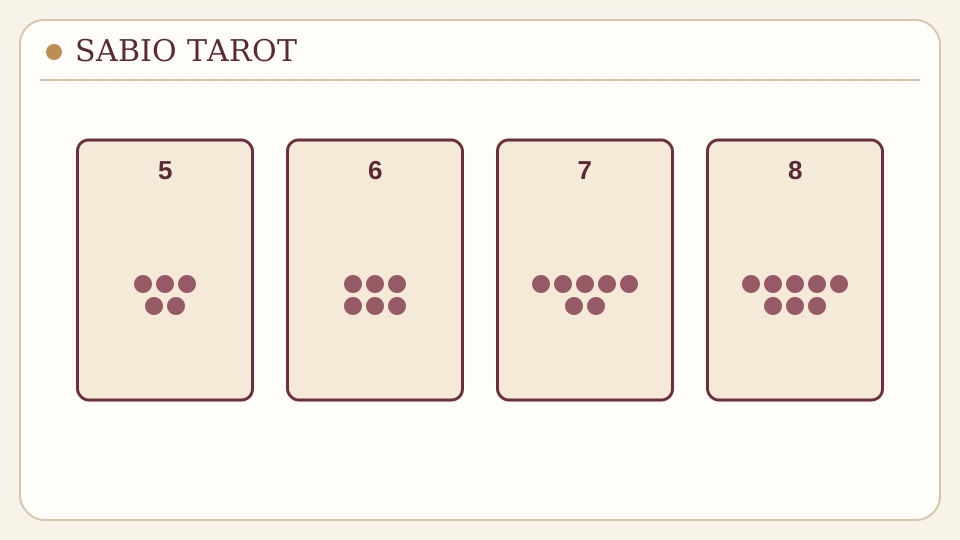
As a private exercise, divide a sheet into “what changed,” “what remains,” and “what I do not yet need to decide.” Write only facts and resources that you truly recognize. If the second column is empty, do not invent supports to complete the outline; perhaps it is time to seek them with someone you trust or a competent service. The diagram of the five shows numerals and asks us to separate quantity from an emotional experience.
To go further, see Cups, Relationships, and Affections, the numbers five, six, and seven, and Tarot Rider-Waite from Scratch. The Five of Cups can leave an open and dignified question: “What do you need to have acknowledged before talking about what comes next?”