Sabio Tarot · Minor Arcana
Ace of Swords: Clarity and the Cost of Saying Something

A person knows they must communicate a schedule change to their team, but fears disappointing them. In the “next step” position, the Ace of Swords appears. It does not promise that the conversation will be comfortable or that everyone will accept the news. It can point to the need to formulate precisely the fact, the reason, and the room for negotiation. Saying something clearly is a beginning; managing its effect requires listening and later decisions.
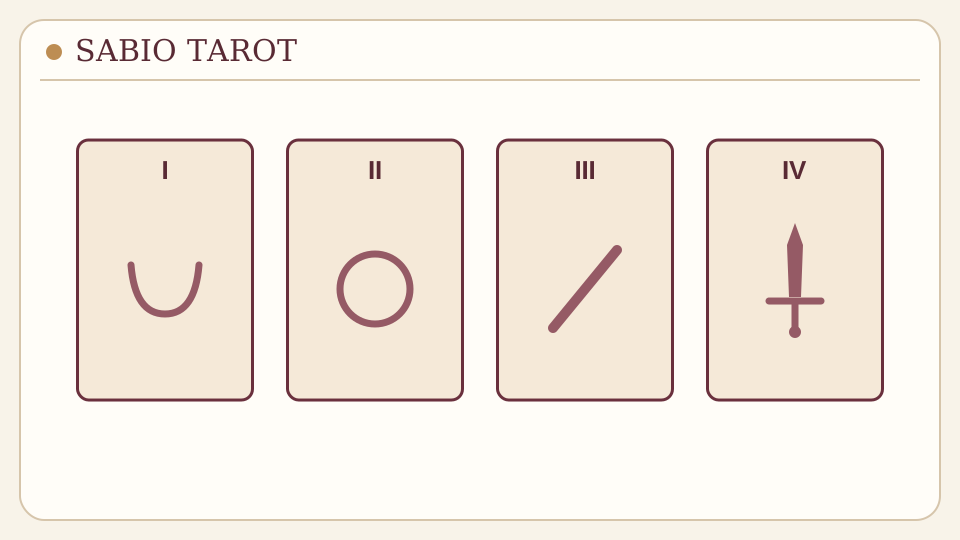
- 1Cups
- 2Coins
- 3Wands
- 4Swords
Observe the Symbol Before Loading It with Certainties
In Rider-Waite-Smith, Waite describes a hand holding a vertical sword with a crown, among other details of the image. His description of the ace allows one to observe a weapon presented, not a conversation already resolved. The sword can be used as a metaphor for distinction, language, or decision, but that is an interpretive choice. There is no need to treat it as an order to wound with words or as proof that the person consulting is right.
In a Marseille Ace of Swords, the sword appears as the main emblem with decorative elements; one should not transfer to it, without warning, the hand, the crown, or the landscape from another edition. The Metropolitan Museum documents swords as one of the four historical suits. The V&A explains Pamela Colman Smith's role in the scenes of the Rider-Waite-Smith minors. Comparing the decks shows different graphic resources for thinking about the same suit, not a meaning guaranteed by the drawing.
Clarity Does Not Equal Harshness
Clear communication distinguishes facts, interpretations, and needs. “The schedule changes on Monday” is a verifiable fact. “No one cares about the team” is an interpretation that may be false. “We need to cover the opening” is an organizational need. The Ace of Swords can invite you to order those layers. Speaking frankly does not require humiliating, pressuring, or turning an opinion into a verdict. Sometimes clarity includes saying, “I don't have an answer yet.”
The cost of saying something can be real. An honest conversation could generate disagreement, the loss of an option, or more coordination work. Naming that cost does not invalidate the decision to speak. It helps prepare for it: choosing the moment, documentation, and possibilities for adjustment. If the question concerns a relationship with a risk of violence or retaliation, a direct conversation may not be safe; seeking support and planning protection takes priority over any symbolic reading.
The Card's Function in the Spread
In “resource,” the Ace of Swords could represent an idea or an ability to distinguish the central issue. In “obstacle,” it might invite you to review an overly blunt phrase or a need for immediate certainty. In “action,” it can suggest drafting a question, proposal, or concrete boundary. In “outcome,” it does not guarantee victory in a conflict or a favorable court ruling. The position must be known before attributing a function to the sword.
Alongside the Two of Swords, it can show that clarity requires missing data. Alongside the Ace of Cups, it may be worth combining precise information and emotional care. Alongside the Five of Swords, it is important to assess whether a formulation seeks to resolve or to win at the expense of the bond. Combinations are questions to check against what is happening, not formulas that reveal hidden intentions.
Fictitious Example: Announcing a Shift Change
Invented scenario to illustrate a method, not a real reading. Eva coordinates a small customer service team. Management tells her that opening will be moved up by half an hour. Eva asks: “How can I present the change without promising something I cannot decide?” She sets positions for 1) the central message, 2) information she must verify, and 3) room for response. The Ace of Swords, Two of Pentacles, and Two of Cups come up.
The Ace of Swords in the first position invites her to draft a simple sentence with the date and reason provided by management. The Two of Pentacles in the second reminds her to check which shifts are altered and whether there are compensations. The Two of Cups in the third suggests a conversation where the team can point out problems and propose adjustments. Eva cannot guarantee that the schedule will be reversed, so she does not imply it. Her draft says: “Opening moves earlier starting Monday. Before setting final shifts, I want to review each person's restrictions and send the issues to management on Thursday.”
The example shows the cost of clarity: perhaps someone will get upset, and perhaps Eva will have to manage a need she cannot satisfy. But an ambiguous phrase (“we'll see, it probably won't affect you”) would add uncertainty. The card helps choose responsible communication, not eliminate discomfort. If Eva later discovers that the date changed, she corrects the message. Being clear also includes rectifying with new facts.
A Short Script That Can Actually Be Checked
Before a difficult conversation, write four lines: a fact I know, a piece of information I must verify, a request I can make, and a response I do not control. Read them aloud and remove phrases that attribute motives to other people without evidence. Then decide what document or agreement should be put in writing. This exercise turns the sword metaphor into a communication tool; it does not expect everyone to react well.
In health, legal, or financial questions, clarity can mean formulating a better question to the relevant professional, not drawing a conclusion from a card. In relationships, avoid using the Ace of Swords to declare that the other person is lying. If you need to know something, ask respectfully and listen to the answer. If there are no safe conditions for asking, prioritize real support.
The diagram of the four suits allows you to compare clarity with emotion, initiative, and material resource to rehearse four different questions. Continue with Swords: conflict and thought, the four aces compared, and Rider-Waite Tarot from Scratch. A good Ace of Swords reading ends with a verifiable sentence and a willingness to listen to what that sentence provokes.