Sabio Tarot · Tarot basics and learning
How to check a tarot interpretation without seeking confirmation at all costs
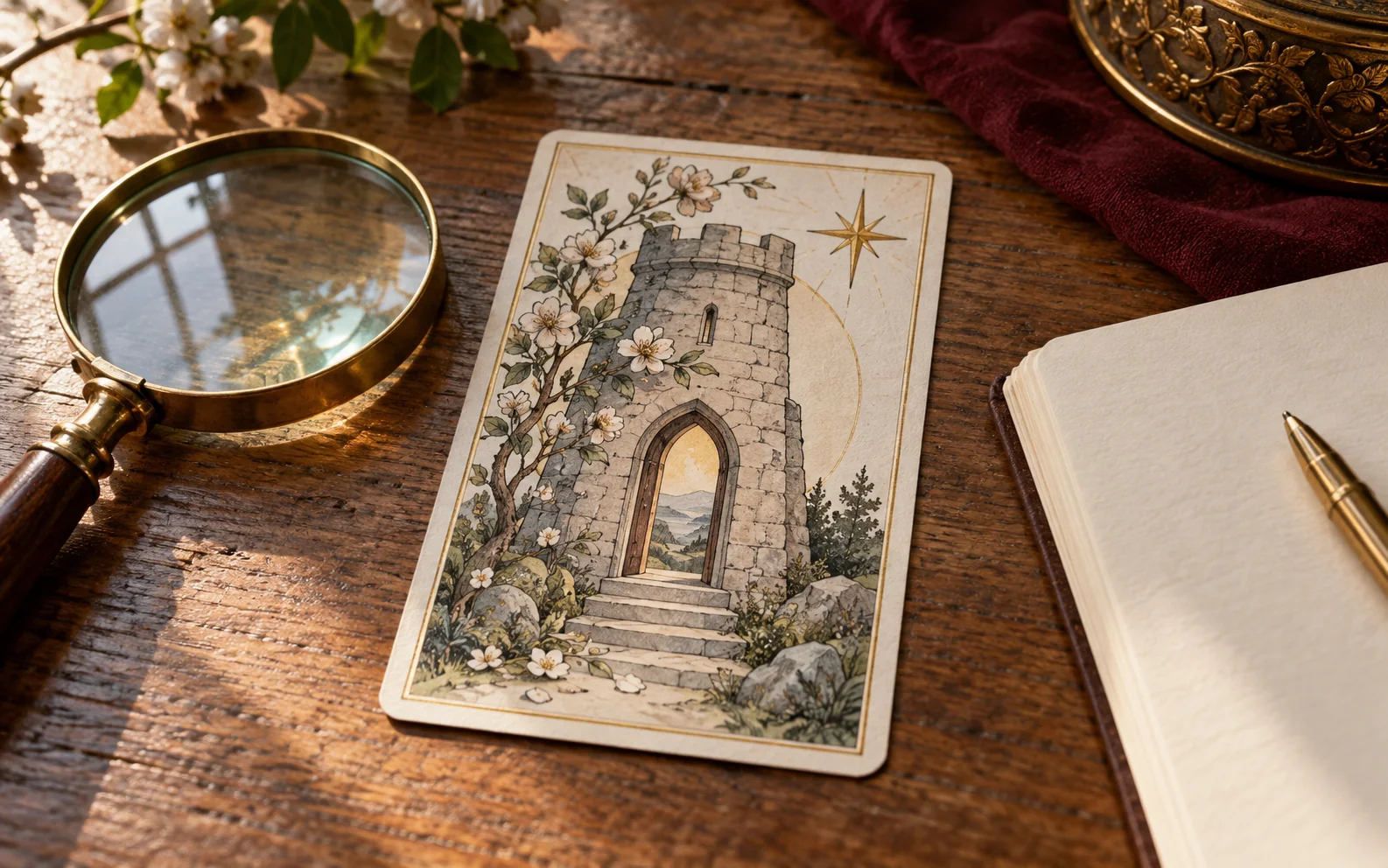
A card seems to speak exactly about what you feared. The temptation is to repeat its meaning until it fits: “If The Tower comes up, something bad is going to happen.” Before accepting that sentence, it is worth subjecting it to a simple test. What does the card in your edition show? What did the position in the spread call for? What facts do you know and which are you assuming? Is there another plausible reading? Checking an interpretation does not mean proving that tarot predicts events. It means reviewing whether your conclusion comes from a clear method and whether it is useful without turning an image into certainty.
The exercise has four movements: write the hypothesis, note the support, look for a counterexample, and close with a degree of uncertainty. You can do it in a journal after a single card. If you are just starting out, first practice how to describe a card before interpreting it; the separation between observation and personal association will be the basis of this test.
Write the hypothesis as a sentence that can be reviewed
“Strong energy” is hard to verify because it does not say which aspect of the question matters. “In the obstacle position, this card makes me think that I am trying to sustain a plan with outdated information” is more precise. You can argue with it: maybe the problem is not the information but the deadline; maybe there is no external obstacle. A useful hypothesis leaves open the possibility of being wrong.
Avoid introducing guaranteed outcomes. “I will lose my job” does not follow from a drawing, and a tarot consultation cannot replace employment data. The reviewable version would be: “I am worried that the work agreement will change; I am going to check which conditions are in writing.” The second sentence preserves the theme of the worry and proposes a real verification. If you need specialized advice, the card does not provide it.
Also write down the original question, the date, and the place of the card in the spread. If you drew a card for available resource, the same image should not simply be interpreted as future risk. Do not change the position label after seeing the result. That discipline makes it possible to compare later readings and detect when you moved the goalpost to save a conclusion.
Look for support in the image and in the position
For each hypothesis, note at most two pieces of support. One must belong to the card in front of you: a gesture, a composition, a name, or a documented convention of the deck. The other must connect that element with the question and the position. If the support is simply “my manual says it means change,” the bridge to the situation is missing. You can use the manual, but explain why that meaning and not another answers the query.
For example, a card with an altered building could suggest reviewing a structure. That is an interpretive association, not proof that a company is going to close. If the card occupies assumption I must question, the reading can ask which part of a plan is being taken as stable. If it occupies resource, it may help recognize the capacity to reorganize after an interruption. The link is justified by the position, not by a list of disconnected meanings.
Also compare your reading with the exact edition. Marseille and Rider-Waite-Smith images are not interchangeable in all details, and many contemporary decks reinterpret their symbols. If your argument depends on an object that does not appear in your card, note it as borrowed from another source or discard it. Distinguishing both systems will help you identify differences that matter for the reading.
Look for a counterexample before feeling sure
This is the part that is usually omitted. Ask: “What other explanation would be compatible with the card and with what I know?” If you think The Tower announces a breakup, consider whether it could refer to an expectation that falls, a necessary conversation, or a way of organizing yourself that no longer serves. Not all alternatives are equally good; the point is to keep the first emotion from deciding for you.
Then ask what fact would be missing to choose between the two. “I do not know what changes the company is considering” is a real limit of knowledge. “I have not asked the other person what they need” is too. The reading can lead you to prepare that question, but not to invent a private answer. If you cannot point to an observation or a piece of data that distinguishes the hypotheses, leave the result provisional.
A second card does not automatically resolve uncertainty. It can add material, but it can also create another interpretation that needs testing. Before drawing it, write down which specific doubt you are trying to clarify. If the doubt is “I want to be totally sure,” no number of cards can give that guarantee. A pause and a conversation may be more appropriate steps.
Fictitious example: a meeting that is unsettling
Imagine a person who is going to have an evaluation meeting at work. They do not know the exact reason and fear bad news. Question: “What can I prepare to attend with clarity?” Set three positions: what I know, what I am assuming, and my next step. In this fictitious exercise, Eight of Pentacles, The Tower, and Two of Swords come up. We will use The Tower, placed in what I am assuming.
The first impulsive hypothesis would be: “They will fire me.” It fails the test: the reason for the meeting is not confirmed, and the position indicates an assumption, not an outcome. A better hypothesis is: “I am treating the meeting as a certain collapse; it is worth distinguishing fear from information.” The support lies in the image of alteration that the reader observes in their edition and in the position set as an assumption. The counterexample is that the meeting could be about objectives, team changes, or training; the card does not distinguish among those possibilities.
The responsible synthesis would be: “I will prepare my progress and questions; I will ask for the purpose of the meeting if I can; I will not interpret the prior silence as a decision already made.” The reading does not minimize the worry. It gives it a form of action that remains useful whether the news turns out easy or requires a difficult conversation. It is precisely that usefulness that we seek when reviewing the interpretation.
A brief review table
You can copy these five boxes into a journal page:
| Box | Question to answer |
|---|---|
| Hypothesis | What exactly am I saying that this card in this position may suggest? |
| Visible support | What detail or convention from my edition am I using? |
| Link | How does it answer the question written before shuffling? |
| Alternative | What other plausible reading competes with the first? |
| Limit and action | What do I not yet know, and what step can I check outside the spread? |
If you cannot complete the second box, perhaps you are reading an emotion of your own rather than the card. If you cannot complete the third, the interpretation may sound nice but not answer the query. If the fifth only says “I will draw more cards,” stop and think about what real-world information is missing. The table is designed to stop leaps in logic, not to turn every reading into a long report.
Reviewing later without rewriting the past
Keep your first sentence with the date. Weeks later you can add a new note, but not replace the previous one. Comparing what you interpreted with what you later learned makes it possible to detect apparent hits, overly vague predictions, and changes in criteria. Do not count as “confirmation” a sentence that fits only because you made it broader after the fact.
The most valuable checking happens at the moment of reading: when you admit that a card can support more than one idea and still choose a proportionate response. You do not need certainty to offer a clear reading. You need to show what you observed, how you related it to the question, and where the evidence ends. To keep training, try the same card in two questions and record the differences before looking at how each situation turned out.