Sabio Tarot · Tarot basics and learning
How to Describe a Tarot Card Before Interpreting It
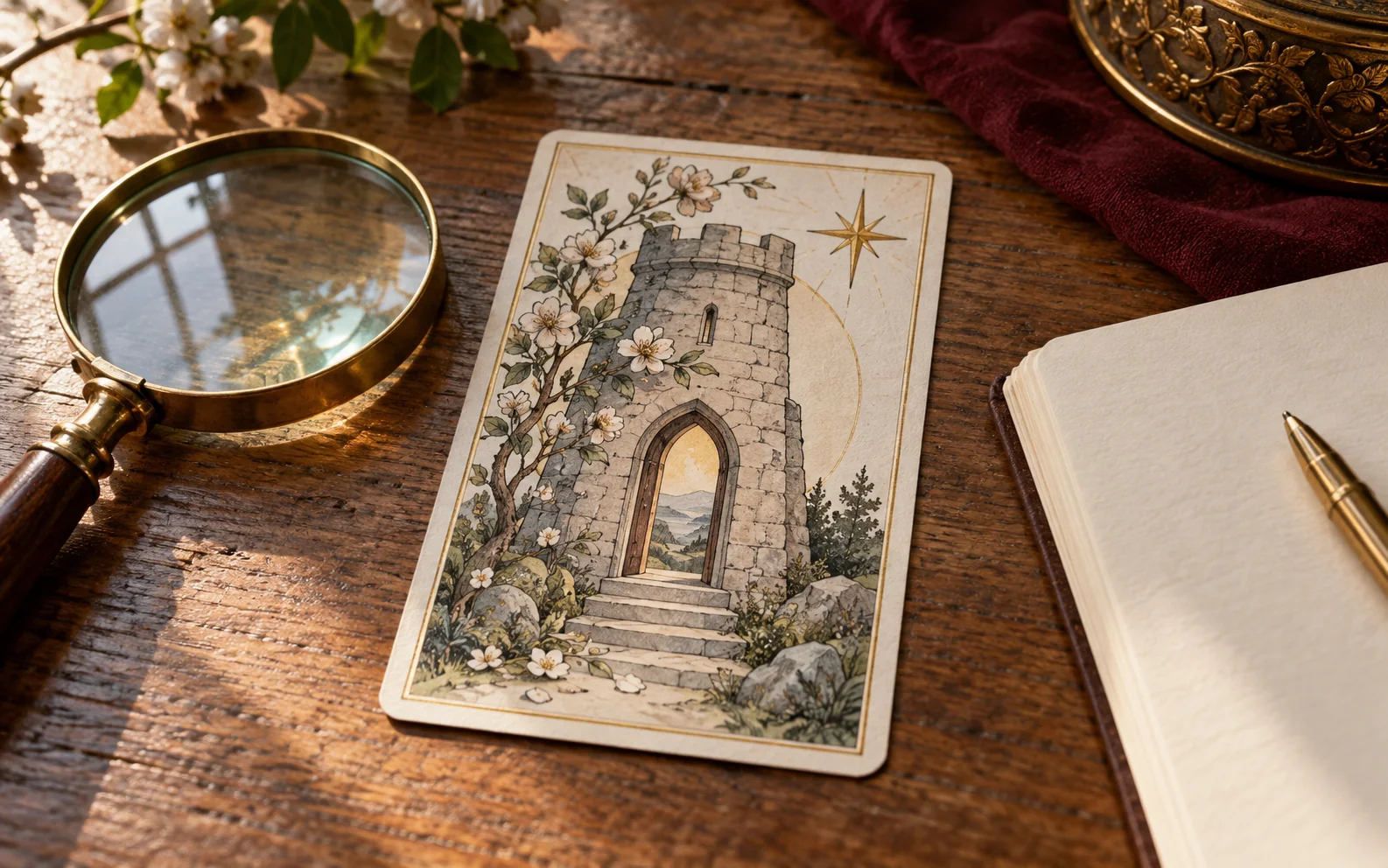
A person looks at a card and immediately says, “This announces a change.” That reading may serve them, but we still don't know which detail in the image supports it, which part comes from the guidebook, or which part was born from their personal situation. Describing the card first doesn't delay the reading: it gives it a point of support. The exercise consists of writing what is visible, what you infer, and what you associate on separate lines. Then you choose what relates to the question and what should remain a hypothesis.
You don't need esoteric vocabulary or a professional camera. A deck you can look at calmly, a notebook, and five minutes are enough. If your card belongs to a specific edition of Marseille or Rider-Waite-Smith, write the name of that edition: a difference in drawing can change the observation. For a first map of both systems, see how to recognize your deck. If the link doesn't match your edition, go back to the article library and look for the name of your deck.
First layer: what anyone can point out
Place the card in front of you and pretend you have to describe it to someone who cannot see it. Name concrete elements: how many figures appear, what they hold, where they look, what objects are nearby, and how the space is distributed. “There is a person standing next to a table” belongs to this layer. “They are confident” does not: that already interprets an attitude. The description can be brief, but it should allow another person to check whether they observed the same thing.
A small test helps. If someone responds, “Where do you see that?”, can you point to an area of the card? “Two objects are separated” can be checked. “The card is sad” may describe your reaction; to turn it into an observation, you would need to specify what gesture, color, or composition led you to think that. Even then it will still be an inference, because another person may read the gesture differently.
Also note relevant absences carefully. You can write, “I don't see a second figure in this edition,” if you have really examined the image. Don't write, “The other person has disappeared,” as if a card showed facts about the querent's life. An image offers a visual detail; the relationship to real life requires context.
Second layer: a hypothesis about the scene
Now ask what could be happening in the drawing. Perhaps a figure waits, prepares, or protects an object. Use provisional verbs: “could be evaluating,” “seems to hold,” “suggests a pause to me.” A hypothesis is more useful when it allows an alternative. If the character looks to one side, both “avoids conflict” and “attends to something outside the frame” may fit. The question of the spread and the position will help you choose; the image alone does not force one answer.
Compare your hypothesis with the deck's system. In Marseille, many numeral cards present the suit's symbols arranged ornamentally. A detailed narrative scene you have seen in Rider-Waite-Smith should not be automatically transferred to that Marseille numeral. In a modern deck, the artist may add new symbols. Note what comes from the image in front of you and what comes from another book or deck. That separation prevents attributing to the card details that do not actually appear in it.
The hypothesis is not a divination exam. You can cross it out if you find a better explanation. If a card shows two opposing figures and you thought “argument,” also ask: could they be collaborating or simply occupying two sides of a symmetrical composition? There's no need to multiply endless options; one reasonable alternative is enough to avoid an automatic conclusion.
Third layer: your personal association and its limit
Finally, write what the card reminds you of. A table may make you think of your desk; a door, of a recent move. This association is legitimate as a prompt for reflection, but it is not a universal property of the card. Label it “it reminds me of…”. If you read for another person, don't turn your memory into a statement about them. You can ask, “Does this image suggest any limit or beginning to you?” and leave them room to disagree.
Personal associations change over time. That is why it is worth dating the note and keeping it alongside a visible description. When you review the tarot journal, you may discover that the same card evoked haste one week and relief another. That doesn't prove the symbol changes on its own; it shows that the reader brings a different question and experience to each session.
Fictitious example: a card before a study decision
Let's imagine a teaching card created for this exercise, with a seated figure, three closed books on a table, and an open window. It does not represent a historical card or a commercial edition. The question for the exercise is: “What do I need to review before choosing a course?” The position was fixed in advance as information I am missing.
In the first layer we write: “A seated figure looks at three books; none is open; there is a window on the right.” In the second: “Perhaps they compare options without having examined their contents yet.” The alternative would be “They already compared and are resting”; the image does not show the earlier sequence. In the third: “It reminds me of when I kept course brochures without reading the requirements.” This last sentence speaks of our experience, not of the querent.
The useful synthesis is not “the tarot says to choose the third course.” It is: “Before choosing, it is worth opening the options: reviewing the program, duration, and real cost.” If the reading were about a relationship, the same books could suggest incomplete information of another kind; we would not have the right to impose the academic reading. The question and position delimit the leap from the image to an action.
A five-minute worksheet for practice
Use this template with a card from your own deck. You don't need to fill every box with long sentences:
- Edition and card. Write the printed name, the deck, and, if applicable, the version or publisher.
- Question and position. Note them before looking at the card; that way you won't adapt them to the drawing afterward.
- Three visible facts. Describe objects, gestures, or arrangement that another person can point out.
- One hypothesis and one alternative. Formulate two plausible readings without declaring them facts.
- One association of yours. Label it as personal so you don't confuse it with the deck's meaning.
- One synthesis sentence. Relate it to the question and end with a fact or action you can verify.
If you have only noted words such as “success,” “danger,” or “love,” go back to the first visible box. Ask what concrete element made you choose them. If none appears, perhaps those words come from memory or from a list consulted before looking at the card. You can use a guidebook, but it is worth knowing what the guidebook contributed and what the drawing contributed.
What to do when two readers see different things
Disagreement can be fertile if both point to the evidence. One reader sees a figure moving away; another sees a figure arriving. Compare the orientation, the setting, and the position of the card. Then ask which reading best serves the consultation without erasing the alternative. If there isn't enough data, a provisional and modest conclusion is better than a fabricated certainty.
This exercise also protects against retrospective reading. If you wrote “seems to pause to examine options,” keep that sentence. Don't change it weeks later to “I already knew I would choose the second option” just because the result turned out that way. The value of the record is in showing what you could observe before knowing the facts.
Layer-by-layer description is not meant to take intuition away from tarot. It allows you to recognize when an intuition illuminates an image, when it merely reproduces a fear, and when it is better to ask for more context. Practice it with a daily card for a week and compare your worksheets; you will see more precisely how you move from looking to interpreting. To continue with contextual reading, you can practice how to read a one-card spread and how to relate position and meaning.