Sabio Tarot · Tarot basics and learning
Memorizing the Four Tarot Suits with Questions, Not Lists
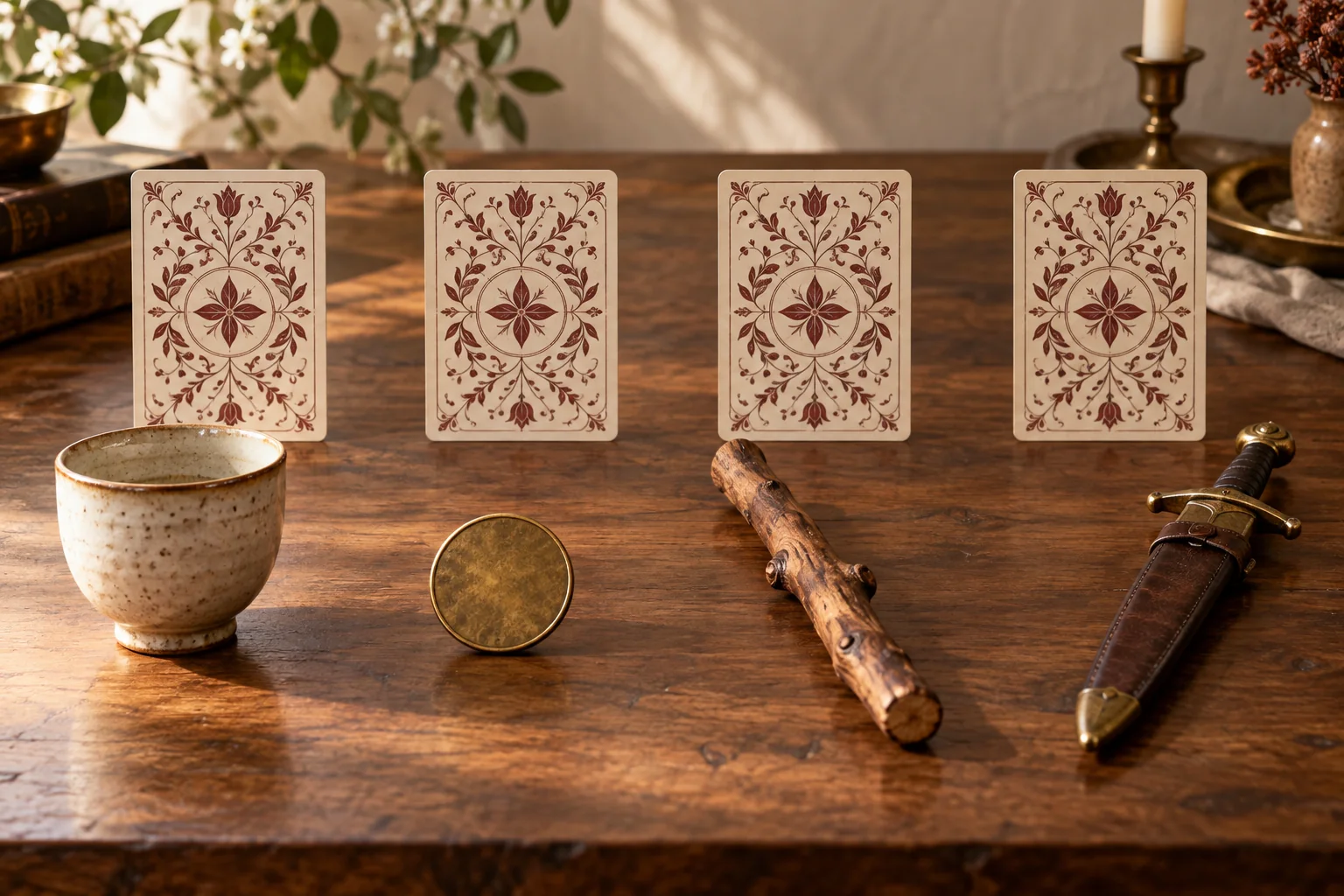
Cups = emotions, Pentacles = money, Swords = conflict, Wands = action. It's a quick way to start and an easy way to get it wrong. A conversation about money can also be shot through with Cups; a creative project can demand material work and appear alongside Pentacles; Swords isn't always a fight. To learn the suits, it's more useful to practice what question you would ask when you see each one in a specific situation than to repeat a one-word equivalence.
This exercise uses common associations as a starting point, not as universal rules or as facts about the future. The images of the numerals change among Marseille, Rider-Waite-Smith, and modern decks. If you still can't place the 56 minor arcana, see how the 78-card deck is organized and come back here with four cards, one from each suit.
From the suit name to a reading question
Instead of memorizing “Cups = love,” try: “What relationship, desire, or emotional need is at stake?” Instead of “Pentacles = money,” ask: “What resource, time, or material condition do I need to attend to?” For Swords: “What idea, decision, or conflict of interpretation requires clarity?” For Wands: “Where do initiative, impulse, or sustained effort appear?” They are open questions. They don't force the answer to be favorable or unfavorable.
Write the four on cards. On the front, only the suit and a situation. On the back, the question you would pose, a visible detail from your card, and a warning against oversimplification. For example: “Pentacles before a move; what real cost and what practical support should I check?; don't automatically conclude that there will be gains.” The cards are useful if they force you to connect the symbol to the problem, not if they only make you repeat the same definition.
You can add a working verb for each suit, but don't fix it as the only reading. Cups can lead you to listen; Pentacles, to measure; Swords, to clarify; Wands, to begin. In a specific situation, maybe Cups asks you to set a boundary and Wands to wait. The charm of the method is that each initial word must pass through the question and the position before becoming a conclusion.
Four cards with the same situation
Imagine, as a fictitious exercise, that a person wants to organize a book club. The written question is: “What should I take care of during the first month?” Prepare four practice cards, one per suit. You haven't drawn four real cards, nor are you making a prediction; you are comparing possible lenses for the same query.
Cups. Question: “What experience do the people who come want to share?” You might pay attention to welcome, listening, and the group's atmosphere. Counterexample: a Cup doesn't guarantee that everyone will get along; maybe you need to ask directly what they expect.
Pentacles. Question: “What resources make the meeting viable?” Place, schedule, accessibility, and cost may matter more than a nice idea. Counterexample: a Pentacle doesn't promise financial profit; the club could be free.
Swords. Question: “What conversation rules should be clarified?” How to choose books, distribute turns, and handle disagreements are decisions. Counterexample: a Sword doesn't announce an inevitable fight; it can represent the need to express yourself precisely.
Wands. Question: “What initial momentum can I sustain without exhausting myself?” Maybe it's better to launch a pilot session instead of announcing a year-long program. Counterexample: a Wand doesn't mean you should act without reviewing time and resources.
The four questions each contribute something different. If your answers end up being identical for all the suits, review the card: maybe you wrote advice so general that no card was necessary. If a card only speaks about a stereotyped topic, look for a concrete action linked to the book club.
Add number and position without losing the suit
Once you distinguish the questions of each suit, introduce the number or figure. Don't assume that “Two” means the same thing in all four cards; use it as another element to observe within your deck's system. In Marseille, the count and arrangement of symbols may be especially visible in the numerals. In Rider-Waite-Smith, the scene provides gestures and relationships that you shouldn't import into a Marseille card without marking the difference. The minor arcana section helps you place them before making finer comparisons.
Position also changes the work. A Five of Swords in what I should clarify doesn't answer the same as in what I already know. If your card doesn't indicate a position, note “dress rehearsal.” When you practice a real spread, write the position before looking at the suit and ask how it modifies your initial sentence. A memorized convention is a starting point; the specific question decides whether it contributes anything.
Don't turn numerology into an automatic formula. You can observe patterns of two, three, or five symbols, but check whether your edition's image organizes them in a way that supports your reading. If the meaning comes from a manual, note which one. Knowing where a word came from prevents you from repeating it as if you saw it in every deck.
Two counterexamples for each simple association
To check whether you are learning or just remembering a slogan, prepare counterexamples. Cups doesn't only refer to a partner: it could speak of friendship, belonging, or an unshared desire. Pentacles doesn't only refer to income: it could deal with time, the conditions of the work environment, or care for an object. Swords isn't only argument: it can be a clear decision, a difficult question, or an idea that must be expressed. Wands isn't only beginning: it can ask you to maintain a practice or recognize that enthusiasm isn't enough.
Write your own example for each simple association and its counterexample. Don't try to make one card cover all possibilities simultaneously. In a spread about organizing the club, perhaps Pentacles focuses on the venue; in a spread about learning, Pentacles focuses on practice time. The fact that both examples are possible doesn't imply that the card has confirmed either one. You need context and, outside tarot, verifiable data.
If a counterexample seems too far from the system you're studying, consult that edition's manual and adjust the card. The goal isn't to be original by obligation, but to avoid associations so narrow that they prevent you from reading a real question.
One-week spaced review
Practice for one week with four practice cards a day. Day one, create a different situation for each suit. Day two, swap situations between suits and observe how the question changes. Day three, add a spread position. Day four, look at a real card from your edition. Day five, write a synthesis sentence with a possible action. Day six, look for a counterexample. Day seven, return to the initial cards and correct only what you can justify.
You don't need to draw a card every day. Some practices can be done with authorized images or with the cards you already own. Date your notes to observe whether your questions become more specific. If only the keywords increase, maybe you are accumulating vocabulary without applying it. You can turn the best cards into a personal glossary with the origin of each association.
Learning the suits doesn't mean reducing them to four drawers. The cards help you recognize a reading direction and test it against question, position, number, image, and real data. When you can formulate a different question for each suit in the same case, you will have advanced more than by reciting four equivalences without context.