Sabio Tarot · Tarot basics and learning
Blind reading exercise: looking at a card before reading its name
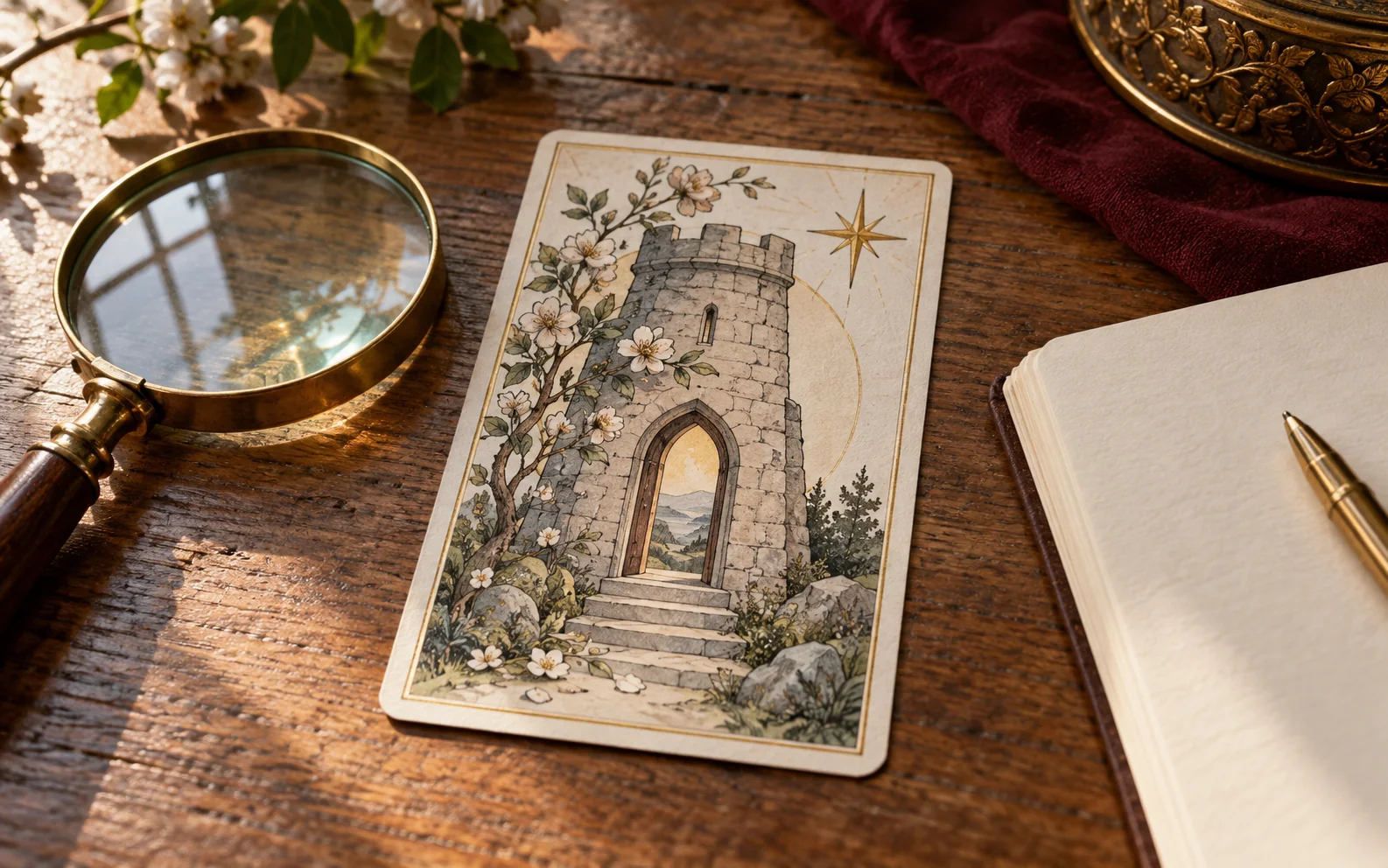
You know that a card is called “The Chariot” and, before seeing the drawing, you already expect movement and victory. That knowledge can help you, but it can also cover up what the image in your edition actually shows. A blind reading consists of temporarily covering the title and number, observing the card, noting three details, and formulating a modest hypothesis. Then you uncover the name and check what the drawing, your memory, and the manual added. It is not about guessing the card or measuring a supposed paranormal faculty; it is an exercise to train attention.
You can do it alone or with another person. Choose a deck that you own and whose artwork you can look at comfortably. If the design has small symbols, use good light or an authorized image of that same edition. Do not publish photos of other people's decks without checking rights. To learn to separate first impression from description, it is helpful to first read how to describe a card.
Preparation: cover without altering the central image
Use a strip of opaque paper to cover the name and, if you can, the number. Do not stick tape on the card or damage the deck. If the title appears integrated into the drawing, you can ask another person to choose a card and place it so that you do not read it until the end. Set a short time: three minutes of observation and two of writing. The time limit prevents you from turning the task into a search for hidden symbols.
Before drawing the card, decide whether you are working with a question or only with observation. For beginners, we recommend starting without a personal consultation: “What relationship is seen between figures and objects?” Then repeat with an everyday question, for example “What do I need to review when preparing an activity?”, and a fixed position such as resource I can observe. Do not change the question when you uncover the name.
Prepare a sheet with four boxes: visible, hypothesis, doubt, and check. The doubt box is essential. If a figure appears to move forward, also ask whether it might be still and you supplied the movement. Blind reading does not reward guessing a name; it rewards being able to explain what you saw and what you assumed.
First round: visible description only
Write three statements that another person can check by looking at the card. “There is a figure in the center,” “holding an object,” and “two elements occupy opposite sides” are observations. “She is self-confident” is an interpretation; it can go in the next box if you point to a specific gesture. Do not correct what you wrote after uncovering the name.
Include the general arrangement: Is the scene full or empty? Is there a clear direction of gazes? Do the suit symbols repeat? Does the background take up a lot of space? These questions work both for a narrative Major Arcana card and for an ornamental numeral. In a Marseille Minor Arcana card, there may be no human figures. Describing its structure is not “seeing less” than in Rider-Waite-Smith; it is working with the visual material of another system.
If you do not find three details, note one. Better an honest observation than inventing something to fill the sheet. In generated or reinterpreted cards, some objects can be ambiguous. You can write “it looks like a staff, although it could be something else.” Uncertainty is part of what you see.
Second round: one hypothesis and one alternative
Now formulate what might be happening in the image. Use “might” or “seems,” and relate your sentence to a detail from the first round. An alternative must be plausible, not an absurd negation. If you see a person with their head turned, perhaps they are looking back or listening to something outside the frame. Neither option forces you to conclude what is happening in the life of the querent.
If you are working with a question, add a bridge sentence: “In the resource position, this posture might suggest…” That way you will avoid reading a card as a generic omen. If the exercise is visual only, limit the hypothesis to the scene. Do not attribute private thoughts to drawn figures or rush to identify a “traditional meaning” that you have not yet consulted.
Also note what information you would need to choose between hypotheses. It could be seeing an object better, reading the legend of the edition, or knowing more about the situation that prompted the question. When the checking phase comes, you will know what to look for. Without that written doubt, it is easy to remember only the part of your hypothesis that later seems correct.
Fictitious example: an invented card for practice
Imagine a fictitious card for this exercise: a person sits next to a half-open door, holds a key, and looks at a table with two notebooks. This described scene does not belong to a historical deck or a commercial edition. The fictitious question is: “What do I need to prepare before changing my study routine?” The position is information I need to organize.
First round: “There is a key in the hand,” “the door is half-open,” and “two notebooks are on the table.” Second round: “She might be ready to enter, but she is still checking her materials.” Alternative: “Perhaps she has just left and is deciding what to keep.” In the doubt box: “I do not know whether the door represents beginning or closure; the image does not show what is on the other side.”
When you uncover the invented title—let us suppose “The Threshold”—a word appears that favors the idea of passage. But the name does not prove that the first hypothesis was correct or that the routine change will work. In this question, a useful answer would be “Organize what material you need and what habit you will keep before starting.” The action comes from the question and the observed details; not from the impression of having “guessed” the title.
Uncover the name and compare with the manual
In your real deck, uncover title and number. Read the explanation in the manual for that edition. Divide what you learned into three rows: it matched my observation, it added a convention I did not know, and it did not fit this question or image. Do not turn the third row into a failure. A manual may discuss another type of consultation or a symbolism that does not appear obviously in your reproduction.
Be careful with a frequent illusion: after reading the name, it seems that you “always knew” which card it was. The sheet written beforehand prevents that retrospective memory. If your hypothesis came close to the guide, point out exactly how. If it moved away, ask what detail you omitted or what personal association dominated the reading. Both answers teach something.
Blind reading does not replace historical or iconographic study. A symbol can have a context that is not discovered by looking for a few seconds. The exercise only shows what you can observe without additional information; the manual and documented sources broaden that framework. To compare systems, consult how to recognize Marseille and Rider-Waite-Smith.
Variations to repeat without turning it into an exam
One variation consists of using two cards from the same deck and asking what visual relationship appears, without naming them. Another consists of comparing the same card in two authorized editions and writing what actually changed in the drawing. If you practice with another person, exchange the sheets and discuss only what each of you was able to point out; do not look for a “winner.”
Limit the session to three cards. More quantity encourages tiredness and the repetition of vague phrases. Keep the date, edition, and question. After several weeks, you will be able to see whether you observe more details, whether you write better alternatives, and whether you distinguish more quickly what belongs to the deck from what you contribute.
The valuable result is not recognizing hidden names, but reaching a less automatic reading. First the image, then the hypothesis, then the check, and finally a sentence that answers the question without promising certainties. If discrepancies arise when comparing with the manual, organize your vocabulary by provenance and keep the doubt instead of filling the gap with ten new meanings.