Sabio Tarot · Minor Arcana
Nine of Pentacles: Autonomy and Invisible Supports
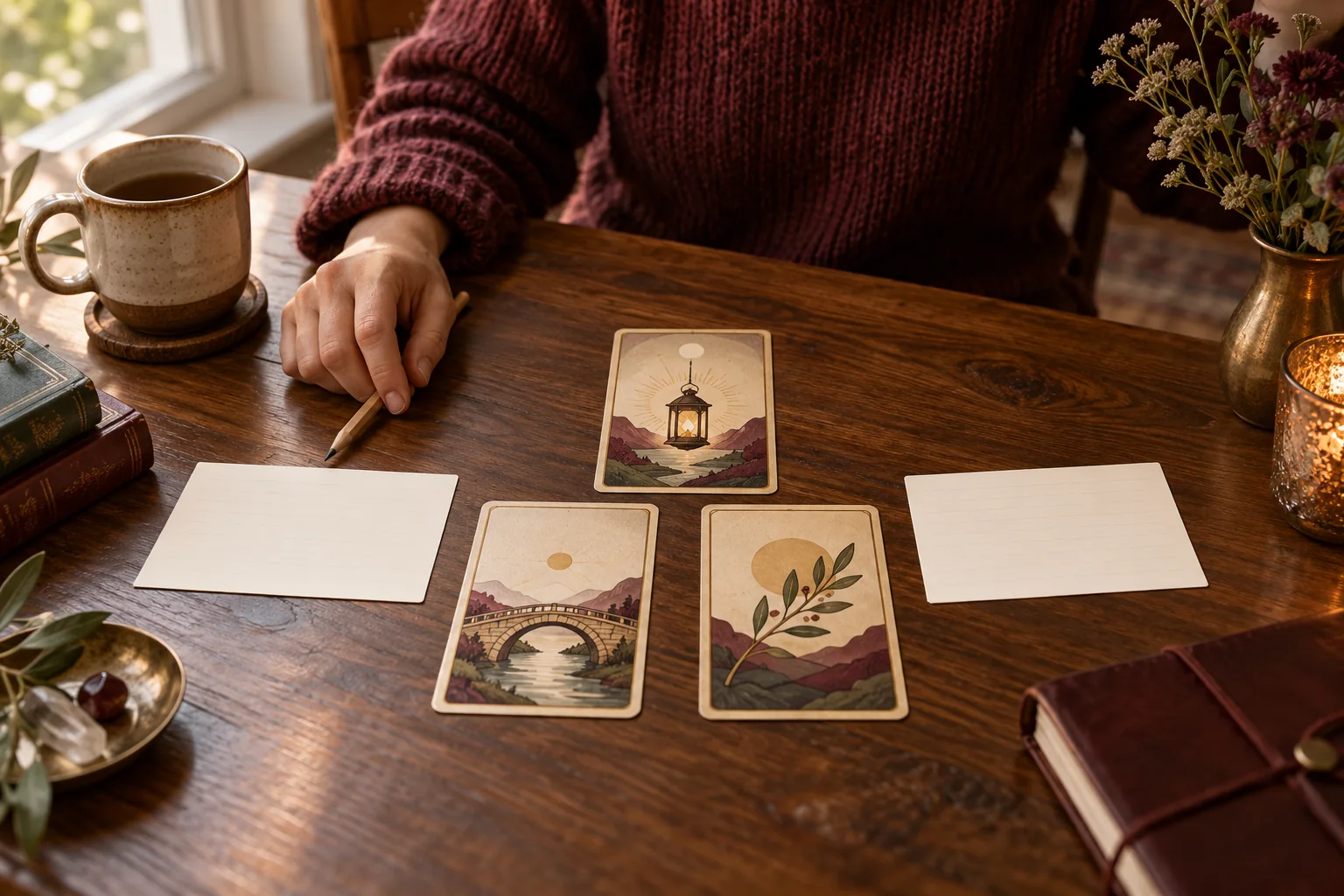
A figure in an abundant garden can suggest independence. But no life is sustained without infrastructure, relationships, other people's work, and material conditions. The Nine of Pentacles allows us to ask what resources are available, what room for decision they offer, and what supports they depend on. It does not promise wealth or turn economic capacity into a measure of personal worth. A careful reading can celebrate achieved autonomy without rendering invisible care, community, or inequalities.
- 19
- 210
Waite's Image and Its Questions
Waite describes a woman with a bird on her wrist, in a garden of vines associated with abundance; he says that she may be the owner of the place. That "may" is important: the image by itself does not prove ownership. Its interpretation belongs to Rider-Waite-Smith, not to any nine-coin numeral. The V&A contextualizes visual changes between decks. In a Nine of Pentacles from Marseille there may be organized coins without a garden or a character; do not describe a scene that does not appear.
Observe the composition: figure, garden, elements of wealth, and the boundary of the space. Then ask what is not seen. Those who planted, maintained, or financed the garden do not appear, nor do contracts or future security. It is a static image of a represented state. The reading can use it to talk about current room for choice; it cannot infer from it that the person "has achieved it alone" or that "they will never need help." Nor does it allow judging someone who does not yet possess similar resources.
Autonomy Does Not Mean Isolation
A person can decide freely because they have reliable support: friendships, chosen family, public services, teamwork, or shared knowledge. Autonomy includes being able to ask for help without losing one's voice. Ask what decisions the person can make, what resources they need to carry them out, and what relationships make the margin sustainable. If someone rejects help to prove independence, it may be worth reviewing the cost. If someone receives support but cannot decide about their life, there is also a problem. The card can open both questions without decreeing which one is occurring.
Separate own resource, shared resource, and conditional resource. One's own savings are not the same as a promise of a loan; a network of friends available for an afternoon is not equivalent to continuous care. Write conditions and limits clearly. In relevant financial matters, use numbers, contracts, and appropriate advice. Tarot does not estimate solvency or asset value. It can help organize a conversation about sufficiency; it is not a financial planning tool by itself.
Fictional Example: Working for Oneself
Invented case. Mireia is thinking about devoting more time to her work as an illustrator. The Nine of Pentacles appears in "resource." A simplistic reading says "you will be rich and self-sufficient." Mireia makes a real inventory. She has a small client portfolio, savings for four months, technical skills, a friend who occasionally reviews contracts, and a shared workspace. She also depends on insurance, a sales platform, and income from another part-time job. Her margin exists, but it is neither unlimited nor solitary.
Mireia decides to try a fixed schedule for commissions for three months without yet leaving the part-time job. She defines an income threshold and an hour limit. She consults a professional to review tax obligations. She asks her friend for a one-off review with a clear agreement, without turning the friendship into permanent unpaid service. The Nine of Pentacles inspired a conversation about real and sustained autonomy, not a prediction of success. If the data do not improve, she will adjust the plan without interpreting the card as failure.
In another fictional consultation, a person already has enough income but feels that every decision must please their family. The card could invite them to define autonomy in terms of boundaries and voice, not only money. Ask what decisions are theirs, what ties they want to preserve, and what conversation they can sustain. Avoid diagnosing "dependence" from an image. Material and relational resources are distinct dimensions; both deserve attention.
The Material Network Behind the Garden
Make a map of resources in circles: income, housing, food, health, information, transportation, friendships, and time. Mark what the person controls directly, what they share, and what depends on institutions. The map does not seek to produce guilt for having help. It seeks to understand vulnerabilities and strengths. If a support fails, is there an alternative? If a task always falls to someone invisible, how can it be recognized and distributed better? The garden card is an occasion to see beyond the framing.
A lone figure in an illustration does not prove economic independence. Complete a table of "resource / condition / person or institution / review": the autonomy of a real case depends on those data, not on the isolated appearance of a card.
Sufficiency as Its Own Question
"Having enough" is not equivalent to a universal figure. It can mean covering needs, reserving time, keeping an option open, or reducing dependence on a single source. Ask what criterion the person adopts and how they will verify it. In a work reading, it could be a minimum amount of savings or diversified clients; in a creative one, time to produce without constant urgency. Avoid imposing an ideal of luxury. The garden can be a metaphor for cultivated care, not a mandate to accumulate.
The card position changes its function. In "resource," look at what margin already exists. In "risk," ask whether the appearance of sufficiency hides fragile dependencies. In "next step," define a concrete measure to strengthen the margin. In "possible outcome," keep the hypothetical character; do not turn the scene into a promise of wealth. A responsible interpretation also points to what the image cannot know.
Closing
The Nine of Pentacles from Rider-Waite-Smith presents visual abundance and a figure in a garden, but real autonomy has conditions. Tarot Rider-Waite from Scratch serves to study that edition. Before the card, ask what resources sustain your decisions, which depend on others, and what it means to you to have enough. Acknowledging supports does not diminish the achievement; it allows you to care for it better.