Sabio Tarot · Tarot basics and learning
Tarot after a breakup: what questions can help you without promising reconciliation
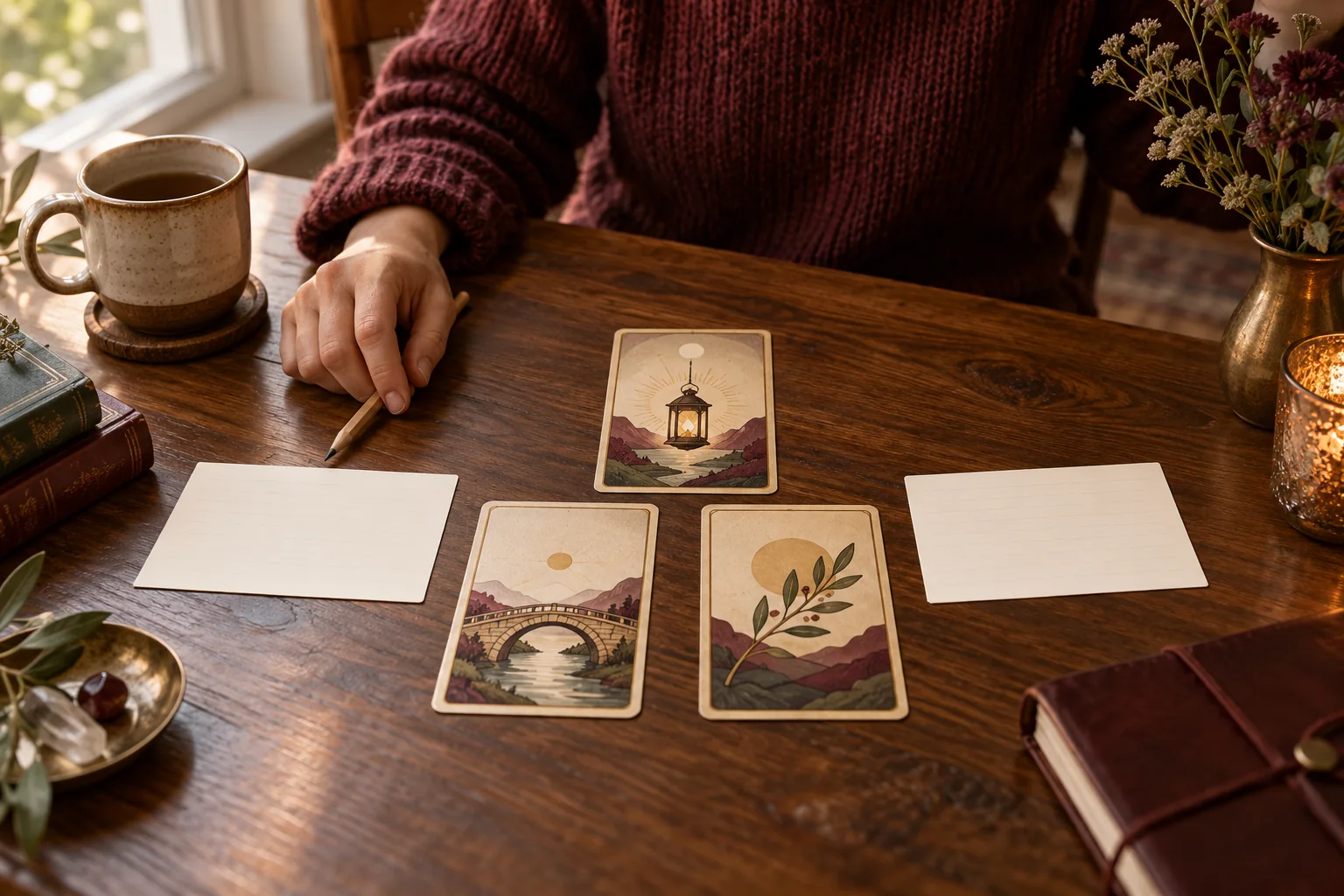
After a breakup, "Will they come back?" can become the only question that seems to matter. The difficulty is that it leaves you waiting for someone else's decision that the cards cannot verify. A more careful reading looks at what you need to understand about what happened, what boundary protects you now, and what actions depend on you. It doesn't erase sadness or demand that you be okay immediately; it prevents a symbolic image from becoming a promise of reconciliation.
Before shuffling, acknowledge the moment you are in. A separation agreed after months of conversations is not the same as a sudden breakup communicated yesterday. If you are in the first hours and need to talk to someone, eat, sleep, or resolve practical matters, those needs take priority. Tarot can wait. If there is fear, pressure, violence, or risk to your safety, seek direct support and professional resources in your area; do not use a spread to determine whether the danger is "real."
Three kinds of question after a breakup
The first kind seeks understanding: "What communication pattern from this relationship do I want to review?" The second seeks to protect a boundary: "What would I need to maintain a distance that helps me during these weeks?" The third seeks to take a concrete step: "What small routine would help me reclaim my own space?" Each question has a different task. If you try to resolve all of them in one spread, you may end up with a long text and few usable decisions.
Avoid questions that require entering your ex-partner's mind: "Do they still love me?", "Are they with someone?", "Will they regret it?" A card does not know their private life. Even if an interpretation calms you today, it may make you check your phone every hour tomorrow. You can acknowledge the need underneath: perhaps you want to know whether it is worth writing to them. Rephrase it: "What would I need to be clear about before starting a conversation?" If they have already asked you not to contact them, that real boundary weighs more than any symbol.
It also helps to distinguish reconciliation from repair. You may never get back together, and yet there may be something you want to understand, forgive, be grateful for, or stop repeating. A conversation may be possible without it implying restarting the relationship. The cards can help you name those differences; they cannot guarantee the other person's response.
A spread with a short horizon
A three-card layout is enough to start. Define the positions like this: 1) what I need to acknowledge today; 2) what I must not turn into certainty while data is missing; 3) a gesture of care or a boundary that I can decide. It is important that the third position not be "what will happen." It should allow a small action, proportionate to the moment: stop rereading messages for an afternoon, talk to a friend, sort out shared matters, or write a letter you don't need to send.
You are not obliged to interpret every card instantly. First describe what is visible, then the meaning your book proposes, and finally how it relates to the position. If you use Marseille and a numeral comes up, do not add a Rider-Waite-Smith scene that your card does not show. If a disturbing arcana card appears, avoid turning it into a verdict on the future of the bond. It may be helping you express the weight you already feel.
You can record the question and the interpretation in a journal. Add a column for "facts I know" and another for "possibilities I imagine." That way it will be easier to see whether the reading sparked reflection or led you to treat a conjecture as news. In how to keep a tarot journal you will find a general method; here the special precaution is not to use the notes to chase signs of return.
Fictitious example: a separation with unfinished business
In this didactic example, Marcos and Eva have ended a relationship. They need to return some belongings and have not yet agreed how. Marcos wants to use that meeting to ask for a new chance. He acknowledges that Eva has asked for space. Before consulting the cards, he writes down two facts: there are objects to return and there is a request for distance. His question is: "How can I handle the return while respecting that boundary and take care of what I feel afterward?"
Suppose that with a Rider-Waite-Smith deck he gets Five of Cups, Justice, and Four of Swords. In the first position, the Five of Cups allows him to name sadness without turning it into an order to "look on the bright side." In the second, Justice does not say that Eva will return or that Marcos is right. It reminds him that there is a practical agreement that must be clear to both and a request for space that he cannot erase. In the third, the Four of Swords suggests a deliberate pause after the exchange: perhaps agreeing on a brief handover and spending the afternoon with someone he trusts.
Marcos writes down a possible message: "I can leave your things with our mutual friend if you agree. If you prefer another way, tell me. I will not use this errand to talk about the relationship." The reading did not manufacture Eva's consent: Marcos will have to ask. Nor did it dictate that they can never speak again. It only helped distinguish a practical obligation from an emotional desire and formulate a gesture that respects the known boundary.
There could be another reading of the Four of Swords: perhaps Marcos needs rest before writing any message. That alternative is also reasonable. He will decide based on his state and the real urgency of returning the objects. A responsible interpretation does not claim that a single phrase is the infallible translation of the card.
What to do when a "return card" appears
Some people use that name for a card they associate with memories, review, or reunion. That name does not prove that the other person will contact you. Ask what is in the image, what position it occupies, and what external fact would support that hypothesis. The Six of Cups, for example, can evoke shared memory; remembering someone is not the same as rebuilding a relationship. Judgement can suggest reviewing a decision; it does not require that the person reviewing it be the ex-partner.
If the card drives you to seek more and more readings until you get a definitive answer, it is worth pausing. You can decide not to repeat the same query for a while and return to your notes only when there is new information. This is not a magical rule about how many days must pass; it is a way to distinguish reflection from an anxiety loop. In how to talk about uncertainty in a reading that distinction is explored.
A closure that does not depend on a prediction
The reading can end with three sentences: "This hurts me," "this I know for certain," and "this I will do today to take care of myself or resolve what is practical." If you don't know the third, perhaps the action is to ask for company or postpone the interpretation. The goal is not to speed up grief or turn it into an optimistic lesson. It is to preserve the capacity to decide even when you do not yet know the future.
To study the deck you practice with, you can consult Marseille Tarot from Scratch or Rider-Waite Tarot from Scratch, depending on your edition. No book replaces a conversation in which both people want to talk or the personal support you can seek by another route.