Sabio Tarot · Minor Arcana
Ten of Swords: Intense Closure Without Catastrophe

The Ten of Swords from Rider-Waite-Smith is one of the images that can frighten people the most. A careless reader can use it to announce harm, death, or inevitable betrayal. The card does not prove any of those facts. A useful reading acknowledges the visual intensity and asks what stage, expectation, or strategy might be exhausted, what information is available, and what support the person needs in order to decide. It does not minimize real pain, but it also does not turn a drawing into a future threat.
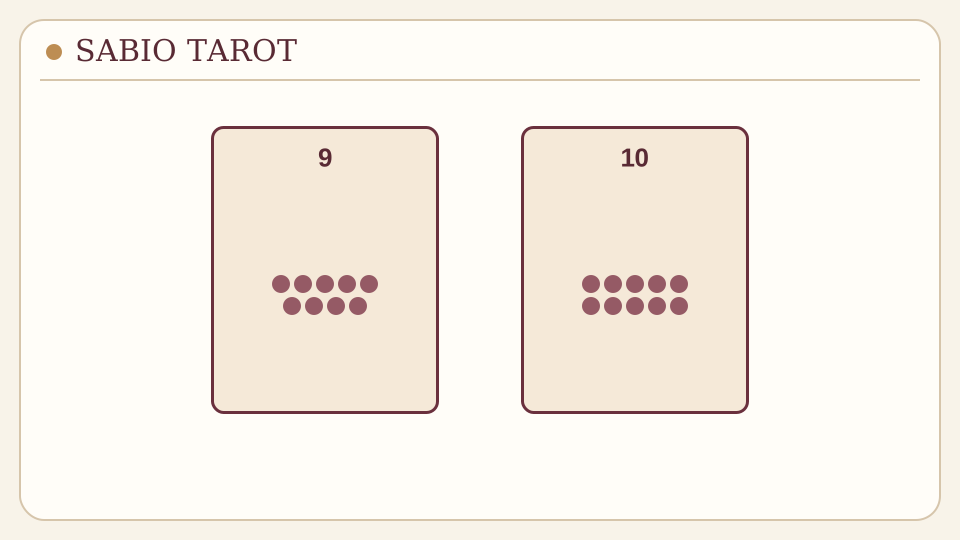
- 19
- 210
What the Primary Source Describes
Waite describes a lying figure pierced by the card’s swords. Although he associates the image with affliction, he clarifies that it is not specifically a card of violent death. This precision from his own text matters in the face of sensationalist interpretations. The scene belongs to Rider-Waite-Smith. In Marseille, a Ten of Swords is often presented as a numeral without a lying body; do not transfer the scene to a card that does not contain it. The V&A offers context on visual diversity and the development of the illustrated minors.
Describe the image as an image. A depicted figure is not the body of the querent. The swords are not real injuries, and the number ten is not a date. If the person knows the card and becomes alarmed, acknowledge the emotion: “It is a strong image.” Add the limit: “I will not use it to predict physical harm.” Then ask whether, within the question posed, there is a process that feels finished or a way of acting that no longer works. Careful language can sustain a conversation even with a harsh symbol.
Four Possible Phrases, Four Different Effects
“You are going to lose everything” imposes a future without evidence and increases fear. “A strategy seems exhausted” narrows the scope to a process and presents it as a hypothesis. “Perhaps it would be wise to acknowledge an ending that has already occurred” asks about present facts. “What support do you need to close this stage?” opens up an action that can be chosen. The same card can prompt these four phrases, but only the last three respect uncertainty and autonomy. Even they must be adapted to what the person actually recounted.
The closure can be administrative, creative, relational, or internal. Finishing a draft that is no longer useful, abandoning a study technique, or accepting that a negotiation has ended are very different examples. Do not merge them into a general prophecy. Ask what evidence would indicate that something ended: formal communication, a date, an explicit decision, or the repetition of a boundary. If that evidence does not exist, the reading can invite you to look for it instead of declaring an ending.
Fictitious Example: A Project That Changes Shape
Invented case. Paula has spent a year trying to sell a recorded course on tarot symbols. She has invested time, but the edition is old, there are errors, and she no longer likes the format. She asks what to do, and the Ten of Swords appears in the position “what should not be prolonged.” An alarmist reading would say that her career will end. Paula reviews the data: few sales, recurring questions the course does not answer, and a library of valuable notes. The useful hypothesis is that this version of the product may be exhausted, not that her work lacks a future.
Paula decides to withdraw the old edition from sale after notifying those who bought it and maintaining access as promised. She keeps notes to create revised free articles. She evaluates later whether a new course makes sense. The closure has concrete tasks: communication, support, and archiving. The card did not dictate bankruptcy or guarantee later success. It helped her separate the value of what she learned from the obligation to keep selling a format that no longer meets her standard.
Another fictitious case: a person asks about a relationship, and the Ten of Swords comes up. There is no basis for saying “your partner will leave you.” You can ask whether there is a pending conversation, an agreement that has already ended, or a pattern you both have recognized. If there is violence, coercion, or danger, the priority is to seek specialized support and a safety plan, not to make predictions with cards. If the relationship is fine, a dramatic image should not create suspicions without facts. The reading must allow you to say “I do not find a useful connection to the question.”
Closing a Strategy Is Not Closing an Identity
“This method does not work” is not equivalent to “I am a failure.” A failed exam can close one specific preparation and open another. A campaign without results can indicate that the message, audience, or channel needs revision. A distant friendship may need conversation or acceptance of change, without turning anyone into a villain. Tarot can help name the object of closure precisely. Write a sentence that begins with “ends...” and check that its subject is an identifiable practice or stage, not a person’s worth.
Then write “remains...”. Skills, rights, obligations, affections, or supports can remain. A real closure rarely erases everything. The visually extreme Ten of Swords can invite a feeling of totality; your job as a reader is to contrast it with concrete life. If there are documents or commitments, check their terms. If there is grief, do not pressure the person to immediately find “the positive lesson.” Sometimes the right action is to acknowledge the loss and be present.
Position and Follow-Up
In “what has already ended,” the Ten of Swords can help accept existing evidence. In “risk,” it can warn against interpreting a setback as a catastrophe. In “next step,” it can suggest closing a specific activity in an orderly way. The positions guide explains how to maintain a defined function. Do not turn a future position into an announcement of harm. If the spread design favors alarming predictions, change the question: “What can I review to go through this closure with support?”
In a real conversation, the outcome may contradict the initial hypothesis. An honest reading records the change and returns to the data, without retrospectively attributing any outcome to the card.
Closing
The Ten of Swords is a strong image and deserves especially precise language. Rider-Waite Tarot from Scratch can help you study the reference edition. In a real reading, ask what concrete process seems exhausted, what evidence indicates it, what remains, and what support is needed. Do not use the card to announce physical harm or to define a person’s identity based on a setback. A revisable conclusion offers more help than a dramatic verdict.