Sabio Tarot · Card combinations
The Moon and the Sun: Clarity Does Not Always Resolve the Whole Question
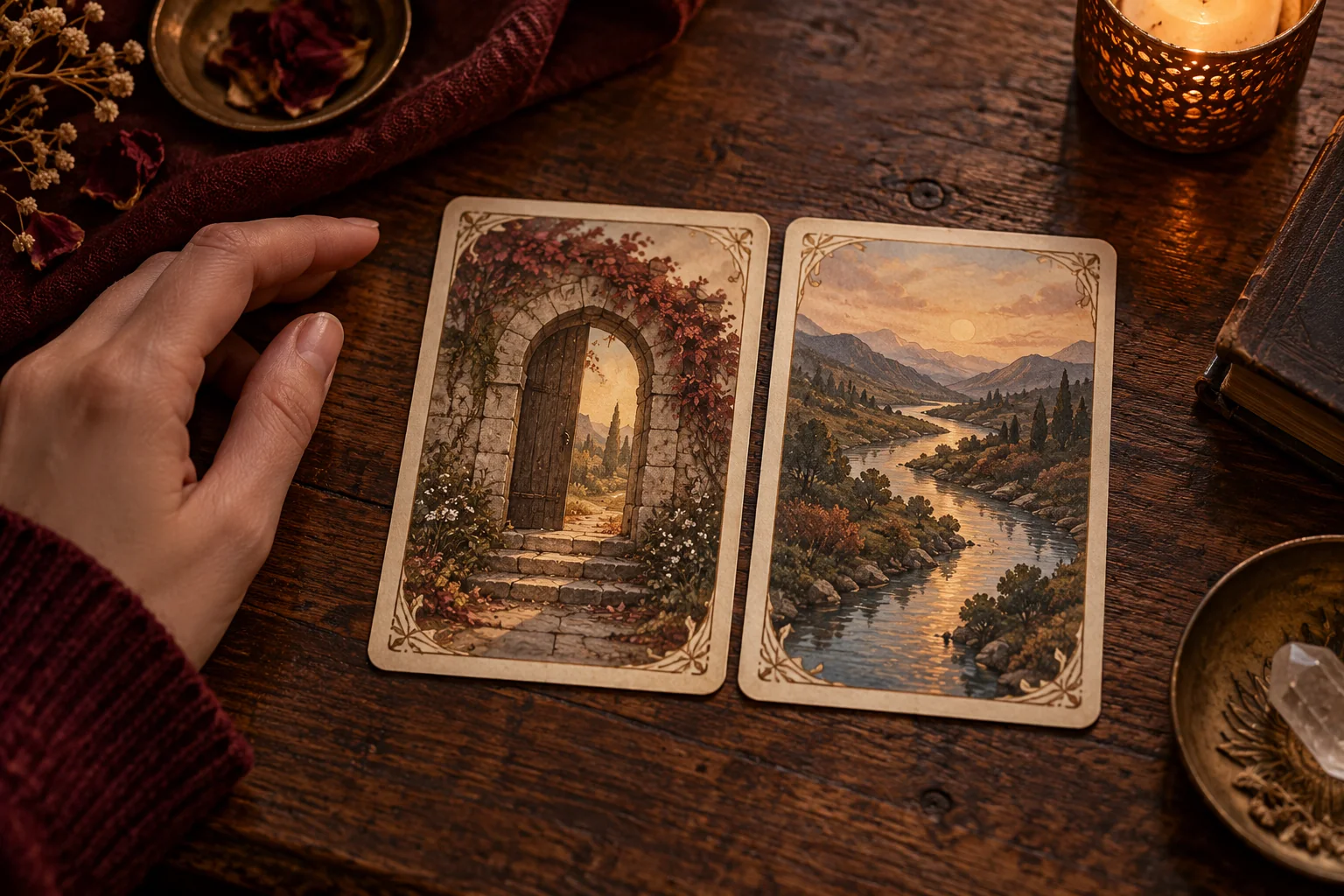
The Moon and The Sun often invite a story of darkness that ends in light. This can be a useful metaphor, but not a guarantee that tomorrow we will know everything. In a responsible reading, The Moon can point to incomplete information, impressions that are difficult to verify, or an emotion that affects the interpretation. The Sun can open the possibility of ordering facts, asking for an answer, and recognizing what is clear. The pair works best when the person distinguishes data, assumptions, and pending questions.
Fictitious example: Eva receives an offer to collaborate on a project. The message sounds promising, but it explains neither tasks nor payment. Question: “What do I need to clarify before accepting?” The Moon falls in the “uncertain zone” position and The Sun in the “clarifying mode” position; these labels belong to this example. The reading can help her write three questions: scope, timeline, and compensation. It does not ensure that the project is fraudulent or that the contract will be good. Partial clarity comes when the other party responds in writing and Eva compares those answers with her needs.
Do Not Call Every Uncertainty “Deception”
An imprecise proposal can come from poor organization, an initial conversation, or conditions not yet decided. The Moon does not identify hidden intent. If Eva says, “They are going to deceive me because The Moon came up,” she may ruin an opportunity without verifying anything. If she says, “Everything will be transparent because The Sun came up,” she may accept without reading the conditions. Both phrases delegate a necessary evaluation to images. A useful reading formulates a verifiable question and keeps more than one hypothesis open.
Separate three columns. In “I know,” Eva writes the project name and who contacted her. In “I assume,” what she imagines about hours and pay. In “I ask,” what she needs to clarify. The Sun does not fill in the third column; the conversation or the document does. If the other party does not respond, that lack of response becomes a new piece of data.
The Order of the Cards
Moon → Sun, in positions “situation → next step,” can suggest moving from impressions to explicit questions. Sun → Moon, in “the visible → the pending,” reminds us that a clear presentation can still leave conditions undefined. It does not imply that the truth will “darken” afterward. The order is not a temporal forecast if the positions were not established that way. The same pair can illuminate one point and leave another open.
If The Moon appears in “resource,” perhaps the person recognizes that something bothers them and can examine why. If The Sun appears in “obstacle,” perhaps an overly simple explanation covers up nuances. These are possible readings only when the question and the facts justify them. Do not make each position confirm your first idea; look for an alternative and ask which one fits the person's experience.
Second Fictitious Context: A Family Misunderstanding
Marcos believes his sister is upset because she replied with a short message. Question: “How can I talk without assuming what she feels?” The Moon can point to the distance between an ambiguous signal and the story Marcos constructs. The Sun can invite a direct and kind question: “Is now a good time to talk? I noticed your brief reply and I prefer not to interpret it on my own.” Neither of the two cards reveals the sister's emotional state. She may be busy, tired, or indeed upset; only her response can clarify it.
Clarity may be partial. If the sister says she needs space, Marcos will know a boundary, not all her reasons. The Sun does not grant unlimited access to another person's inner life. Respecting what someone chooses to share is part of a responsible reading. If Marcos insists on drawing cards until he “knows the truth” about her, it is better to return to the conversation and to privacy boundaries.
A Clear Fact May Not Resolve the Decision
Suppose Eva receives the offer in writing. Now she knows that the project requires ten hours and pays a specific amount. She still must decide whether it suits her. The pair does not replace that evaluation of time and money. Informational clarity is different from certainty about the future. There may be enough information to make a prudent decision without knowing how the collaboration will end.
In Marcos's case, an honest answer from his sister may reveal a problem, but not fix it in a single conversation. Knowing something does not oblige one to resolve it immediately. The Moon and Sun pair should not become a mandate to “bring everything to light” without consent. Sometimes it is enough to acknowledge an uncertainty and live with it temporarily.
Editions and Visual Details
The scenes of The Moon and The Sun change from deck to deck. In Rider-Waite there may be details that are not in a specific Tarot de Marseille, and vice versa. If you interpret figures, landscape, or animals, verify the card in front of you. The general opposition between darkness and light is a broad metaphor; it does not authorize attributing the same composition or the same historical meaning to all editions.
The guide how to interpret two cards together proposes reading relationship and position. Here it is worth adding a practical rule: for each symbolic sentence, write the external data that would allow you to verify it. “There is an unclear condition” leads to “ask for the conditions in writing.” “Perhaps I interpreted a silence” leads to “ask without accusing.” If there is no verifiable data, keep the sentence as a personal hypothesis.
Closing Without Promising a Revelation
Eva could leave with an email of three questions and a deadline for responding. Marcos, with a brief message that allows his sister to accept or postpone a conversation. These are small, respectful, and reversible steps. If the answers do not come, that absence will guide the next decision. There will be no need to say that The Sun “failed”: it never promised complete information by itself.
The Moon and Sun teach us to calibrate certainty. Some things are observed, others inferred, and others asked about. The image can awaken curiosity, but the method allows us to know what we know and what we do not yet know. Clarity is not a magical state without doubts.
Method and Limits
Original interpretation by Sabio Tarot. Eva and Marcos are fictitious examples. The cards do not read thoughts, do not verify contracts, and do not guarantee the transparency of third parties.