Sabio Tarot · Tarot basics and learning
What to Do with a Difficult Card Without Consulting Ten Meanings
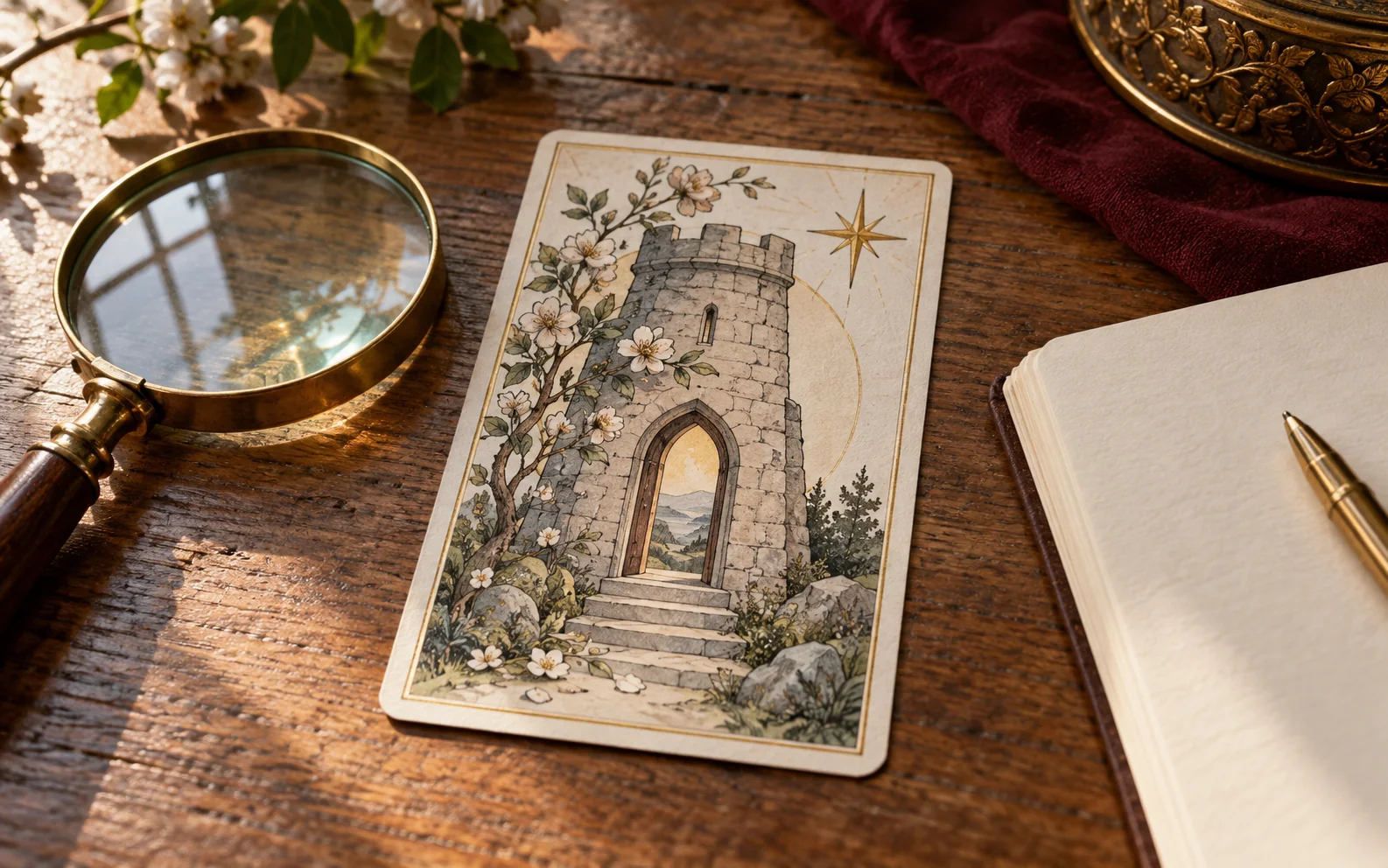
You don't understand a card and you open several guidebooks, two videos, and a forum. One talks about travel, another about fear, and a third about reconciliation. After half an hour you have more phrases than at the start and none of them answers your question. The problem isn't that different traditions exist. It's having looked for definitions before settling what the card needs to explain in that reading. To get unstuck, follow a short order: question, position, image from your edition, primary source, and a hypothesis you can express in your own words.
Consulting a book is good practice. Consulting ten at once usually mixes decks, contexts, and levels of certainty. This method doesn't promise that you'll always find "the correct meaning"; it helps you distinguish when you have enough to offer a prudent answer and when you should leave a doubt open. If you still don't separate observation and interpretation, first practice describing the card in three layers.
Step 1: Return to the Written Question
Read the sentence you set before shuffling. "What should I prepare for a meeting?" and "what do I value in this relationship?" don't require the same answer. A general meaning may be relevant to one and noise to the other. If the question was too broad, don't rewrite it to fit the card; note that you need to formulate a more precise query another time.
Define the matter in one line: a concrete decision, conversation, practice, or concern. Also note what external information you already know. The card can't tell you the contents of a contract, a professional's diagnosis, or another person's private intention. If the meaning you found online asserts one of those things, you have a reason to discard it even if it sounds convincing.
This return to the question narrows the field a lot. If you're preparing for a meeting, words like "listen," "clarify," or "bring data" can become verifiable actions. "Destiny" or "universe's energy" may not add anything to that query. There's no need to ban them in every tradition; it's enough to ask whether they help answer the situation in front of you.
Step 2: Let the Position Do Its Work
Look at what role you assigned to the card: resource, difficulty, pending information, or next step. The position is an instruction you chose before the outcome. If an image of pause comes up in resource, it might remind you that you have time to review. In obstacle, it might point to a delay you don't want to acknowledge. The image can be the same; the work you asked of it changes.
Don't turn every position into a moral label. "Obstacle" doesn't mean the card is bad, nor does "resource" guarantee success. An intense card can serve as a resource for seeing a tension clearly. If you're unsure, write two sentences: "In this position it could speak of..." and "It does not allow concluding..." The second prevents a borrowed meaning from becoming a blunt assertion.
If you're using a one-card spread, the position still exists. It can be "aspect to observe" or "question I need to ask," defined before drawing. The one-card spread shows how to keep that focus without reducing the answer to a single word.
Step 3: Observe Your Edition, Not a Remembered Drawing
Name the deck and look at two or three real details. Is it a Major Arcana card with a central figure? A Marseille numbered card with symbols arranged geometrically? A narrative scene in a Rider-Waite-Smith minor? Describe what you see without immediately attributing emotions or facts to it. If the word you're looking for depends on an object that doesn't appear, it may come from another edition.
This doesn't prevent learning from comparisons. You can note: "There is no scene in my card; a Rider-Waite-Smith guidebook explains it with a different scene." What's not advisable is erasing that difference and presenting the foreign scene as if it were printed on your card. How to recognize Marseille and Rider-Waite-Smith gives you a starting point for checking the system.
If a detail impresses you a lot, ask yourself why. Perhaps a figure's gesture reminds you of a recent argument. It's a possible personal association, but don't make it the only reading. Record the visible detail, your association, and an alternative. That small step is enough not to confuse reaction with evidence.
Step 4: Consult a Primary Source and Close It
Choose the guidebook for the edition you're using or a reliable guide to the same system. Read its explanation once and note one idea that clarifies the card in this position. Write the page if you have it. Don't copy an entire list. If the text contradicts a detail you see, there may be an edition or translation problem; record the discrepancy instead of forcing a concordance.
Then close the book and formulate a sentence of your own. If you can't, you probably haven't decided what part of the source is relevant. Return to the question and choose a single connection. You can consult a second source when you have a specific doubt, for example a difference in numbering or iconography; not to gather more adjectives without order.
It's also legitimate to say "my guidebook doesn't resolve this position." A source doesn't have to answer every query. You can describe the image, offer a modest hypothesis, and make the limit clear. In a reading for another person, that's more transparent than reciting five contradictory definitions in a tone of certainty.
Fictitious Example: A Card That Doesn't Seem to Fit
Let's imagine a person preparing a collaboration project and asking: "What should I clarify before accepting?" They set three positions: what I offer, what I need to ask, and a limit to take care of. In what I need to ask, The Hermit appears. The person had expected a conversation card; the solitary image confuses them. Let's suppose a Rider-Waite-Smith edition with a figure holding a light.
The first internet search offers them "solitude," "wisdom," and "inner journey." None of them yet answers the collaboration. They return to the order. Question: what should they clarify. Position: what to ask. Image: a figure lighting a nearby stretch, not the whole path. In their edition's guidebook, choose an idea about examining before advancing. Provisional hypothesis: "Before accepting, I need to ask for details about what tasks I'll do autonomously and when there will be joint review." It doesn't assert that the other party wants to isolate them.
An alternative would be: "I need time alone to read the agreement before answering." Both respond to the position. The difference can be resolved with external data: ask for the work plan and set aside time to study it. If the person still doesn't know what the project includes, no card can fill that gap. The useful result is a concrete question, not a supposed revelation about third parties.
An Exit Rule So You Don't Lose an Hour
Set a five-minute limit for the first interpretation. Write a sentence containing card, position, and question; then an action or fact to check. If after five minutes you're still accumulating meanings, stop. You can come back another day, ask someone how they see the image, or mark "I don't know." Drawing clarifying cards without a precise doubt may only add more ambiguous material.
Keep the record with the date. Later you'll see whether your first hypothesis had enough support or whether new information changed it. Don't rewrite the old note to make it look accurate. Learning happens when you recognize what you didn't know, not when you adjust the story after the fact.
A difficult card stops being an exam when you know what to ask before opening another book. First the context, then the position, then the image, and finally a source that truly corresponds to your edition. If two plausible readings remain, check the hypothesis and its alternative. Giving a provisional answer is a reading skill, not a deficiency.