Sabio Tarot · Minor Arcana
Four of Pentacles: Protect Resources or Close Yourself Off
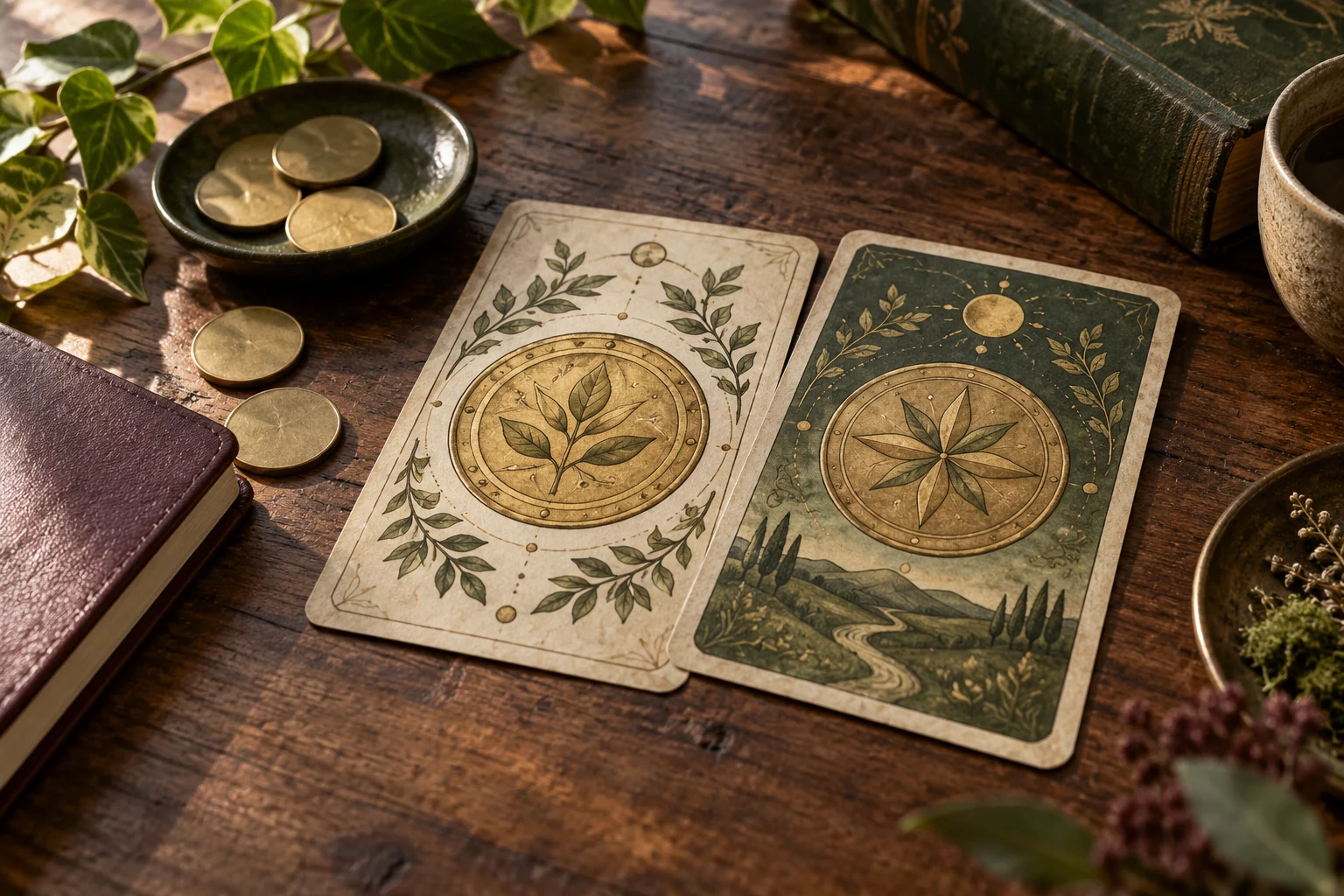
A person avoids spending money on a course. The Four of Pentacles comes up. Someone might call her “greedy” and conclude that she must pay. But perhaps she has high rent and a small emergency fund. Perhaps, instead, she has room to spare and rejects any expense out of fear of making a mistake. The card does not decide which of these situations is true. It offers two hypotheses — prudence and rigidity — that must be compared with facts and with the actual purpose of the resource.
- 11
- 22
- 33
- 44
Four Coins, One Stance, No Biography
Waite describes in the Rider-Waite-Smith a crowned figure who holds one coin, carries another on his head, and rests his feet on two more. His primary description allows one to observe a bodily relationship with four pentacles. It does not allow one to know the figure's wealth, family history, or moral intention. Reading “miser” as the querent's identity would be an unjustified attribution.
In a Marseille Four of Pentacles, the four coins appear in ornamental composition, not necessarily held by a person. The Metropolitan Museum documents coins and numerals in the historical suits; the V&A places Pamela Colman Smith's scenes in the Rider-Waite-Smith deck. The comparison reminds us that the same nominal card can offer very different images. In Marseille, the question of whether to keep or circulate resources arises from the interpretive method and the case, not from a body embracing coins.
When Keeping Is a Sensible Decision
Keeping can protect basic needs, make it possible to face an upcoming expense, or avoid a poorly documented offer. In that case, the four could represent a useful limit: “I will not yet commit this money.” One has to look at figures and obligations. A reserve is not a spiritual failing; it can be a condition of safety. There are also non-monetary resources: rest time, attention, work materials, or a room that someone needs for their activity.
Prudence can usually explain what it protects and when it will review its decision. “I will not sign up for the course until I pay for the bicycle repair” has a criterion and a horizon. “I will never spend anything on learning” may deserve a different conversation, but it should not be labeled without knowing the circumstances. The reader is not authorized to pressure spending or to turn a card into financial advice.
When Keeping Can Turn into Rigidity
A resource reserved for a purpose can lose usefulness if it is never used. An instrument kept so that it does not wear out does not help make music. A training budget that is not used for fear of any decision can hinder the goal it was meant to support. The question is not “Why don't you let go?” but “What condition would have to be met to use it safely?” Sometimes a short trial, a second opinion, or a maximum amount is enough.
Rigidity can also affect control of a project. A person may keep all the information and not delegate because they fear others' mistakes. Perhaps they have reasons: previous experiences, lack of time to explain, or legal responsibilities. Before recommending “trust more,” identify what part can be shared, with what instructions, and what risk is acceptable. The card does not diagnose a permanent personality trait.
Position and Context in the Spread
In “resource,” the four can represent a base that should be protected. In “obstacle,” it raises the question of whether keeping prevents something from being used for its purpose. In “action,” it may ask you to set a spending limit or a small trial; it does not mean paying immediately. In “outcome,” it does not guarantee wealth or announce loss from “holding on.” What changes is the question you ask the person and the facts.
With the Ace of Pentacles, compare a new opportunity with an existing reserve. With the Two of Pentacles, look at whether the budget or schedule can support another load. With the Five of Pentacles, be especially careful: there may be real need and not a psychological attitude that can be fixed by “letting go.” Combinations do not replace a financial inventory or the voice of the person living the situation.
Fictitious Example: Investing in a Tool
Invented case to show two hypotheses. Carmen repairs bicycles and is considering buying a diagnostic tool. Question: “What do I need to check to decide whether to spend the workshop's savings?” We agree on positions: 1) protected resource, 2) potential value, and 3) purchase criterion. The Four of Pentacles, Three of Pentacles, and Justice come up. The four in the first position names the money reserved for urgent repairs; it does not say that Carmen is stingy.
The Three of Pentacles in the second position suggests checking whether the tool improves the quality of work and whether someone on the team knows how to use it. Justice in the third position leads to reviewing price, warranty, training, and return conditions. Carmen calculates that buying it today would consume almost her entire reserve. She asks for a demonstration and inquires about renting one for a week. If the month's jobs justify the purchase, she can set aside a specific saving; if not, she keeps the reserve. The card allows both decisions because the facts, not the symbol, determine which better protects the workshop.
Let's imagine that Carmen had a large reserve and rejected even a cheap rental despite losing jobs she wants to take on. The rigidity hypothesis would gain strength, but one would have to ask her why. Perhaps an experience with a failed warranty explains her caution and suggests investigating suppliers, not attacking her character. Tarot helps build a conversation with evidence, not a moral label.
A Test Before the Yes or No
Write down: available resource, need it covers, cost of using it, cost of not using it, and condition for reviewing the decision. If the option is reversible, design a limited test. If it puts housing, debt, or significant savings at stake, consult relevant documentation and professional advice. In relationships, “saving energy” can also be a legitimate boundary; do not force a person to offer more intimacy because a card seems closed.
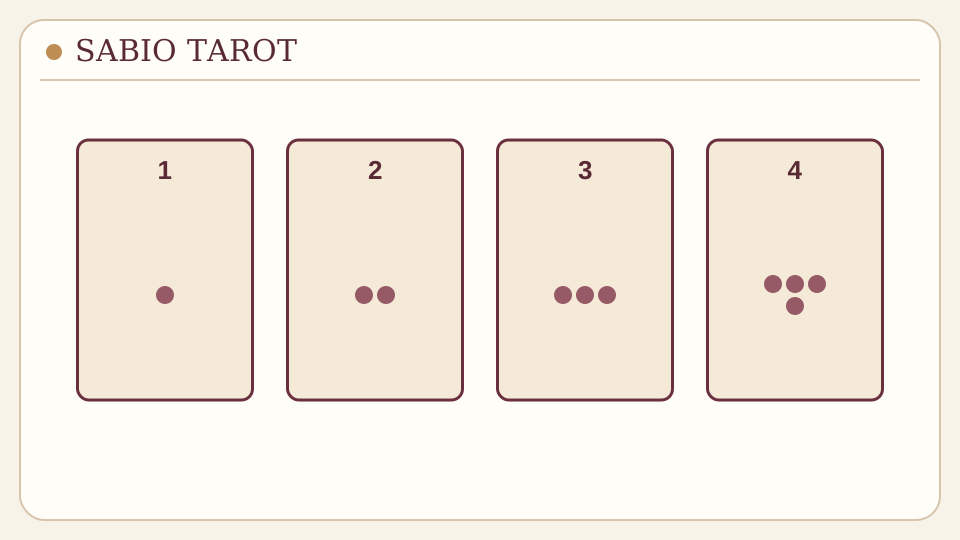
The diagram of the four studies quantity and suit before debating prudence or rigidity. Expand with Pentacles and Resources, the numbers two, three, and four, and Rider-Waite Tarot from Scratch. The final question of the Four of Pentacles is: “What does this boundary protect, and under what circumstances would it stop serving?”