Sabio Tarot · Minor Arcana
Two of Pentacles: Balance Between Two Demands
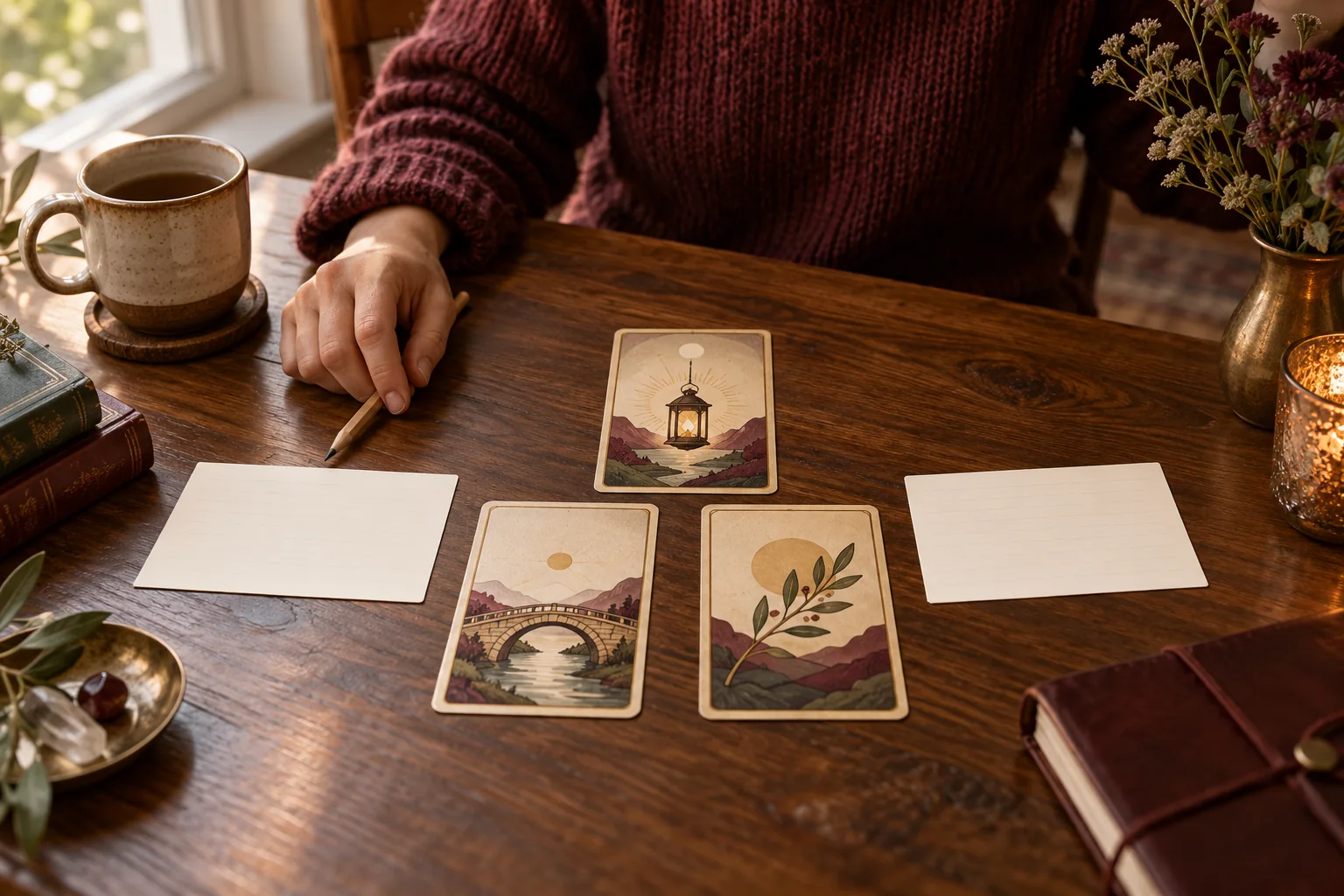
Accepting an extra assignment seems possible on paper, but there is already another project, commuting, and caregiving tasks. The Two of Pentacles comes up in a reading about the decision. Saying “you are flexible, you can handle everything” would be a bad reading: flexibility does not create new hours. The card helps compare two demands, their deadlines, and the energy needed to sustain them. Sometimes balance means alternating; other times, it means giving up, delegating, or changing conditions.
- 11
- 22
- 33
- 44
The Figure Who Moves and the Sea Behind
Waite describes in Rider-Waite-Smith a young man juggling two pentacles (called “oros” in many Spanish-language decks) joined by a figure-eight ribbon, with boats in the background. The primary description shows movement and coordination, not a guarantee of permanent control. The image invites us to ask whether the juggling is brief and chosen or whether it has become a continuous demand. The fact that the figure does not drop the coins in one instant does not prove that they can hold them for months.
In a Marseille Two of Pentacles there are two suit emblems in a design that varies by edition. A person juggling does not necessarily appear. The Metropolitan Museum documents the traditional numerals and the V&A contextualizes the scenes created by Pamela Colman Smith for the Rider-Waite-Smith minors. The idea of “balance” is a reading suggested by the two and, in Rider, by the scene; it is not a diagnosis of the querent’s schedule.
Two Demands That May Not Weigh the Same
Before interpreting, name the two obligations. One may be paid and have a contract; the other may be an unpaid family responsibility. Comparing them only by money hides an important cost. Write down hours, travel, preparation, margin for unexpected events, and the possibility of asking for help. If one demand is urgent and the other flexible, the solution may be to reschedule. If both cannot be postponed, you must evaluate what external support exists. The card does not turn overload into a virtue.
Healthy flexibility has negotiable limits: a week with two deliveries may require temporary changes and then rest. Overload shows when the margin disappears, when work is sustained with insufficient sleep, or when the person cannot say no. It is not the reader’s place to diagnose exhaustion from a card; they can ask how the pace manifests and whether professional attention or a real adjustment of commitments is needed.
Another clue is the ability to absorb a small unexpected event. If a medical appointment or a delayed transport makes the whole week collapse, the schedule is not balanced even if both tasks appear neatly ordered. A viable schedule needs margin for ordinary life. Ask whether that margin exists before praising the skill of “juggling.”
Interpretation According to Position
In “resource,” the two can acknowledge an ability to alternate priorities, provided the person gives examples. In “obstacle,” it points out that the shift system or the number of tasks may not be sustainable. In “action,” it can invite reviewing the calendar and agreeing on a specific change. In “outcome,” it does not promise that all obligations will be satisfied. Position modifies the interpretive task; the real numbers determine viability.
Alongside the Ace of Pentacles, a material opportunity must pass through the filter of capacity. With the Four of Swords, rest stops being “what is left over” and enters the time budget. With the Three of Pentacles, there may be a distribution of tasks that reduces load. No combination justifies asking one person alone to sustain two incompatible commitments.
Fictitious Example: Two Clients and One Week
Invented case. Samuel designs posters. He has a delivery agreed for Friday and receives an invitation for another poster with the same deadline. He asks: “Can I accept without breaching the first agreement?” He lays out cards for 1) current capacity, 2) a condition he must clarify, and 3) a reversible decision. The Two of Pentacles, Justice, and the Page of Pentacles come up. The two relates to the need to coordinate two jobs; it does not mean the universe will grant him extra time.
Samuel calculates remaining hours and discovers that the first assignment needs twelve, the second at least eight, and he has fourteen this week and ten the next without sacrificing rest. Justice reminds him of the contract and the first client’s deadline. The Page of Pentacles inspires a concrete proposal to the second: accept a preliminary version this week (two hours, which fit within the free margin) and the final one the next (the remaining six hours, within the ten available), with price and scope in writing. If the second client demands everything by Friday, Samuel declines. That refusal protects his work and his health; he does not “fail” at reading the Two of Pentacles.
The synthesis might be: “You can explore a negotiation, but do not assert capacity until you count hours and confirm conditions.” If the client accepts the staggered delivery, Samuel will set a maximum number of revisions. If not, he will preserve the relationship respectfully and can propose another future date. The card helped visualize the movement between two demands; the time budget showed where the limit is.
A Scheduling Exercise That Avoids Magic
Draw two columns of tasks and a third for unavailable time: sleep, commuting, care, and breaks. Add realistic hours, not ideal ones. Then distinguish negotiable and non-negotiable tasks. Formulate a single request for adjustment that you can communicate today. If no combination fits, accept that the answer may be “no” or “not yet.” True balance includes the possibility of releasing a load.
In relationships, two affections or responsibilities are not resolved by treating people as interchangeable coins. Talk about needs and agreements. In money, check income, expenses, and contracts with data; tarot does not guarantee solvency. The diagram of the two shows the numerical value, not personal experience. Continue with Pentacles and resources, the numbers two, three, and four and Tarot Rider-Waite from Scratch. The final question is: “What must I change so that this pace is possible without hiding its cost?”