Sabio Tarot · Minor Arcana
Ace of Pentacles: concrete resource and limited opportunity
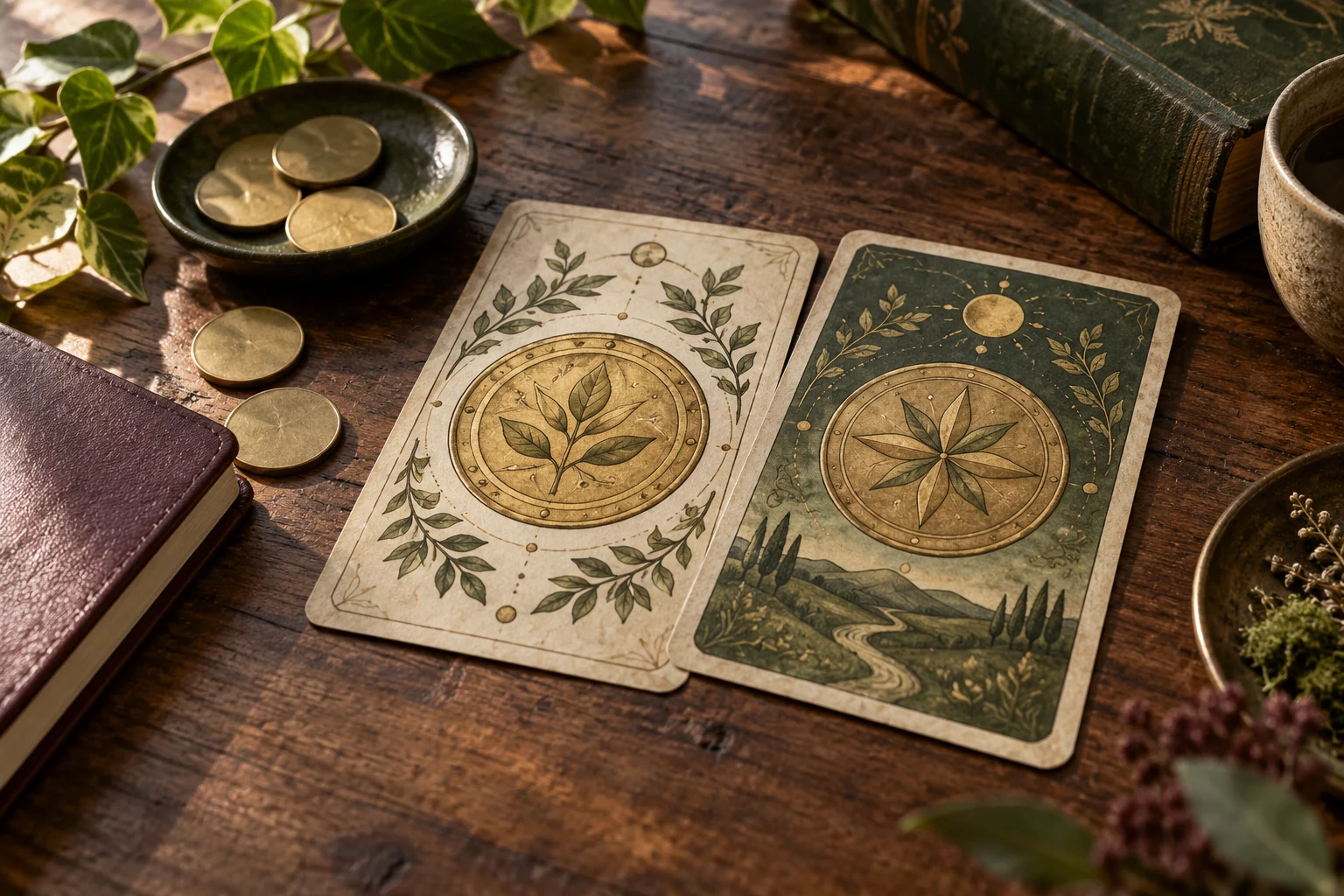
A workshop offers a craftswoman use of its space two afternoons a month. In a spread about how to evaluate the proposal, the Ace of Pentacles appears. It is not a winning lottery ticket or a guaranteed future income. It can point to an identifiable material resource: table, tools, time of use, and access conditions. The reading improves if you ask how much it costs to take advantage of it, what can be done there, and what remains to be agreed. An ace opens a possibility; it does not include the later stages of production and sale.
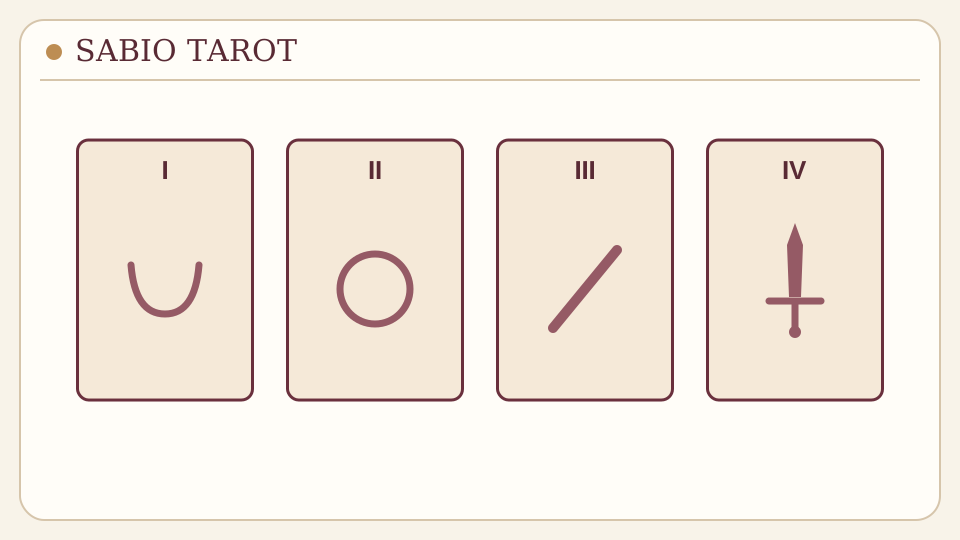
- 1Cups
- 2Coins
- 3Wands
- 4Swords
From the image to what can be verified
In Rider-Waite-Smith, Waite describes a hand presenting a pentacle. The primary description allows us to speak of the emblem offered in that edition. The object does not have an amount or a contract written on it. Interpreting it as a financial opportunity may be appropriate in an economic question, but it does not authorize announcing profits.
In an Ace of Pentacles from Marseille, the central emblem is usually an ornamental coin; one should not add the hand from the cloud or the garden of Rider-Waite-Smith if they do not appear. The Metropolitan Museum documents coins among the historical suits, while the V&A contextualizes the creation of minor scenes by Pamela Colman Smith. The name “oros” or “pentacles” changes depending on the deck and translation; it is best to use the one from the edition being studied.
Resource, cost, and access
A resource can be money, but also space, a tool, permission, a contact, or time. To evaluate an opportunity, write down what is being offered exactly, who has the right to use it, and for how long. Add direct and indirect costs: transport, maintenance, training, or giving up another task. If you cannot answer those questions, the card can serve to draw up a checklist, not to decide that “the universe is giving you abundance.”
The word “limited” matters. An offer may expire on Friday, have only two places, or depend on a condition. It can also be limited by the person’s capacity to sustain it. The ace does not oblige you to accept for fear of losing “the chance.” In money decisions, review documents and seek competent advice when necessary. Tarot can organize questions, but it does not replace a budget or a legal assessment.
If someone offers a borrowed tool, also clarify who is responsible for damage and when it must be returned. These are unglamorous questions, but they turn an “opportunity” into a use relationship understandable to both parties.
The card’s place in a spread
In “available resource,” the Ace of Pentacles invites you to identify something already accessible. In “first step,” it may suggest asking for terms in writing or carrying out a small test. In “obstacle,” it may indicate that an offer seems tangible but its true cost is unknown; that hypothesis needs corroboration. In “outcome,” it still does not guarantee performance: it could represent that a material option appears, whose use will depend on other decisions.
Next to the Two of Pentacles, the reading can look at how to integrate the resource into an already busy schedule. With Three of Pentacles, roles and work quality appear. With Ace of Wands, distinguish enthusiasm for starting from concrete means to do so. No combination turns the deck into an income calculator or announces a payback period. Before testing a resource, set a date and a signal to review whether it remains useful.
Fictional example: using a shared table
Invented case to explain the method. Inés makes notebooks and works at a small table at home. A cooperative workshop offers a station two afternoons per week. Inés asks: “What should I verify before trying the space?” She defines three positions: 1) resource, 2) possible hidden cost, and 3) reversible test. Ace of Pentacles, Two of Pentacles, and Page of Pentacles come up. The ace names the table and the tools the workshop says it offers; it does not forecast sales.
The Two of Pentacles in the second position invites her to calculate travel and compatibility with current orders. The Page of Pentacles in the third leads her to request a visit and a four-session trial over two weeks, with clear conditions. Inés discovers that using a machine requires additional training. She includes that cost in her budget and accepts the trial. At the end, she will review how many notebooks she was able to produce, quality of work, and tiredness. If the trial does not pay off, she can leave it without turning the result into a “failure of the card.”
The synthesis of the reading would be: “There is a real resource that deserves inspection; calculate the full cost and test it before committing.” The phrase “the Ace of Pentacles guarantees that you will sell more” would have mixed access to the workshop with market demand. They are different variables. Even if Inés produces twice as much, selling may require adequate photography, distribution, and price. The card does not eliminate that work.
Inventory sheet before accepting
Write down four data points: resource offered, condition of use, total cost, and sign that it works. A sign can be time saved, better quality, or a verifiable number of orders, depending on the person’s goal. Also set the point at which you will review the decision. If the offer includes debt, investments, or rights over work, read the conditions with appropriate professional help. Do not use an optimistic interpretation to skip a clause you do not understand.
In emotional questions, the Ace of Pentacles can represent a material gesture of care, such as offering time or space; it does not prove love or future intention. In health, it can suggest available support resources, but it does not diagnose or cure. Returning to the question prevents “gold” from being reduced to money and “ace” from becoming sure victory.
The diagram of the four suits compares suits and helps distinguish opportunity from resource. To go deeper, consult Pentacles and resources, the four aces compared and Tarot de Marseille from Scratch. The practical question the Ace of Pentacles leaves is: “What resource exists, under what conditions, and how will I know if it serves me?”.