Sabio Tarot · Decks and systems
Mountains and Heights in a Card: Visual Distance, Obstacle, or Goal
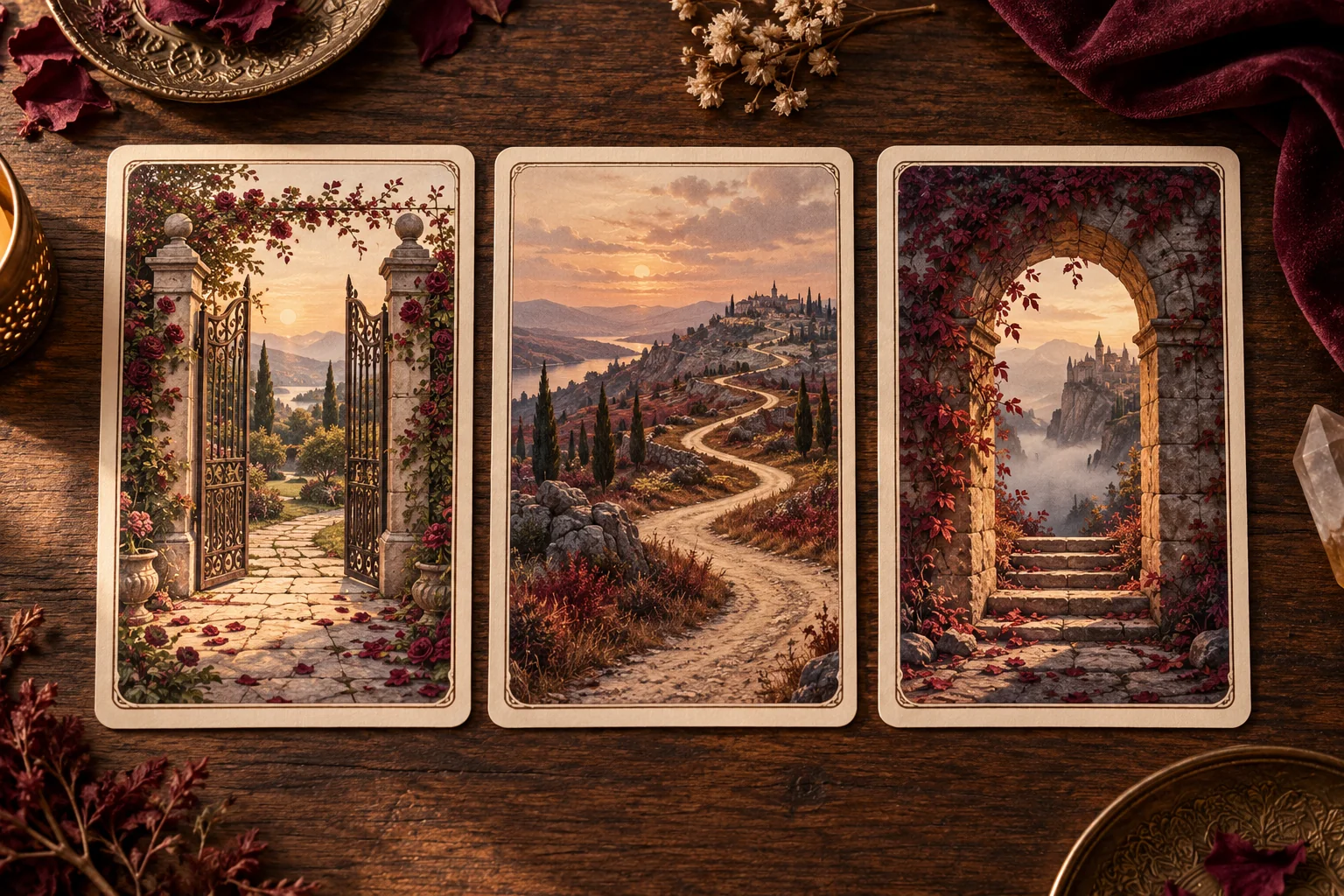
A drawn mountain may look like an obstacle, but perhaps it only occupies the horizon. It can also represent a height from which we see a scene or a destination to which a path leads. The difference depends on position, scale, and relationship to figures or routes. This article proposes a method for describing those features before interpreting. There is no rule by which every summit means overcoming nor every valley announces difficulty.
Where the height is in the composition
Locate the horizon line and ask whether the mountain appears behind a character, cuts across a path, or fills the foreground. If it is very far away, perhaps it serves to give depth. If a figure is on a slope, height influences their position. If the path ends in front of a rocky wall, you could explore the idea of a barrier, but check whether the drawing actually shows that blockage. A path that continues toward a mountain is not the same as a path closed by it.
In the illustration on this page, the central card presents a winding route that heads toward a structure on elevated terrain, with mountains in the distance. The card on the right shows an arch and stairs from which a landscape with relief is seen. They are imagined educational illustrations. They can be described to learn composition, but they do not serve as proof of how Pamela Colman Smith drew a specific historical card. The V&A documents the diversity of decks and editions; the comparison here is a visual practice of the site.
Three hypotheses for the same mountain
Imagine that the central card appears in a question about studies. First hypothesis: the distance reminds you that the goal takes time. Second: the curved path suggests that there is no straight route. Third: the tall structure marks a visible place toward which you could orient your next steps. None is mandatory. To choose, ask what part of the reader's plan is really at stake. If they already know how long the program lasts, talking about duration does not add much; perhaps they need to decide a first stage. If they lack access requirements, the structure can lead to checking those requirements, without pretending that the drawing contains them.
Also write a counterexample. If the project is almost finished, the distant mountain does not prove that much remains. An image can remind you of a horizon, but the real calendar can say otherwise. If the question is about an immediate conversation, perhaps the shape of the terrain is irrelevant. The fact that a symbol is drawn does not oblige you to make it the main topic of every reading.
Fictitious example: preparing a creative excursion
Invented scene, no real consultation. Paula organizes a drawing outing to a viewpoint and asks, “What should I check before proposing the plan to the group?” In an illustrative card she sees a route that goes up toward a high area. She could interpret “the group will reach the summit,” but that promise is not justified. A responsible reading asks about the actual elevation gain and accessibility. Paula checks the official map, the weather forecast, and the needs of those who will attend. She discovers that one person cannot manage steps, so she looks for an accessible observation point.
The mountain in the card helped recall a dimension of the plan; the decisive information came from data and from the person involved. If the group had been preparing a mural of mountains without traveling, the same image would have had a different relevance. The reading must not become hiking safety advice based on cards. Terrain conditions, weather, and participants' capacity are verified with sources and with them.
A high perspective is not equivalent to authority
A figure drawn high up may look at a scene from another perspective. Do not conclude that they “are right” or that they are above someone in a moral sense. Height can be a compositional resource that allows showing landscape, a place of isolation, or simply the location of the scene. If a question deals with conflict, one possible reading is “I need to see more context”; another could be “I have moved too far away.” To choose, ask for facts. The image does not measure a real person's empathy or knowledge.
If there are two figures at different heights, note whether they appear connected by a staircase or path. A visible difference in level does not establish a social hierarchy without source or context. In a contemporary illustration, an artist may use perspective for aesthetic reasons. Attributing a “spiritual ascent” reading to an ancient tradition would require a specific source for that tradition and an identified edition. Avoid presenting a personal interpretation as tarot history.
Honest comparison between Marseille and Rider-Waite-Smith
In a Major Arcana card of any system there may be landscape, depending on the edition. In the Minor Arcana numerals of Marseille, suit symbols and ornamentation are usually seen, while Rider-Waite-Smith popularized complete scenes in those numerals. That general difference is described by the V&A; even so, check your copy before saying that a specific mountain exists or does not. Do not import into Marseille a remembered relief from a Rider-Waite-Smith card.
If you compare two decks, use images whose provenance you know and note manufacturer, card, and date. A cropped photograph can hide a path or alter color and scale. Divide the observation into background, visible barrier, and viewpoint; point out only mountains, routes, or arches that actually appear. A compositional similarity does not prove that one artist copied another.
Review checklist
Answer in writing: Where is the height? Is there a figure or route that interacts with it? What part of the question makes that detail relevant? What alternative would be reasonable? What real data would you need? If you cannot answer the second, do not call the mountain an “obstacle” just out of habit. The guide on position and meaning helps adjust the hypothesis to the card's task within the spread.
The final synthesis might say, “The distant relief reminds me that I should check the stretch between the current point and the goal”; not “The mountain ensures that there will be a great test.” A good visual reading recognizes distance, scale, and the conditions of the consultation before writing a metaphor.