Decks and systems
Compare Marseille, Rider-Waite-Smith and other decks before choosing how to study.
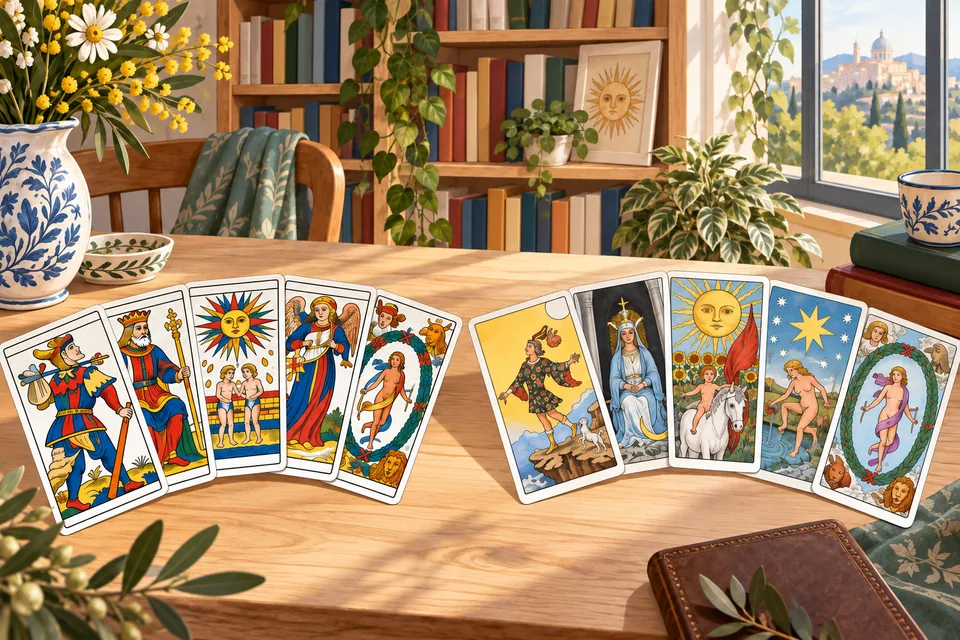
Tarot de Marseille vs Rider-Waite-Smith: Four Cards Compared
Compare the Fool, Lovers, Justice and Five of Cups across two deck traditions and adapt your reading without mixing their imagery.
Read articleIs Your Deck Marseille or Rider-Waite-Smith? Four Cards to Check
Check an unillustrated Minor Arcana card, Justice, Strength and the Fool to identify your tarot deck's visual tradition.
Read articleWhy Marseille Minor Arcana Cards Do Not Show Scenes
Read suit, number, composition and neighbouring cards in Marseille pip cards without importing Rider-Waite-Smith scenes.
Read articleHow to Read Scenes in Rider-Waite-Smith Minor Arcana
Observe figures, gestures, objects and relationships in illustrated Rider-Waite-Smith pip cards without treating the image as a prediction.
Read articleJustice and Strength: Why Their Tarot Numbers Change
See why Justice and Strength have different numbers in Marseille and Rider-Waite-Smith decks, and check your edition before reading.
Read articleTarot Cards vs Oracle Cards: How to Tell the Difference
Compare deck structure, suits, trumps, card counts and guidebooks to choose between a tarot deck and an oracle deck.
Read articleDo All 78-Card Tarot Decks Read the Same Way?
A shared card count does not guarantee shared artwork, names or reading methods. Check what changes between editions and whether a manual fits.
Read articleHow to Choose a Tarot de Marseille Edition
Compare source pattern, reproduction quality, legibility, colour and guidebook before buying a Tarot de Marseille edition.
Read articleWill an Older Tarot Book Work with Your Modern Deck?
Check four cards and five correspondences to see whether a classic tarot manual truly describes your modern deck.
Read articleStart Tarot with 22 Major Arcana or the Full 78 Cards?
Practising with 22 cards can simplify the start but leaves out suits, numbers and court cards. Learn when each approach helps and how to progress.
Read articleHands and gestures in tarot: observe before assigning meaning
Learn to describe hands, objects, and directions in a card without confusing visual observation, deck convention, and the interpretation of a reading.
Read articleGazes and Direction of Figures in Tarot
Learn to observe where a figure is looking and what is left outside the card without attributing thoughts or promises about another person to it.
Read articleObjects on a table in tarot: inventory before symbol
Observe which objects appear, how they are distributed, and what can be inferred from them without imposing a table with the same meaning on every deck.
Read articleDoors, Paths, and Thresholds in the Cards: What Is Seen and What We Imagine
An exercise with original images to distinguish a drawn route from the promise of a new beginning and to formulate useful questions.
Read articleLandscape and Background in a Tarot Card: How Much Weight They Carry in a Reading
An attention exercise to distinguish foreground and landscape, check whether the background changes a hypothesis, and avoid universal meanings.
Read articleAnimals in the Tarot: Drawing, Context, and Conjecture
Compares three animals visible in specific cards without turning them into a universal dictionary of character or destiny.
Read articleWater in different tarot cards: why it does not always mean emotion
Compare water as action, boundary, and landscape in specific images and learn to justify the reading according to the question.
Read articleMountains and Heights in a Card: Visual Distance, Obstacle, or Goal
Learn to distinguish a background mountain from a barrier crossed by a character before turning height into meaning.
Read articleCrowns and headdresses in tarot: what is seen and what is inferred
Compares the attire of specific figures without inferring real authority, the reader's hierarchy, or an undocumented historical origin.
Read articleSun, Moon, and Stars in the Tarot: Three Images, Several Functions
Compares celestial bodies in specific cards and in an original illustration, distinguishing visual position, printed title, and contextual reading.
Read articleTarot Colors: Edition, Printing, and Interpretation Without Universal Keys
Compares color variants in an original illustration and distinguishes the visible color of a historical object, the printing technique, and the proposed reading.
Read articlePrinted Numbers and Interpreted Numbers in Tarot
Distinguishes between a card's numeral, the number of symbols, and numerological association, with a concrete comparison of Marseille and Rider-Waite-Smith.
Read articleLetters and Words Printed on Tarot Cards: Read Before Translating
Distinguish title, numeral, initial, and workshop mark in a specific edition without fabricating etymologies or attributing hidden meanings to each letter.
Read articleSymmetry and Asymmetry in a Marseille Numeral: Observing Before Interpreting
A method for reading the composition of a numbered Marseille minor arcana card without inventing characters or a narrative scene for it.
Read articleThe Direction of a Horse in Court Cards: Pose, Frame, and Question
Learn to describe where a drawn horse appears to move without turning its orientation into an automatic prediction.
Read articleHands, feet, and posture in tarot: observing the drawn body without diagnosing people
A guide to observing the body in specific cards, with a fictitious example and boundaries so as not to turn an illustrated gesture into a personal label.
Read article