Sabio Tarot · Decks and systems
Water in different tarot cards: why it does not always mean emotion
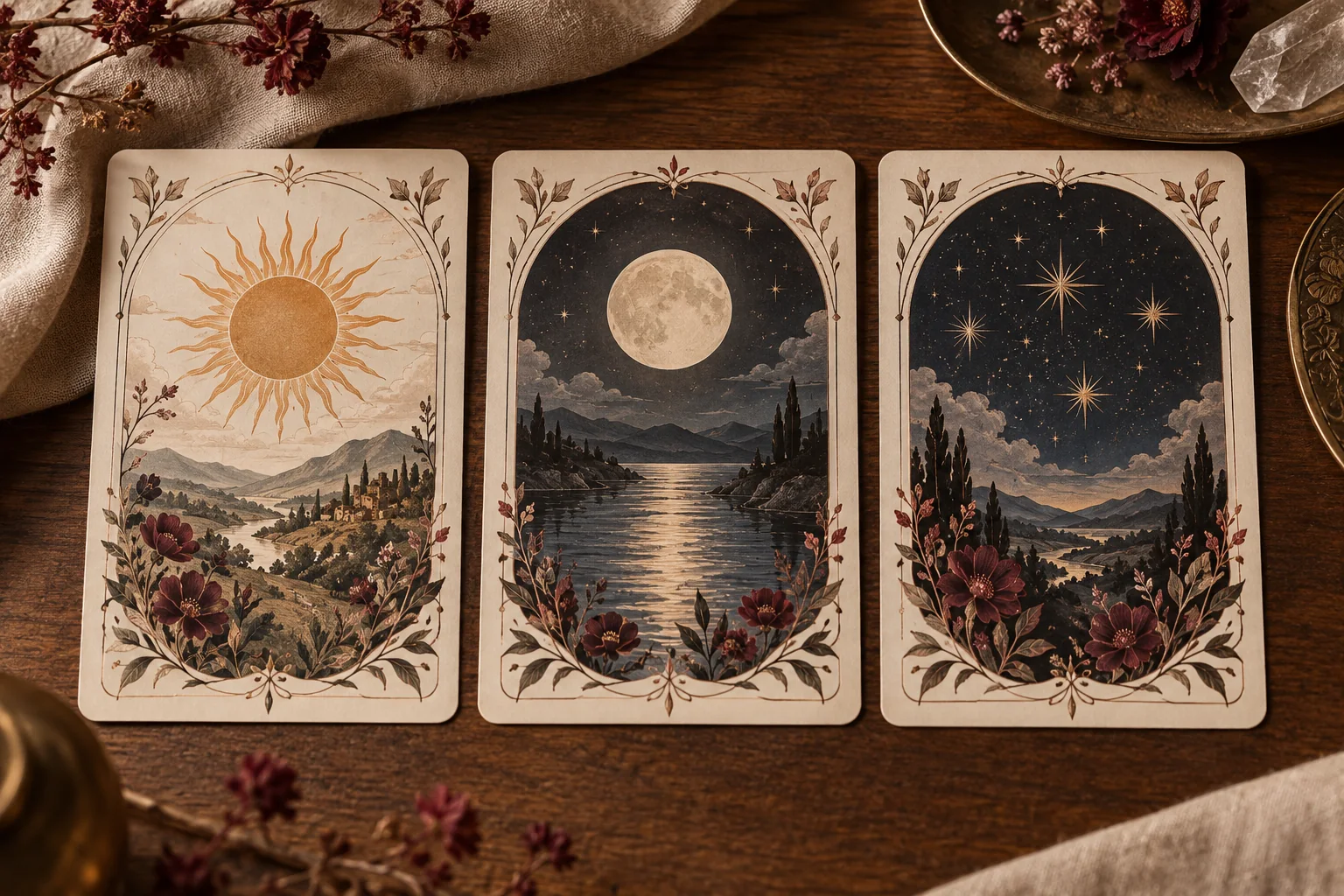
Water often receives an immediate translation: “feelings.” It is a possible association in some readings, but it turns a visual element into a universal key. In an image, water can be something a figure pours, a surface that separates planes, a distant landscape, or a space that occupies almost the entire card. These functions are not equivalent. To study them, we will distinguish three specific images and one fictitious question. We will not attribute the details of an original illustration created for this website to a historical deck.
First case: water as visible action
In the reproduction of The Star on the cover of Rider-Waite Tarot from Scratch, a figure appears beside a body of water and pours liquid. That action is depicted; we do not yet need to state why they do it. Describe the containers, the direction of the pouring, and the relationship among figure, land, and water. If you ask about a work routine, the image might invite you to think about distributing resources. If you ask about rest, it might suggest a pause. Both are contextual interpretations, not facts about the future.
Avoid jumping from “pours water” to “you will receive an emotional confession.” The action does not identify a real person or a news item. Even the exact direction of each stream requires observing the full card, not just a reduced reproduction. The goal of the exercise is to learn to cite the visual detail that supports your hypothesis and to recognize what the image cannot prove.
Second case: water as a boundary of the composition
In the reproduction of The Moon on the same cover, water occupies the foreground, while other figures and structures appear in more distant planes. In this case it can serve as spatial separation. It is not the same use as the pouring in The Star: the visual question changes from “what is the figure doing with the water?” to “what remains on each side of or behind this area?” If a reading is based on distance, describe the distance; do not replace it with the label “deep emotions” without explaining why it is relevant to the consultation.
The watery area may also contain a creature or reflections. If the reproduction does not allow you to distinguish them, note “unverifiable detail” and do not invent their shape. A deck that reinterprets The Moon may move, enlarge, or eliminate that element. A reading that depends on its presence is only valid for an edition where it is actually drawn.
Third case: original landscape, not a historical card
The illustration on this page contains three imagined cards. In the central one, a moon appears over an expanse of water that reflects light. Here water functions as landscape and reflective surface; no one pours it. Ask “what changes if I observe the reflection and not only the heavenly body?” Do not attribute this composition to the Marseille Moon or the Rider-Waite-Smith Moon: compare each one with its actual edition before pointing out details.
Compare the three scenes in a table: visual source, action or arrangement of the water, foreground and background, possible hypothesis, and necessary external information. If a row says only “water = emotions,” the table has not been useful. Look for a verb: pour, cross, reflect, surround, conceal. The verb connects image and question better.
Fictitious example: presenting a creative work
Invented consultation, not a real case. Samuel asks “How should I review a proposal before showing it?” In the position “what part needs attention,” he draws The Star from a Rider-Waite-Smith edition. He observes the pouring gesture and proposes as a hypothesis that he has distributed time between two components, text and image, without checking whether both communicate the same thing. He checks the draft: the text is long and the images lack captions. He decides to write three captions and shorten a repeated section.
The card did not literally say “captions are missing.” That piece of information appeared when looking at the file. If he had drawn The Moon, the foreground-and-background metaphor might invite him to review which central element of the proposal remains hidden; the verification would still be in the draft. If he had used the original illustration of the reflected moon, he might ask whether the project summary reflects the actual content. None of those images confirms the evaluation that the recipient will make.
The connection with the suit of Cups does not resolve all cases
In modern readings, Cups is often associated with emotions or relationships. That does not turn every drawn water into a Cup, nor does it require that a watery landscape be only about feelings. The V&A distinguishes the Italian suits and gathers current associations, but it also documents the historical diversity of decks. If an article attributes an equivalence to a specific tradition, it must say which one and with what source. Here we use a reading association as a hypothesis, not as a visual law or as proof of origin.
You can read a Cup without explicit water, or a card with water that does not belong to the suit of Cups. Therefore it is advisable to record suit, card, and edition separately. In Marseille, the Cups numerals show suit symbols without becoming scenes with rivers and lakes. Do not import a lake from a Rider-Waite-Smith card into a numeral that does not have one.
Exercise with two competing readings
Choose a card from your deck with visible water. Write a reading based on the role of water within the image: action, boundary, or landscape. Write another that uses the emotion association. Ask which one better answers the position and what external evidence you would need to prefer it. If both are plausible, preserve the uncertainty; do not draw another card just to force a key. The guide to card synthesis helps keep one image from eclipsing the whole spread.
To practice the contrast, write three verbs next to the image: pour, reflect, and separate. Point out which one corresponds to the water you actually see and which ones describe absent possibilities. That operation helps prevent replacing observation with a learned meaning. Then formulate a metaphor limited by the consultation question and an external piece of information you can verify.