Sabio Tarot · History and curiosities
Tarot and the Moon: Personal Practice and a Verifiable Claim
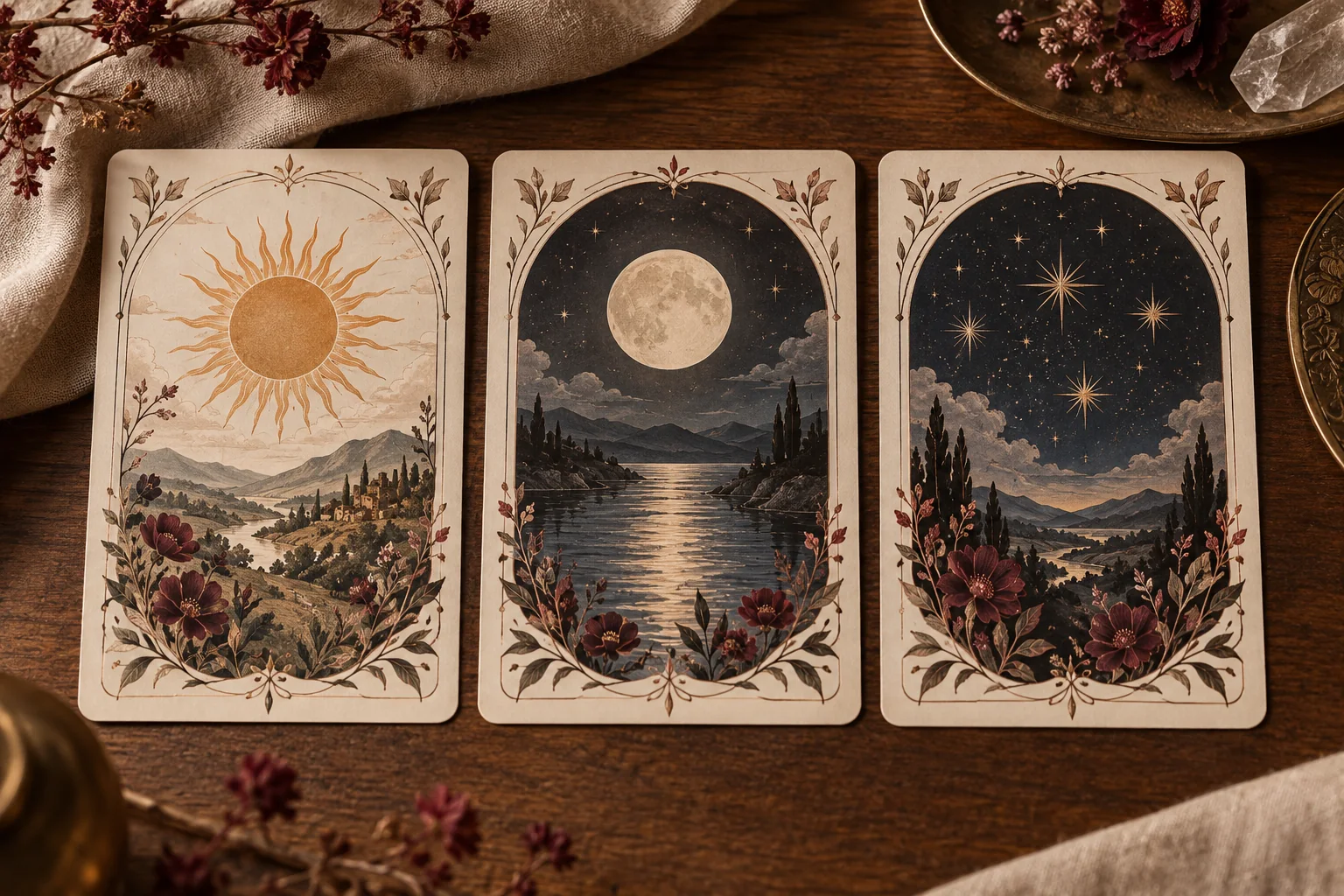
Some people choose to read tarot at the new moon to set intentions and at the full moon to review what has happened. It can be a meaningful routine. Another, much stronger claim would be that a lunar phase makes the cards respond with greater accuracy. To support it, you would need evidence about defined and measured outcomes, not just remembered experiences. This article separates astronomy of the phase, chosen ritual, and claim about efficacy so that the reader can enjoy a calendar without turning it into an obligation or a guarantee.
What a lunar phase is
NASA explains that the Moon orbits Earth and from here we see different portions of its hemisphere illuminated by the Sun; that change of perspective produces the phases. Its guide to phases describes the visual cycle. These are astronomical facts. They say nothing by themselves about the accuracy of a reading. “There is a waxing moon tonight” can be checked with an astronomical calendar. “Therefore my reading will be more accurate” is a different hypothesis that requires its own evidence.
The V&A shows the presence of images such as the Moon on cards and the historical evolution of decks and uses. The title of a lunar trump also does not demonstrate a physical relationship between celestial phase and reading outcome. They are different levels: object in the sky, printed image, and interpretive practice. A person can relate them symbolically without claiming causality. If a book from an edition proposes a lunar ritual, cite that book as the source of that practice, not as astronomical proof.
A calendar as a tool for attention
A recurring phase can serve as a reminder. For example, once a month you choose a question about your project, note a spread, and review progress four weeks later. The practical usefulness may come from having a review date, something you could also do on the first Sunday of each month. That does not make the ritual useless: it can make it pleasant and easy to remember. It simply does not prove that the new moon influences the cards. Presenting the routine as chosen allows another person to use a different calendar without feeling that their reading is worth less.
If a calendar is used, verify time zone and local date. An astronomical phase occurs at a moment, but the calendar date can vary by country. For a flexible ritual, minute precision is not necessary; if someone claims that an exact minute is essential, ask what source and what measurable effect support that requirement. Do not cancel an important conversation because “the phase is not suitable” if the facts require attention today. Safety, deadlines, and consent take priority over a symbolic preference.
Fictional example: reviewing a study habit
Invented case. Celia decides to do a spread at every new moon for three months to review how she learns tarot. In the first, she writes “what part of my method can I improve?” and notes that she looks up meanings before observing the image. She sets a test: for four weeks she will describe each card first. At the second lunar appointment she reviews ten journal entries and sees that she now distinguishes observation from interpretation better. At the third she asks whether she wants to continue or adjust the pace. She does not attribute the change to the Moon’s position; she records that she practiced differently.
Celia enjoys the ritual and keeps it. Her friend Dani prefers to review on Mondays. Both can learn. If Celia missed a new moon, the project would not be “ruined”; she can resume the routine whenever it suits her. The form of a personal ritual should support practice and not create anxiety about meeting an exact condition. If the calendar starts to dominate the decision, it is worth simplifying it.
How to distinguish an observation from a test
“I felt more clarity at the full moon” describes an experience. “Readings at the full moon are more accurate” is a comparative claim. To examine it, you would have to define what accurate means, record outcomes before knowing them, compare phases, and control factors such as type of question, selective memory, and changes in the reader. A favorable anecdote does not do that. Nor does a contrary anecdote invalidate the subjective value of the ritual. Keeping both scales separate avoids unnecessary arguments.
Be wary of headlines that promise “the only night your cards tell the truth.” A clearer proposition would be: “At the new moon, if it works for you as a monthly milestone, set a reviewable intention.” That way you know what you are choosing. You do not need to buy an urgent session for fear of missing a cosmic window. A voluntary practice is different from manufactured commercial pressure.
The Moon card and the Moon in the sky
The card titled The Moon may include a drawn celestial body, creatures, and landscape depending on the edition. Its iconography is studied as part of a specific deck. The actual lunar phase on the night of the consultation is independent astronomical data. You can put both into poetic dialogue: “The image reminds me of the ambiguity of this stage.” Do not say that the presence of The Moon in the spread proves that the celestial phase emits a message. Nor should you assume that all decks illustrate the Moon in the same way; identify your edition.
The sun, moon, and stars drawn here are symbolic motifs, not an astronomical calendar. If you want to know the local date of a real phase, consult a reliable astronomical source and check the time zone. For personal practice, a recurring date you can remember may be enough.
A practice without promises
You can try a three-step cycle: choose a recurring date, formulate a question that depends on your decisions, and review facts at the next appointment. Avoid questions that try to guess other people’s thoughts. Example: “What information am I missing to choose a course?” instead of “Will they call me on the day of the full moon?” Note the position of the cards, the hypothesis, and the action. In the review, compare what you did with what you expected. The ritual provides structure; the data allow learning.
If you need to make a decision before the ritual date, make the decision with the information available. You can use tarot that day if it helps you, or do without it. There is no obligation to wait for a phase. In important medical, legal, or financial matters, consult appropriate sources and professionals; the lunar phase and the card do not replace that information. Symbolism can accompany reflection; it does not govern real deadlines.
Closing
The phases of the Moon are verifiable astronomical phenomena; a lunar tarot routine is a personal choice. We have not provided evidence that a phase improves the accuracy of a reading. Rider-Waite Tarot from Scratch can help you study the images of that tradition. If you like the calendar, use it to formulate questions and review progress. Keep the meaning of the ritual without selling it as a guarantee.