Sabio Tarot · Decks and systems
The Direction of a Horse in Court Cards
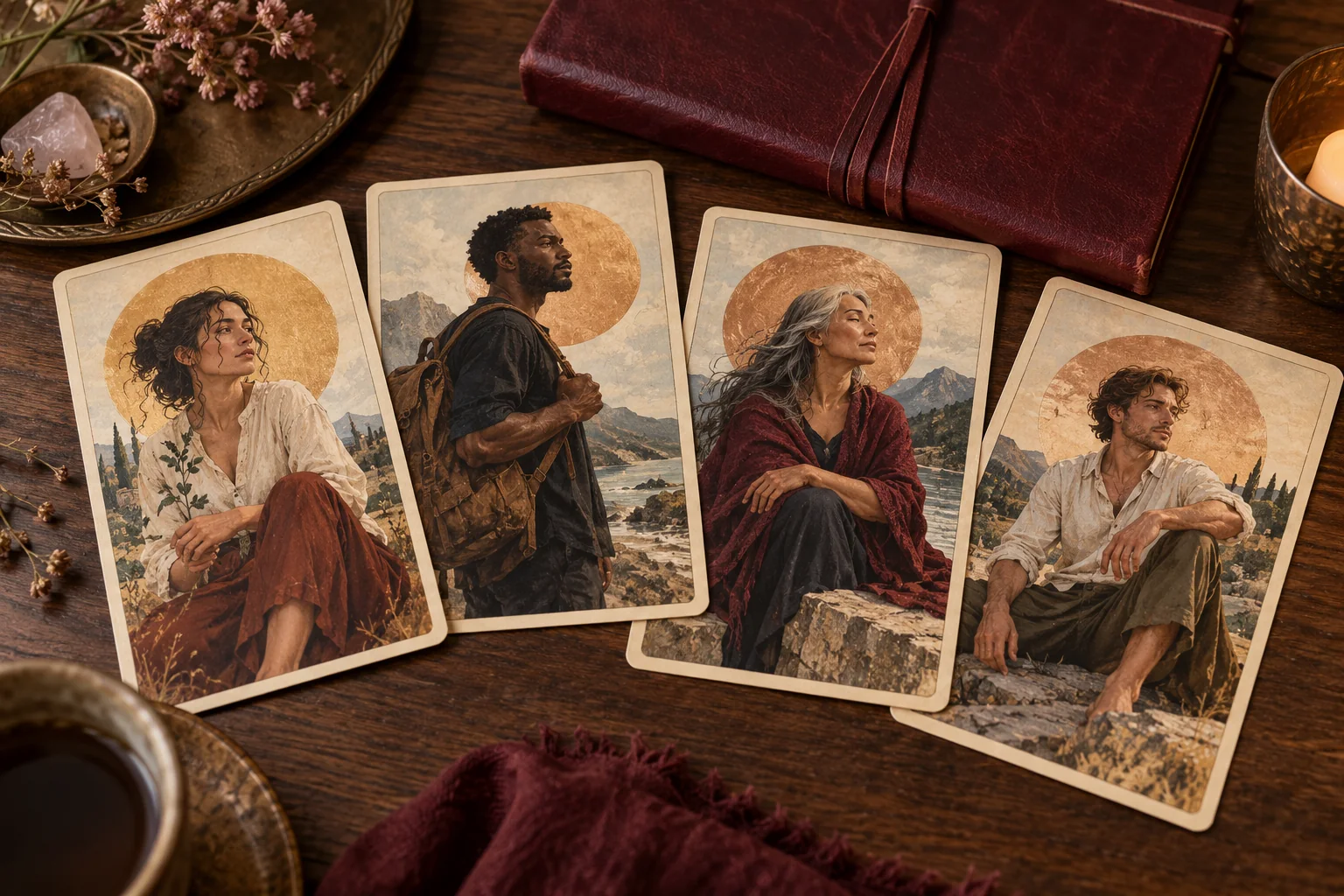
A drawn horse looking to the left seems to speak of the past for some readers; for others, it is simply an artist’s decision. Both may be going too fast. Before assigning meaning to movement, it is worth observing head, legs, rider’s posture, edge of the card, and overall composition. A figure oriented toward one side is not necessarily moving forward. It may stop, look back, hold an object, or remain in a stable position. This article proposes a visual reading that invents neither the querent’s biography nor the illustrator’s documented intention.
Identify the deck and the card first
The expression “tarot knight” groups distinct representations. The V&A history of cards shows that decks change over time and that the Rider-Waite-Smith edition added influential iconography. The British Museum holds a complete Marseille-type deck by Suzanne Bernardin, dated to the 19th century. These sources document objects and visual traditions; they do not authorize describing the four knights of every edition as identical. If you do not have the cards from a specific deck in front of you, do not say that “they all ride to the right” or that “one looks to the left.”
In your notebook, write the printed name of the card, the suit, the edition, the manufacturer or artist if known, and the position in the spread. Then note which side of the image the horse’s head is oriented toward. It is important not to invert the image when photographing it: a front-facing camera can mirror it, and a website can flip a reproduction by design. Check the orientation against the physical card or an identified institutional reproduction. If the edition does not have a knight on horseback, the premise of the exercise does not apply. Do not force equestrian symbolism onto a Page who is on foot.
Looking is not the same as moving
There are at least four separate observations. The animal’s gaze may be directed to one side. The torso may lean in that direction or remain vertical. The legs may suggest trotting, rest, jumping, or a conventional pose difficult to translate into real speed. The rider may hold an object, turn their face, or raise an arm. Describe each feature without yet joining them into a story: “head toward the right edge, front legs raised, rider upright.” Do not write directly “a quick piece of news is going to arrive”; that conclusion requires an interpretive step and the specific question.
The frame also matters. If the figure points toward a mountain, a building, or an empty space, ask yourself whether those elements are actually drawn and what spatial relationship they have. Do not invent a destination beyond the edge. A horse that occupies almost the entire card may give a different impression from a small one before a wide landscape. The drawn scale is not a measure of the urgency of anyone’s life, but it can orient a conversation about focus or rhythm if the person recognizes that metaphor.
Fictitious example: a proposal that has not yet been sent
Fictitious case. Omar is preparing a collaboration proposal. He asks: “What should I review before sending it?” In the position called “rhythm,” a knight on horseback from his edition appears. Omar observes that the animal is oriented toward the right margin, but the legs do not look to him as if they are racing; the rider firmly holds an object. He first notes those three observations. Then he poses two readings: perhaps the proposal is ready to move forward with a final review; perhaps the feeling of progress comes from expectation and documents are still missing. The card alone does not decide which is correct.
To choose, Omar opens his actual list: confirmed budget, shared calendar, correct recipient, and written conditions. A cost figure is missing. He decides to ask for it before sending. The image served to formulate a question about rhythm and preparation, not to predict whether the other party will accept. If the card had come up in the “available support” position, perhaps he would have asked who can review the document. The same visual orientation takes on another function when the spread position changes; consult the guide on position and meaning to practice that relationship.
Imagine now that another reader uses the same card for an emotional question. It would be imprudent to translate “looks to the right” as “that person will return.” There is no identity or calendar printed in the illustration. She can, instead, ask: “Am I looking at a pending conversation or avoiding formulating it?” It is a question about the person present in the consultation, not an attribution to an absent third party. Orientation can open options for reflection; it never proves other people’s mental states.
Compare the four knights without fabricating a rule
If you have a complete deck with four knights, place them together and make a table. Columns: suit, head orientation, leg position, rider’s gesture, object held, background, and degree of certainty. Describe the specific edition. Look for similarities and differences: perhaps two share a direction, but one seems still and another dynamic; perhaps the landscape changes more than the pose. The comparison gives information within that deck. Do not export the result to all decks.
The imagined figures on this page allow a pose to be broken down into body direction, hands, foot support, and surrounding space. They are not four historical knights. To compare real knights, identify an edition and observe the corresponding cards separately. A difference in posture may depend on the artist or the cropping of the image; avoid simply turning it into a universal meaning.
An honest comparison also points out what is missing. If you only know a small thumbnail, do not describe the detail of the legs as certain. If the photo crops the edge, do not claim that the horse leaves the frame. You can write “it cannot be seen.” This phrase preserves the usefulness of the record: a reader will be able to repeat the exercise with their own deck and verify where their observations diverge from yours.
Left past, right future?
That correspondence can be used as a convention in some reading methods, but it is not a physical law or a property of the drawing. Before using it, state the convention and decide how it affects the order of the cards on the table. If you place the past on the left and the next step on the right, “looking toward the future” can be an internal visual metaphor of that spread. If you reverse the order, the metaphor changes. Do not present a spatial convention chosen by you as proof of the manufacturer’s intention.
There is also a problem of perspective: left from the point of view of the card, the rider, or the person looking? Clarify it in the record. “Toward the left margin as seen by the reader” avoids ambiguous discussions. Someone studying tarot can borrow different conventions, but must maintain the same reference during the exercise. If the reversed card is part of your practice, indicate whether you also reverse lateral relationships or whether you do not use them. There is no universal obligation to read reversals.
From the drawing to a useful conversation
A good reading closure separates three sentences. First: “In this edition, the horse appears oriented toward the margin.” Second: “In the rhythm position, it suggests I check whether you are moving with haste or with preparation.” Third: “We can check the calendar, resources, and consent of the people involved.” The first is observation, the second interpretation, and the third verifiable action. If you cannot support the second, stay with the first and ask about the facts.
In Tarot Rider-Waite from Scratch you can expand the study of court figures. For this exercise, an identified card and a specific question are enough. The direction of the horse can enrich a reading, but it does not replace the data, the person’s will, or the complexity of a decision. Looking slowly often reveals more than a memorized equivalence.