Sabio Tarot · Decks and systems
Symmetry and Asymmetry in a Marseille Numeral
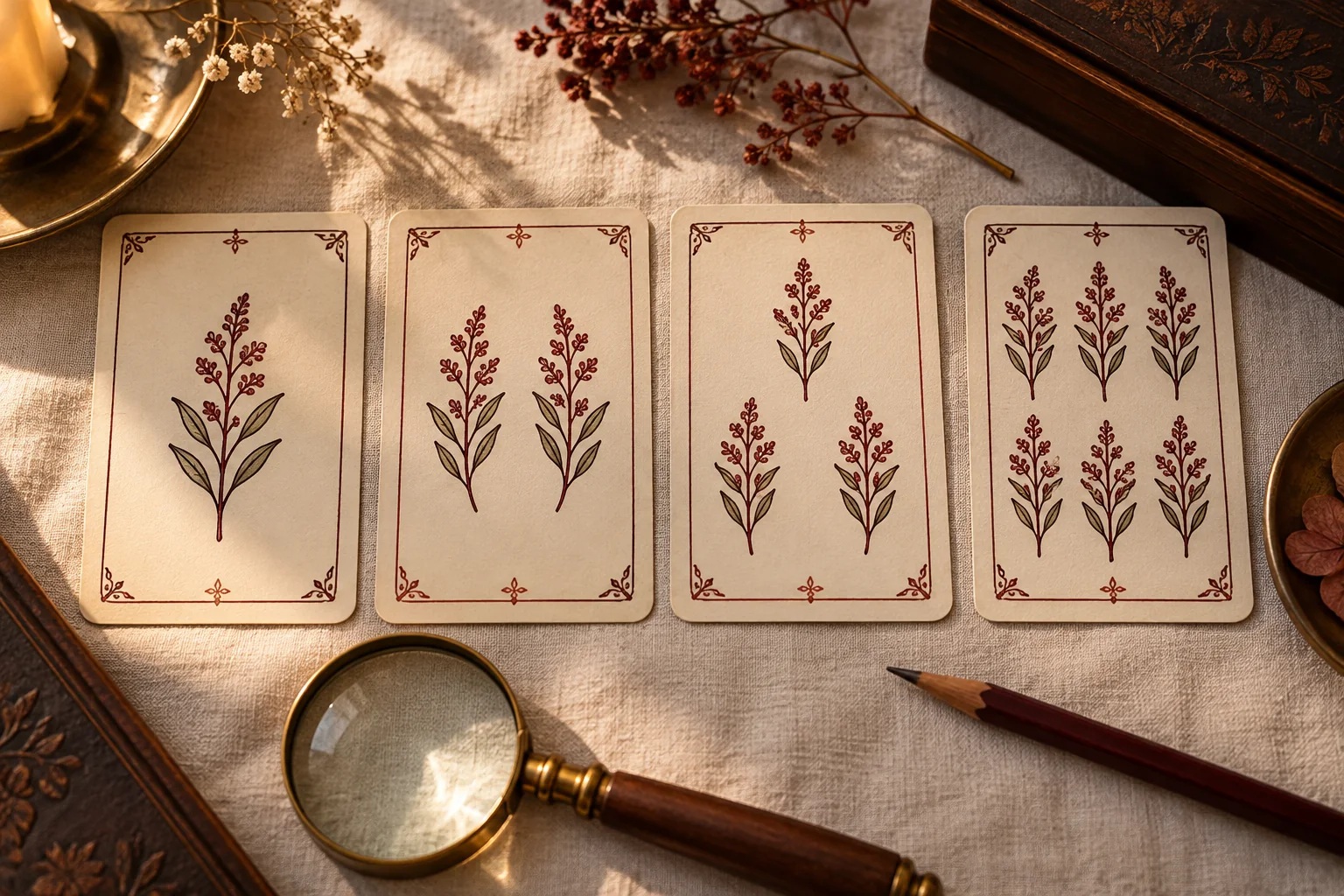
When someone learns tarot with a narrative deck, they may feel lost before a Marseille numeral: they see repeated objects and ornaments, but not a scene with characters. The easy way out is to imagine a story that the card does not draw. A more precise path is to study quantity, distribution, axis, edges, and differences. Those features offer useful questions, although they do not by themselves determine an outcome. The aim of this exercise is to distinguish what is printed in a specific edition from the hypothesis formulated by the reader.
What We Call Symmetry in a Card
An image is approximately symmetrical when a vertical or horizontal division allows similar shapes to be found on both sides. “Approximately” matters: manual printing, ornamentation, and the engraver's decisions can break a perfect geometric correspondence. The Bibliothèque nationale de France describes a Marseille tarot by Philippe Vachier dated 1639, made with woodcut engraving and stencil-applied color. The record serves to identify a historical object and its technique; it does not turn every ink difference into a deliberate message. The British Museum records a complete Marseille deck by Suzanne Bernardin from the 19th century, likewise as a dated material object. Between those two testimonies there are editions, workshops, and centuries: do not attribute a single exact pattern to “the Marseille” without specifying the deck you are observing.
Do a first reading without meanings. Place the card upright and mentally trace a vertical axis. Count the main objects on the left and on the right. Repeat with a horizontal axis. Then note stems, flowers, ribbons, or other ornaments, but separate the main elements from the decorative filler. If you count a leaf as a sword or a coin because you need the numbers to come out equal, you have changed the object you intended to study. You can draw a transparent grid on a working copy you made yourself, without publishing someone else's card.
An Exercise with an Imagined Numeral
The illustration on this page shows imagined didactic cards with one, two, three, and six branching motifs. It is an original resource, not a reproduction of a historical deck nor a proof of how all Marseille minors are organized. Choose the design with two motifs. See whether both are similar in size, whether they face each other or are parallel, and what occupies the space between them. Then look at the one with three: is there a central motif and two supporting ones? Does the visual weight fall at the top or bottom? There is no need to assign “two people” to the two branches. You can say precisely: “The composition groups two forms around a gap.” The reading of that gap will depend on the question.
The same practice carries over to a historical card you legally have in front of you. Write down the deck name, publisher if listed, date or edition, and card number. If the deck is recent and says “Tarot de Marseille,” likewise record what it reproduces and what it changes. Working with an identified object prevents a description from the internet about one edition from slipping into the reading of another. The article library gathers guides to complete that comparison.
Asymmetry Needs a Second Look
A card may appear to have a more loaded side because the photograph is tilted, the crop has shifted the frame, or a small ornament attracts the eye. Before turning that impression into “vital imbalance,” look again. Does the difference affect the number of main objects, their size, their color, or only the edge? Does it repeat in another copy of the same edition? Is it a particularity of your card's wear? A single blurry photograph does not allow you to decide. Note a level of certainty: clear, probable, or unverified.
If the difference is real, describe its visual function without yet turning it into a diagnosis. A displaced object can guide the eye toward an area; a central one can organize the whole. The interpretation “something is demanding attention” is a reading proposal that may prove fruitful in a question about priorities. The statement “the card announces that your partner will betray you” does not follow from a stem being bent. It is an enormous leap from a graphic feature to an external fact.
Fictitious Example: Two Work Commitments
Invented case for teaching the method. Clara asks how to distribute time between her own project and a collaboration. In a three-position spread — current resource, tension, next step — a numeral appears in the tension position that, in her identified edition, shows two groups of elements on either side of an axis. Clara observes that one group has more free space around it, although the main count is balanced. First she writes the datum: “two groups, same main quantity, different space around them.” She does not write “my collaborator gives less” because the image does not contain that information.
Then she formulates two hypotheses. One: her own project needs calendar margin, even if the planned hours are equivalent. Another: perhaps the tension is not about allocation but about interruptions, and the group with less visual space reminds her of that feeling. They are hypotheses about the question, not universal properties of the card. To choose an action, Clara checks her calendar from the last two weeks: actual hours, deadlines, messages, and breaks. She discovers that the collaboration takes fewer total hours, but interrupts four afternoons. That datum supports the second hypothesis more than the first. The card worked as a stimulus to formulate the right question; the calendar provided the evidence for deciding.
In a different reading, for example a decision about study materials, the same composition could lead to comparing two sources or two learning rhythms. There would be no reason to repeat the interpretation about interruptions. The position of each card and the question establish the function of the detail. Symmetry has no fixed meaning outside that frame.
Numeral Is Not Equivalent to Narrative Scene
In a Rider-Waite-Smith deck, many minors carry figurative scenes. In numerous Marseille-type decks, the numerals are organized around suit symbols. This general difference is seen when studying deck collections, but there are editorial variations; therefore it is best to name the edition. If you mix without warning the scene from a Rider-Waite manual with a Marseille numeral, you could interpret characters that do not appear in your card. You can compare systems as an explicit exercise, but identify the borrowing: “I am using an association learned in another tradition,” not “I see that person here.”
Nor must all metaphor be forbidden. A balanced arrangement can evoke negotiation or reciprocity for a reader, as long as they say it is an evocation and submit it to the question. The problem is false literalness. “There are three swords printed” is observation; “there are three decisions to make” is hypothesis; “you will have three conflicts on Thursday” is a prediction that the image does not demonstrate. Separating those sentences allows the reading to be creative without passing itself off as proof.
A Five-Minute Protocol
Place the card in front of you and cover any manual text. For one minute, note only shapes and counts. In the second, draw the two axes and mark pairs, centers, and exceptions. In the third, identify which part could be an effect of printing, photo, or wear. In the fourth, reread the question and the function of the position. In the fifth, write two alternative interpretations and one piece of external information that would help choose between them. If no interpretation adds clarity, leave the detail unused. Not every visible feature has to carry an answer.
A minimal record can have columns “observed,” “inference,” “datum to check.” Example: “six elements in three pairs”; “perhaps it would be good to review how I group tasks”; “check calendar and commitments.” This third column prevents an aesthetic reading from ending up replacing real decisions. If you teach tarot, ask another person to do the first column independently. Discrepancies will show what is visible and what depends on the gaze.
Closing: One Composition, Several Legitimate Questions
Symmetry offers a way of looking, not a verdict. A card can order objects to make reading easier, respond to a graphic convention, or contain small manufacturing variations. Knowing its edition and describing its elements before interpreting gives more information than repeating a memorized phrase. If you want to go deeper into the minors, Marseille Tarot from Scratch offers a study path; here the essential method is simple: name the object, count, compare, ask, and verify. Asymmetry only becomes useful when you can explain what you saw, in which edition, and why you relate it to the question asked.