Sabio Tarot · Minor Arcana
Two of Cups: Reciprocity and Concrete Agreements
Two people enjoy talking, but one wants to know whether they can organize a project together. The Two of Cups comes up. The card can invite a look at the quality of the exchange: do both propose, listen, and accept responsibilities? That is more verifiable than stating that “their souls are destined to meet.” The two can suggest a relationship, but reciprocity means behavior that is observed and discussed, not a secret emotion that tarot certifies.
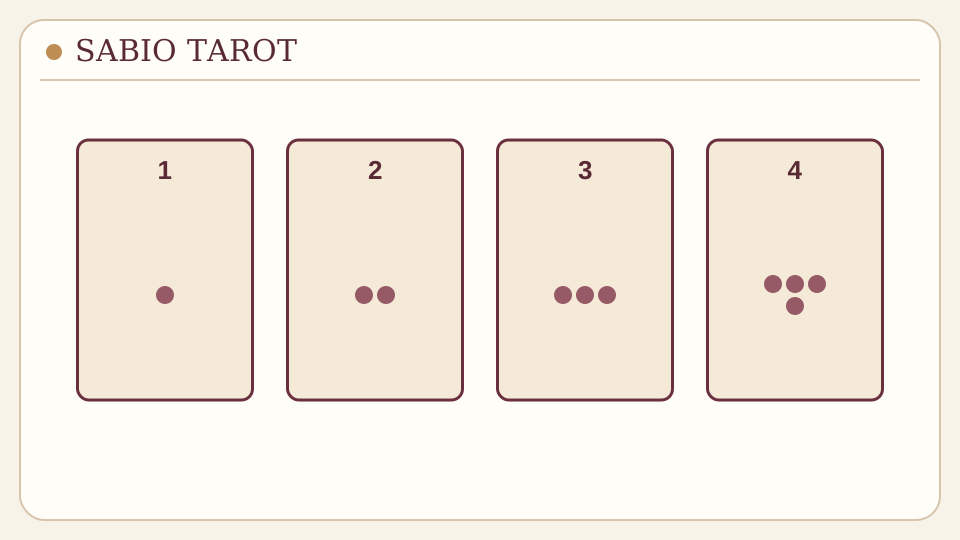
- 11
- 22
- 33
- 44
Two visible figures, many possible stories
In Rider-Waite-Smith, Waite describes two people who meet and raise cups, with symbols above them. The scene lends itself to talk of encounter, recognition, or pact. It does not show how long the bond lasts or who makes decisions outside the image. Waite’s description is useful for observing the iconography of that edition, not for declaring that every couple represented by the card will marry.
In a Marseille Two of Cups, the reading starts from two cups in an ornamental composition; two people facing each other do not necessarily appear. The number two and the suit can lead to a question about emotional exchange, but that is an interpretation that must be explained. The Metropolitan Museum documents the structure of cups among the historical suits and the V&A places Pamela Colman Smith’s work in the scenes of the Rider-Waite-Smith minors. If you change decks, look at the card again before repeating a description.
What counts as reciprocity?
In a friendship it can be initiating contact from time to time, respecting a no, and offering help without keeping score of every gesture. In a romantic relationship it can be talking about needs, respecting boundaries, and agreeing on what commitment each person wants. In a professional collaboration it can be defining tasks, deadlines, and recognition. Reciprocity does not require two people to behave identically; it requires that both have agency, a voice, and a real possibility of accepting or refusing.
That is why a Two of Cups reading should avoid two shortcuts. The first is using the card as a detector of another person’s feelings: “yes, that person is in love with you.” The second is thinking that every pleasant encounter already contains an agreement. There can be goodwill without availability of time, resources, or interest for the next step. It is preferable to ask “what can we propose and verify?” rather than “what is the other person hiding?”
The position orders the reading
In “strength of the bond,” the two can represent an exchange that the person already describes with examples. In “need,” it could indicate that expectations have not yet been discussed. In “next step,” it proposes an invitation or an explicit agreement. In “limit,” it can remind you that feeling affinity is not enough if a task depends on schedules or commitments. The card does not change the facts: if a person systematically avoids responding, that behavior weighs more than a kind image.
Alongside the Ace of Cups one can distinguish one person’s openness from a shared response. Alongside the Three of Pentacles, coordination of a job becomes relevant. Alongside the Five of Swords, it is worth exploring whether a disagreement is eroding trust. No pair of cards forces a verdict; it helps formulate questions whose answer belongs to the people involved.
Fictitious example: a two-voice podcast
Invented example, not testimony. Paula and Leire have recorded two test conversations for a cultural podcast. Paula asks: “What should we agree on before publishing the first episode?” She sets three positions: 1) what already works, 2) what still needs to be made explicit, and 3) a possible agreement. The Two of Cups, Two of Pentacles, and Justice appear. The Two of Cups relates to their mutual listening during the tests, something Paula has observed; it does not prove that Leire wants to continue indefinitely.
The Two of Pentacles points to the practical difficulty of coordinating two schedules. Justice leads to putting in writing who edits, who pays for hosting, how cuts are approved, and what happens if one wants to stop the project. The synthesis would be: “There is a good basis for conversation; before publishing, check that both of you want the same level of commitment and agree on responsibilities.” Paula proposes a half-hour meeting and brings a short draft. If Leire cannot take it on, the decision can be to postpone the premiere without disparaging the bond.
The same example shows why tarot should not replace dialogue. Paula could leave the reading convinced that Leire “surely agrees,” but that would be an unjustified inference. The agreement exists when Leire can read it, change it, and freely accept it. The card helps recall the value of two voices; the concrete conversation makes reciprocity possible.
When the question is romantic
When faced with “do they like me?” turn the query into something the person can do without intruding: “What respectful invitation can I make?” or “What observable signs show mutual interest?” A kind response, an alternative proposal if they cannot meet, and a clear conversation are different signs; none is infallible. If there is uncertainty, it can be tolerated without turning the Two of Cups into an invisible test. If there is rejection, respecting it is compatible with having seen this card.
Nor is it advisable to use “two” to demand impossible symmetry. People with different schedules, communication styles, or needs can build fair agreements. The question is not whether they return every message in the same minute, but whether both understand what is offered and have the freedom to express limits. If a relationship includes pressure or fear, prioritize safety and appropriate support; an image of encounter does not invalidate the facts.
As a practice, write two columns: observed gestures and pending agreements. Add a third with open questions you would ask the other person directly. The didactic diagram of the two serves to separate the numeral from a couple story. Continue with Cups and Relationships and Rider-Waite Tarot from Scratch. The best result of this card is not certainty about an absent person, but a more honest conversation between those who can actually decide.