Sabio Tarot · Minor Arcana
Five of Wands: Productive Conflict or Drain

Five people propose different changes in a project. There is disagreement, but we still do not know whether it is a problem. It can produce a better solution, help distribute tasks, or consume every meeting without deciding anything. The Five of Wands is useful when read as a question about the quality and cost of friction, not as the label “fight” stuck to whoever appears in the reading.
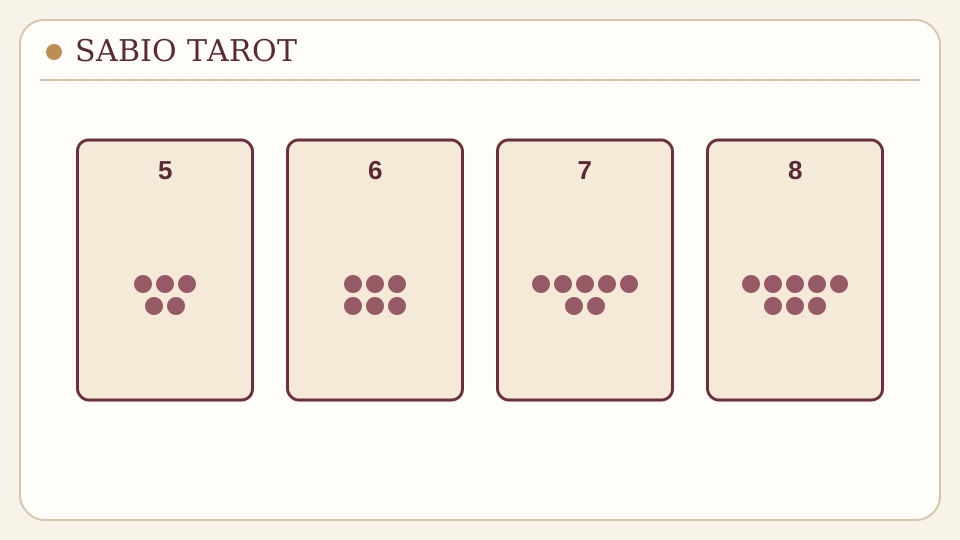
- 15
- 26
- 37
- 48
A Deliberately Ambiguous Image for Reading
Waite describes in Rider-Waite-Smith young people raising wands in a way that could seem like play or strife. The image shows simultaneous movement; by itself it does not certify violence, victims, or a victor. Consult Waite's description. The visual ambiguity is a teaching advantage: it forces us to ask whether the real disagreement has rules, a goal, and a possibility of closure. If those conditions are missing, the energy can turn into a drain. If they are present, it may be a normal trial phase.
In a Marseille Five of Wands there are five emblems of the suit and ornaments, not necessarily five people. Counting five “opponents” in that edition would be projecting the scene from another deck. The Metropolitan Museum describes the structure of the numerals with suit symbols; the V&A documents Pamela Colman Smith's role in the illustrated minors. Responsible comparison asks what is observed in each edition and what association the reader adds.
Debate, Competition, and Dispersion: Three Different Situations
A useful debate has a defined subject, a turn to listen, criteria, and a final decision. A competition has participants pursuing a limited resource or recognition; it may or may not be regulated. Dispersion is recognized when each person pushes a different goal and there is no way to choose. All three situations could be evoked by the Five of Wands, but the next actions are different. Debate needs a well-facilitated conversation; competition needs clear rules; dispersion needs prioritizing one goal.
Therefore, it is worth translating the card into observable questions. What concrete decision is pending? Who has the authority to make it? Is there a deadline? What would it cost to keep arguing for two weeks? Is there anyone who cannot participate without fear of retaliation? The last question is essential: a situation of harassment or abuse must not be called “productive conflict.” In that case, protection and appropriate support are needed, not a recommendation to compete better.
According to Position and the Neighboring Card
In “resource,” the card could show different perspectives that still enrich the idea. In “obstacle,” it may point to meetings where no one listens or decisions that are reopened for no reason. In “action,” it can invite setting rules for an exchange, never provoking a fight. In “possible outcome,” it indicates a phase of negotiation or trial without guaranteeing victory. Position prevents selecting the meaning that best fits a prior prejudice.
A neighboring Three of Pentacles makes one think of coordination of functions: discrepancies can be resolved if roles are clarified. A Five of Swords forces us to assess whether winning the argument damages the relationship. A Four of Wands may suggest that a shared milestone can coexist with pending differences. Do not turn these combinations into fixed recipes: look at what place each card occupies and whether the person's account supports the hypothesis.
Worked Fictitious Case: A Poster in Dispute
Invented situation. Four members of a cultural association prepare a festival; a fifth person designs the poster. Each wants to highlight a different message, and publication is delayed. The question is: “What structure can help us finalize the poster this week?” Positions are defined: 1) current dynamics, 2) available resource, and 3) decision step. Five of Wands, Justice, and Three of Pentacles come up.
In the first position, the Five of Wands describes the crossing of proposals well, but it does not accuse anyone of sabotage. Justice in “resource” suggests returning to the written brief: audience, legibility, date, and budget. Three of Pentacles in “step” leads to naming roles: the team sets two criteria, the designer presents two versions, and an authorized person decides after hearing comments. The synthesis is not “my idea will win,” but “the disagreement can be resolved if it is turned into shared criteria and the design role is respected.”
Let us imagine that after establishing rules one person continues insulting or blocking the work. The reading must be updated with the new fact. There is no obligation to keep the optimistic hypothesis merely for the sake of fidelity to the card. Mediation, boundaries, or an organizational decision may be needed. Tarot serves to open questions; real-life information has priority. Likewise, if the group meets once and agrees on a better poster, it would not be correct to conclude that all future discussions will be healthy.
Two Assessments for Deciding Whether to Keep Debating
Make a learning assessment and a cost assessment. In learning, note what new proposal appeared, what error was avoided, and whether participants understood the goal better. In cost, note hours invested, tasks halted, and people who stopped speaking. If the first assessment stops growing while the second increases, it is time to change the method. It could be voting, delegating, consulting the public, or postponing a feature. The card does not choose the mechanism; it invites you to see the pattern.
In couple or family readings, avoid turning an absent person into an adversary merely because the Five of Wands appears. Ask about concrete conversations, agreements, and safety. At work, competition can have contractual consequences; review real conditions before acting. If violence or intimidation exists, seek appropriate support without waiting for another card to “confirm” the problem.
The didactic diagram of the five represents quantities and suits, before assigning roles to real people. You can continue with the numbers five, six, and seven, the suit of Wands, and Marseille Tarot from Scratch. When closing a reading, formulate a concrete test: “What rule or criterion would make this difference produce something useful?”