Sabio Tarot · Minor Arcana
Five of Swords: Winning a Dispute and Losing a Bond

In a meeting, a person gets their proposal approved, but two colleagues stop participating. Has the person won? The Five of Swords can help separate a formal outcome from the cost of achieving it. Sometimes defending a necessary boundary makes others uncomfortable, and that does not make the decision wrong. Other times, a victory obtained by humiliating others erodes the trust that made working together possible. The card does not automatically identify a villain; it invites you to make two assessments.
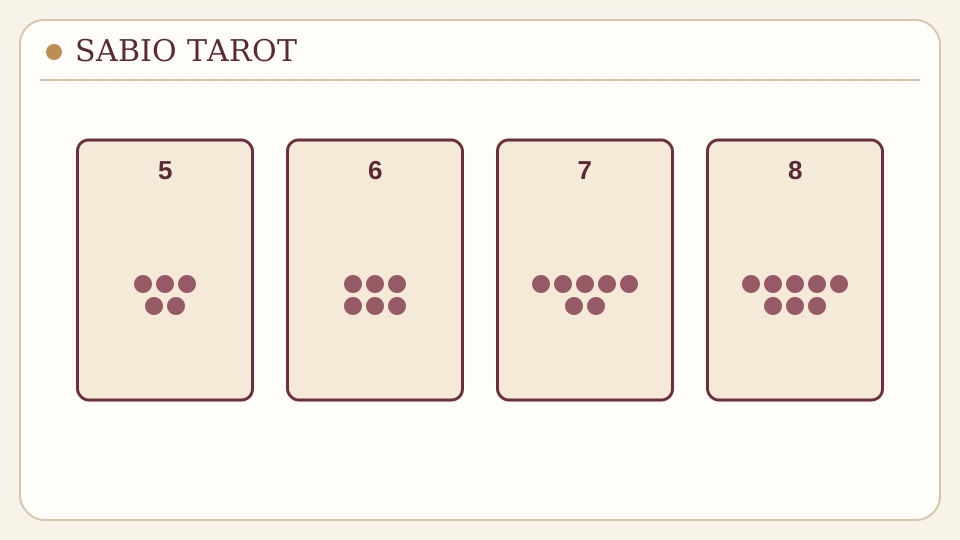
- 15
- 26
- 37
- 48
A Scene with Different Outcomes and Perspectives
Waite describes in Rider-Waite-Smith a man holding swords, other swords on the ground, and figures walking away. The scene shows an asymmetry after a confrontation; it does not say what happened before or which of the characters was right. Waite’s description serves to look at the visible details. Applying it to someone’s life requires asking about facts, not assigning roles of “aggressor” and “defeated” solely based on the arrangement of the drawing.
In a Marseille Five of Swords, the number and suit appear in ornamental design, without characters withdrawing. The Metropolitan Museum documents the traditional numerals and the V&A contextualizes the visual narrative of the Rider-Waite-Smith minors. A reader may associate five with tension and swords with language or conflict, but should say that this is their interpretive method, not a scene visible in Marseille.
First Assessment: What Was Actually Achieved
Write down the concrete objective: was a rule set, was an error repaired, was a resource obtained, or was only an argument won? Then check how long the result will last and whether it can be implemented. A favorable vote may not resolve the team’s resistance. A clever phrase in a conversation may give immediate satisfaction without changing the problem. The Five of Swords invites you to separate the satisfaction of winning from effective improvement.
Second Assessment: What It Cost and to Whom
Look at trust, time, participation, and safety. Did someone lose the possibility of speaking? Was someone personally disparaged? Does the decision leave room to disagree afterward? But do not assume that all distancing is the fault of the one who defended their position. If the boundary protected a person from harmful treatment, the discomfort of the one who crossed it may be an acceptable cost. The moral context is not deduced from the number five.
In a couple’s or family reading, avoid recommending “giving in to preserve the bond” when pressure, threats, or abuse exist. Safety has priority. In a work or legal negotiation, review documents and seek appropriate advice; the card does not establish who will win a lawsuit. The value of the image lies in formulating questions about consequences, not in replacing evidence or professional support.
Position and Nearby Cards
In “risk,” the Five may invite you to foresee whether a way of arguing will damage a relationship you want to preserve. In “past event,” it may help name an argument that already left aftereffects. In “resource,” it perhaps points to the ability to recognize that a tactic is not working and change it. In “action,” it does not order surrender or attack; it asks you to choose the way to defend a need with the least harm compatible with the boundary.
Alongside the Five of Wands, it is worth asking when a debate of ideas became a struggle to win. With the Two of Cups, a path may open to agree on how to argue. With the Three of Swords, it matters to recognize pain without inventing intentions. Neighboring cards are not a tribunal: they help organize aspects of a situation that only people and facts can clarify.
Fictitious Example: An Editorial Decision
Invented case, not a real consultation. Julia edits a neighborhood magazine. In a meeting, she rejects an article because of unverified data and uses a cutting phrase against its author. The decision not to publish may be correct; the way she communicated it has left discomfort. Julia asks: “What should I uphold and what could I repair?” She defines positions: 1) necessary outcome, 2) cost of the manner, and 3) next conversation. Justice, Five of Swords, and Temperance come out.
Justice in the first position recalls the editorial criterion: not publishing claims that have not been verified. The Five in the second makes it possible to recognize that Julia won the vote, but her phrase publicly exposed the author. Temperance in the third suggests a conversation with two parts: maintain the standard and apologize for the disparagement. Julia prepares a message: “I still think we need sources before publishing. My comment about your ability was unfair; I retract it. If you want to review the data, we can look at a new version.” She does not promise that the author will accept.
If the author responds with another act of aggression, Julia can maintain the norm of respect and decide on another channel. If he accepts the conversation, the group can establish a review process that avoids repeating the scene. Tarot does not guarantee reconciliation. Its usefulness lies in distinguishing the criterion that is preserved from the conduct that can be repaired. “Apologizing” does not mean publishing false data, just as “defending quality” does not require humiliating anyone.
A Practical Closing Without Condemning Anyone
Write two columns: “outcome I want to protect” and “relationship or value that also matters.” Mark which phrases or actions were necessary and which only increased the harm. Then formulate an alternative for the next occasion. If you were wrong, acknowledge a specific fact without demanding forgiveness. If another person crossed a boundary, do not erase that fact to produce a kinder reading. The card offers an honest conversation about costs, not a moralizing story with fixed characters.
The diagram of the five allows you to study the numeral before attributing intentions to characters in a scene. Continue with Swords and Thought, the numbers five, six, and seven, and Rider-Waite Tarot from Scratch. The central question is not “who is the bad guy?” but “what did I achieve, what did it cost, and what can I do now with both facts?”