- Books
- Marseille · go deeper
Marseille Tarot Card Combinations
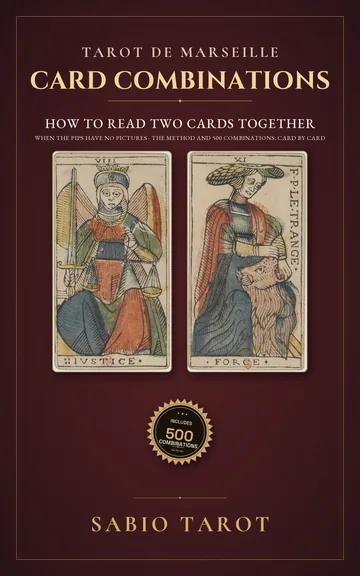
Tarot de Marseille Card Combinations: How to Read Two Cards Together When the Pips Have No Pictures: The Method and 500 Combinations Explained, Card by Card
For readers who know individual cards but still need to explain what two cards say together in a spread.
- English
- 500 pairs
- Reading method
Shop by country and format
Each link uses the ASIN for that format. In Ireland, choose Amazon.co.uk for Kindle or Amazon.ie for print. Price, delivery and availability depend on the store.
This work in other languages
Method, dictionary and practice
Study it chapter by chapter or open it to a particular pair.
A twelve-chapter method
Suit and number, pip arrangement, dominant card, reinforcement, conflict, nuance, gazes, repeated numbers, reversals and a third card.
500 explained combinations
Each full entry gives a joint reading, love, work and a line of advice. Cross-references let you start from either card.
Reference tools
An index listing both orders, tables, a comparison with Rider-Waite and eight small spreads for practising pairs.
From two meanings to one reading
This volume is about the relationship between cards. It first teaches a method for interpreting any Marseille pair, then offers a dictionary of 500 combinations to consult beside a spread.
The approach respects Marseille's visual language. Numbered pips show suits and quantities, not scenes. The book works with what is actually on the cards and how the two interact rather than importing Rider-Waite pictures.
Interpret first; look it up second
With two cards, state your question and decide which carries more weight. Observe suits and numbers, reinforcement or tension and any gaze between figures. Put your own tentative reading into words.
Then find the pair in the dictionary and compare. The entry may confirm an insight or uncover a nuance. The method still helps when a particular pair is not among the 500 entries.
Sabio Tarot · The book
What the 500 combinations are for
The aim is not to memorize 500 answers. The method first asks you to move from two separate meanings to a sentence about the relationship between the cards. Which card carries more weight? Do they reinforce, qualify or challenge each other? What do suits, numbers, reversals and the question contribute? The method also considers what changes when a third card appears.
The reference section develops 500 pairs. Each full entry offers a joint reading and applications to love, work and advice. Cross-references and an index in both orders let you start with either card. Tables and eight small spreads help you practise. The method is intended to remain useful for pairs outside the selected 500.
Try this extra website exercise before looking a pair up: write one sentence for each card and a third that explains their connection. Compare your reasoning with the entry. The goal is to articulate why a reading makes sense, not to repeat a fixed answer.
What Marseille asks you to notice
Its forty numbered Minor Arcana do not tell stories with characters. Observe suit, quantity and the arrangement of symbols instead. Court figures have gestures and directions; the trumps have their own numbering conventions. A scene printed on a Rider-Waite card should not be projected onto a Marseille pip card.
The Marseille books follow the historical pattern used for their images: Justice VIII, Strength XI and an unnamed trump XIII. If your deck differs, compare it closely before applying an interpretation based on a particular drawing. This is especially useful when reading two cards together.
For Marseille readers who know the cards
The images follow the Jean Dodal tradition: Justice VIII, Strength XI and an untitled trump XIII. If your pip cards show cups, coins, swords or batons without scenes, this volume works with your deck.
It does not replace a beginner's course in all 78 cards. Start with the Marseille guide if you are still learning them. There is a separate combinations volume for Rider-Waite decks with illustrated pips.
Frequently asked questions
Does it contain every possible pair?
No. It explains 500 and teaches a method for reading others.
Can I look up either order?
Yes. Cross-references and the final index lead to the full entry from either card.
Does it explain unillustrated pips?
Yes. That characteristic is central to the method.
Are spreads included?
Yes. Eight small spreads help you practise reading pairs.
More from the collection
 Marseille · Start
Marseille Tarot for Beginners
All 78 cards, unillustrated pips and your first spreads.
 Rider-Waite · Start
Rider-Waite Tarot for Beginners
Learn all 78 cards through their scenes and practise spreads.
 Rider-Waite · Combine
Rider-Waite Tarot Card Combinations
Read two cards together with a visual method and 500 pairs.
 Dreams · Dreams
The Great Dream Dictionary
Hundreds of symbols, recurring dreams and a practical dream journal.