Sabio Tarot · Minor Arcana
Two of Swords: When Information Is Missing
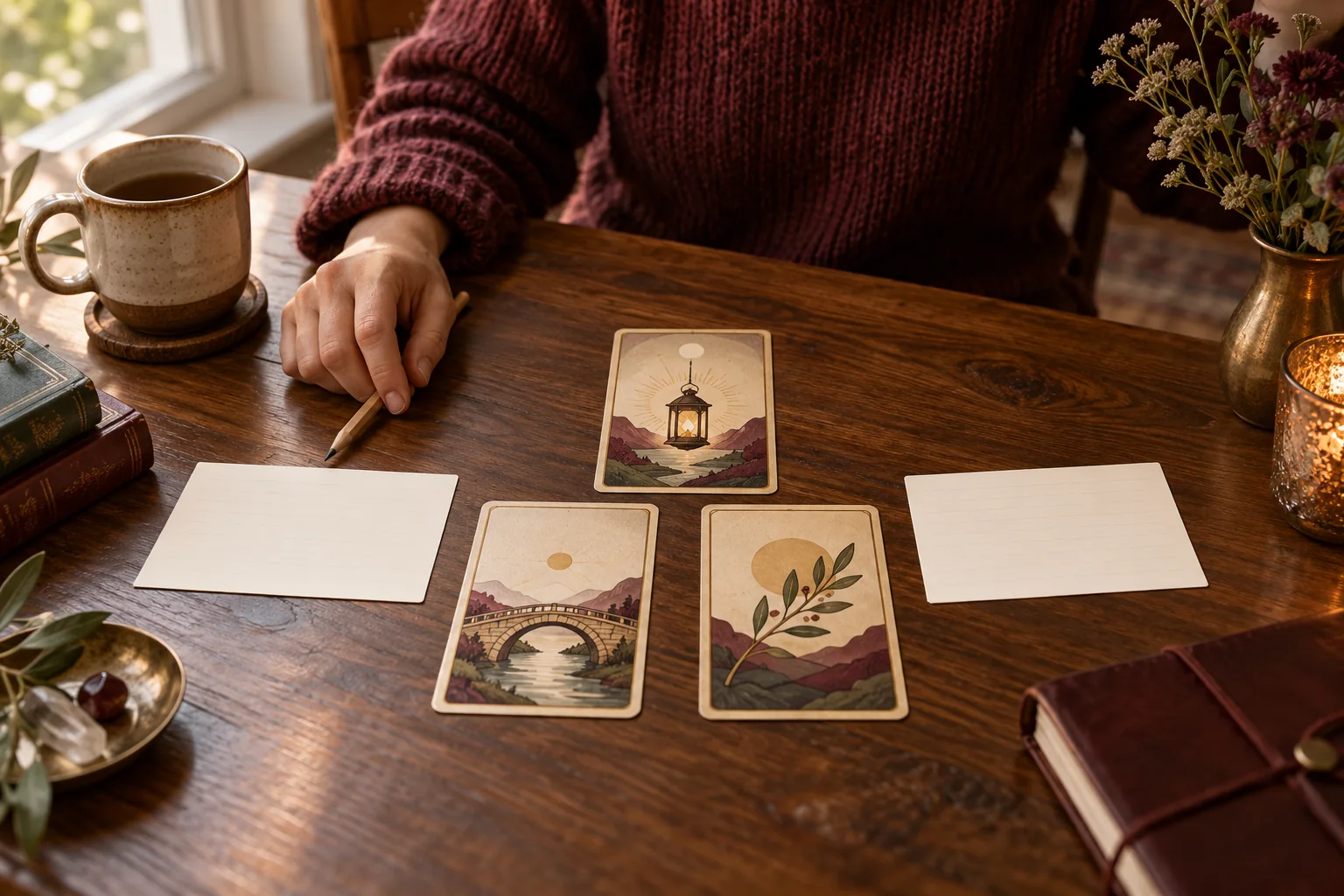
A person must choose between two courses and asks the tarot which one suits them. The Two of Swords appears. Instead of announcing a “voluntary blindness,” it is worth checking what they really know: price, hours, prior level, accessibility, and goals. Indecision can be rational when relevant information is missing. It can also turn into avoidance if all the data is on the table and the person keeps postponing without a new reason. This card helps distinguish between both cases.
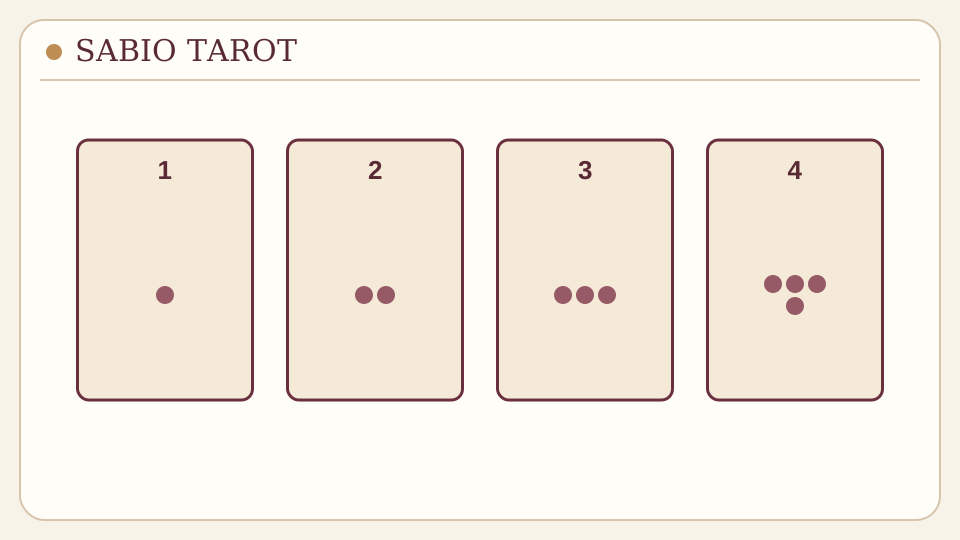
- 11
- 22
- 33
- 44
A Blindfolded Figure Does Not Diagnose the Querent
In Rider-Waite-Smith, Waite describes a seated figure with blindfolded eyes and two crossed or balanced swords. The scene inspires questions about limits of perception and balance between options. The primary description does not reveal why the figure wears the blindfold, nor does it allow attributing fear, trauma, or bad faith to a real person. In a responsible reading, the image is offered as a metaphor and is contrasted with the information the querent provides.
In a Marseille Two of Swords, two weapons appear in an ornamental composition, not necessarily a blindfolded person. Comparing this structure with the Rider-Waite-Smith scene can be very useful: Marseille forces the duality to be formulated more abstractly; Rider offers a concrete posture that can inspire a question. The Metropolitan Museum documents the four suits and the repetition of symbols in the numeral cards; the V&A explains Pamela Colman Smith’s illustrative role. Do not confuse an edition observation with a universal rule.
Useful Postponement Has a Condition
Postponement helps when there is a piece of data that can be obtained within a reasonable time frame and that would change the decision. For example, waiting for a response about a scholarship, a placement test, or the final calendar. Avoidance appears when “I need to think more” is repeated without identifying what information is missing or when it will be reviewed. Even so, there is no need to reproach: there may be tiredness, fear of loss, or external pressure. The card opens a conversation about conditions, not a moral judgment.
A simple tool is to ask: “What would you know tomorrow that you do not know today?” If the answer is concrete and accessible, set out how to obtain it. If the answer is “nothing,” perhaps the challenge is to tolerate that no option brings absolute certainty. Then it is worth choosing with explicit criteria and a review plan, not waiting for a magic sign. Some decisions are reversible and allow a trial; others have high costs and justify specialized advice.
The Position Gives a Different Task
In “obstacle,” the two could name a stalled decision; it is necessary to investigate why. In “resource,” it can recognize the prudence of not responding under pressure. In “action,” it suggests seeking a piece of data, asking for time, or delimiting options. In “outcome,” it does not announce that the person will remain undecided forever. A single card does not set dates or replace the actual acceptance of an offer.
Alongside the Ace of Swords it can show a clear idea that still needs contrast. With the Two of Pentacles, it is worth looking at burden and timing. With Justice, contractual conditions or access rules may matter; if there are legal consequences, consult sources and professionals. Neighboring cards help formulate specific questions, but no pairing decides for a person.
Fictitious Example: Two Illustration Courses
Invented scenario. Leo wants to study illustration and is torn between an intensive in-person course and an online one at his own pace. Question: “What information am I missing in order to decide this week?” He defines three positions: 1) what is not clear, 2) obtainable data, and 3) his own criterion. The Two of Swords, Page of Pentacles, and Four of Wands come up. The Two of Swords does not mean that Leo “refuses to see”; in fact, he has identified some differences and is asking about others.
The Page of Pentacles in “data” leads him to request the syllabus, a class sample, and the refund policy. The Four of Wands in “criterion” reminds him that he needs a dynamic where he can sustain the practice alongside other people; comparing prices is not enough. Leo discovers that the in-person course conflicts with a work shift and that the online one includes monthly live meetings. He decides to take an online sample class and sets a date to enroll or discard it.
If the sample class did not answer his doubts, he would have a concrete reason to ask for more information or choose another offer. If it answered well and Leo kept seeking opinions for months, he could examine whether the search adds data or only delays commitment. The same card allows both readings, but only after looking at the real process. A reader who declared “you are blocked because you do not want to see the truth” would have overlooked perfectly reasonable questions.
How to Record an Incomplete Decision
Make four boxes: confirmed facts, assumptions, the piece of data that could change the choice, and the real deadline. Put an asterisk next to the data that only another person or institution knows. Contact them if appropriate. Then write what you will do if you do not receive a response in time. This last step prevents someone else’s decision from controlling your calendar indefinitely. Sometimes the responsible answer is not to choose yet; other times, to choose provisionally with the available information.
In matters of affection, the Two of Swords does not reveal hidden feelings. You can ask for clarity, but you must accept that the other person has the right not to give an immediate answer or to say no. In health or money matters, uncertainty may require professional evaluation; it is not a failure of intuition. If a situation includes coercive pressure, seek real support before “resolving” the card.
The diagram of the two separates the number from the blindfolded figure of a particular edition. Continue with Swords and Thought, the numbers two, three, and four and Tarot Rider-Waite from Scratch. A useful final question is: “What piece of data would truly change my choice, and how can I obtain it?”