Sabio Tarot · Minor Arcana
Ace of Wands: When an Initiative Is Just Potential

A person receives an invitation to teach a workshop and asks whether it “will go well.” The Ace of Wands appears. The temptation is to answer yes, that the project will grow and that their opportunity has finally arrived. The card allows a more precise reading: there is a possibility of beginning, but it is still necessary to know who will attend, how much preparing the workshop will cost, and what commitment the person wants to take on. The Ace marks the threshold of an action; it does not by itself contain the outcome of that action.
- 1Cups
- 2Coins
- 3Wands
- 4Swords
What Can Be Observed Before Interpreting
In the Rider-Waite-Smith deck, the description published by A. E. Waite presents a hand emerging from a cloud and holding a wand. The hand offers or displays an object: we do not see the querent working, nor a full room, nor the culmination of the project. That visual detail helps formulate a hypothesis of available resource or initial impulse. Waite's description is a primary source for that edition; it does not turn all aces in all decks into the same scene. You can consult his description of the Ace of Wands.
In a traditional Marseille edition, an ace of the suit of Wands is identified by the main wand and its ornamental design; there is no need to invent the workshop story for it or copy the cloud from Rider-Waite-Smith if it does not appear in the copy you have before you. The Metropolitan Museum distinguishes the historical suits of batons, cups, swords, and coins, while the Victoria and Albert Museum explains Pamela Colman Smith's role in the scenes of the minor arcana of Rider-Waite-Smith. It is worth naming the edition when describing a specific image.
Impulse, Authorization, and Capacity Are Not the Same
In a project reading, the Ace of Wands can speak of desire, of a proposal received, or of the first occasion to test an idea. These three things resemble one another in ordinary language, but they require different decisions. If there is only enthusiasm, perhaps the next step is to design a small trial. If there is a proposal from someone else, conditions will need to be clarified. If a material opportunity already exists, it matters to check the date, time, and resources. Asking “what is available today?” prevents the symbol from replacing the facts.
The card also does not say that any invitation should be accepted. The fire with which many manuals associate Wands functions as a metaphor for initiative and movement; it is not an order to act quickly. An idea can be promising and arrive at a moment of tiredness. Useful judgment considers the context of the question and the real capacity to sustain the first step. If a reading produces urgency or pressure, it is worth pausing and noting what information is being taken for granted.
Reading It According to the Spread Position
In “resource,” the Ace can invite recognition of an aptitude or motivation the person already has. In “obstacle,” it could show too many beginnings and little selection, provided the other cards or the conversation support it. In “possible action,” it proposes beginning a delimited trial, not committing forever. In “outcome,” it still does not demonstrate success: it can describe the opening of a stage, whose development does not appear in a single card.
A neighboring card changes the scope. Next to the Two of Wands, the impulse may call for a plan and two comparable options. Next to the Four of Swords, it could ask to check whether there is room to rest before adding work. If a Pentacle linked to budget appears, the question is no longer only about desire. None of this is a fixed equation: these are hypotheses tested against the situation described by the person.
Worked Fictitious Example: The Saturday Workshop
Invented case for teaching purposes. Lucía teaches bookbinding to friends. A bookstore offers her a Saturday morning. She asks: “What do I need to look at before saying yes?” She lays out three cards in agreed positions: 1) opportunity, 2) missing information, and 3) first action. In the first, the Ace of Wands comes up; in the second, Two of Pentacles; in the third, Three of Pentacles. We do not treat this story as a real consultation or as a fulfilled prediction.
The first position matches a concrete invitation and Lucía's enthusiasm. The second shifts the reading toward the balance among preparation hours, possible income, and her regular job. The third suggests talking with the bookstore about materials, capacity, and responsibilities. A responsible synthesis would be: “There is an opportunity worth exploring. Before accepting it, calculate time and costs and agree with the bookstore who does what.” It would not be: “Tarot guarantees that you will fill the workshop.”
Lucía can turn the reading into a verifiable list: price per spot, minimum number of attendees, cancellation deadline, and preparation time. If those data show that the workshop is not viable, rejecting it does not “contradict” the Ace. It means the potential was examined with judgment. If it proves viable, the reasonable first step might be a pilot session. The card is then a language for ordering the decision, not an authority that replaces the numbers.
Three Mistakes That Make This Card Less Useful
The first is reading every new thing as guaranteed success. The existence of a door does not inform you about the complete path. The second is confusing one's own impulse with others' interest: Lucía's desire does not prove that there will be an audience. The third is turning the Ace into a universal instruction. There are people with energy to begin and others who need to preserve time or health. The concrete question decides which interpretation deserves attention.
If the consultation refers to a relationship, “beginning” also does not imply romance or the feelings of an absent person. It can be a conversation that the querent wants to propose; consent and a real response from the other party are needed. If it refers to work or money, check contracts and conditions with appropriate professionals. A card does not replace legal or financial advice.
A Practice for Learning to Read the Ace
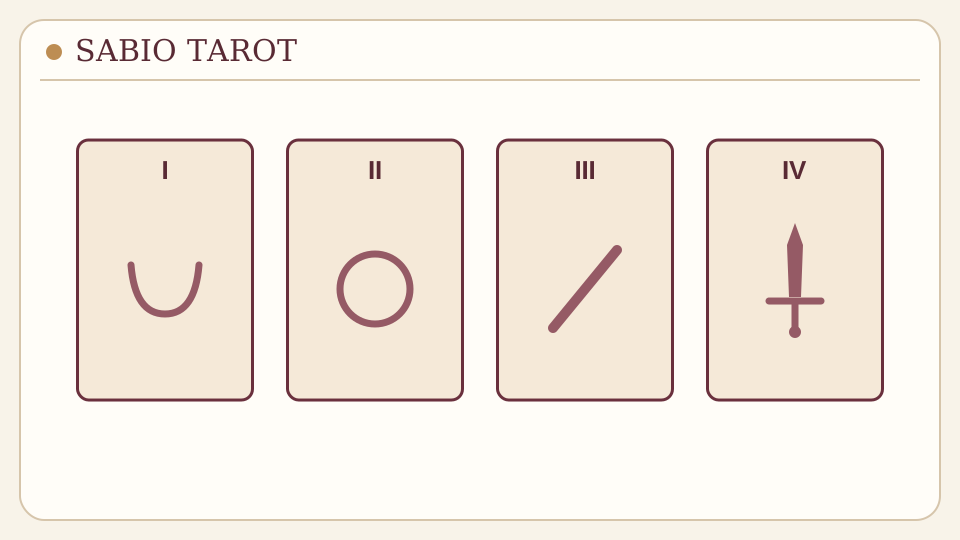
Write two columns: “What already exists” and “What I still imagine.” In the first, note an invitation, a resource, or an action you can show. In the second, place desired outcomes, others' reactions, and still-unknown deadlines. Then choose a low-cost trial and a date to review it. This exercise maintains the energy of the Ace of Wands without transforming it into a forecast. The diagram of the four suits can help you compare the initiative of Wands with an emotion of Cups, a decision of Swords, or a resource of Pentacles; it compares schematic symbols and helps ask what each suit contributes to the case.
To broaden the foundation, consult what the suit of Wands contributes, how to compare the four aces, and the guide Tarot Rider-Waite from Scratch. The best question when closing a reading of this Ace is not “is it guaranteed?” but “what is the first step I can verify without promising myself the outcome?”