Sabio Tarot · Minor Arcana
Two of Wands: Planning Without Turning the Card into a Forecast
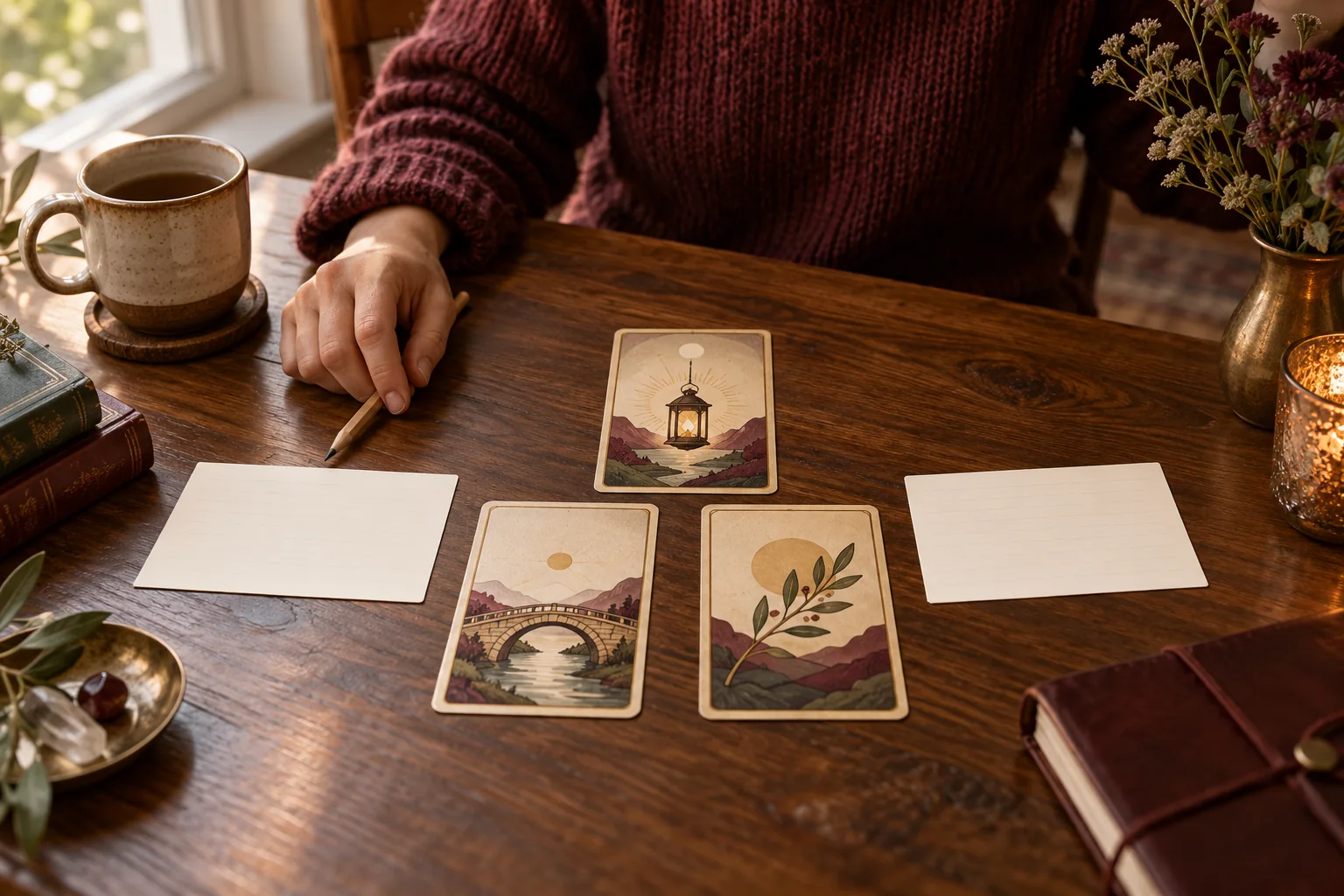
“Should I launch the course live or record it first?” is a more useful question for the Two of Wands than “Will I be famous?” The card can organize a comparison between courses of action. It does not automatically select one or promise that both are available. Its usefulness appears when you recognize what part is prepared, what decision can be postponed, and what data would make choosing reasonable.
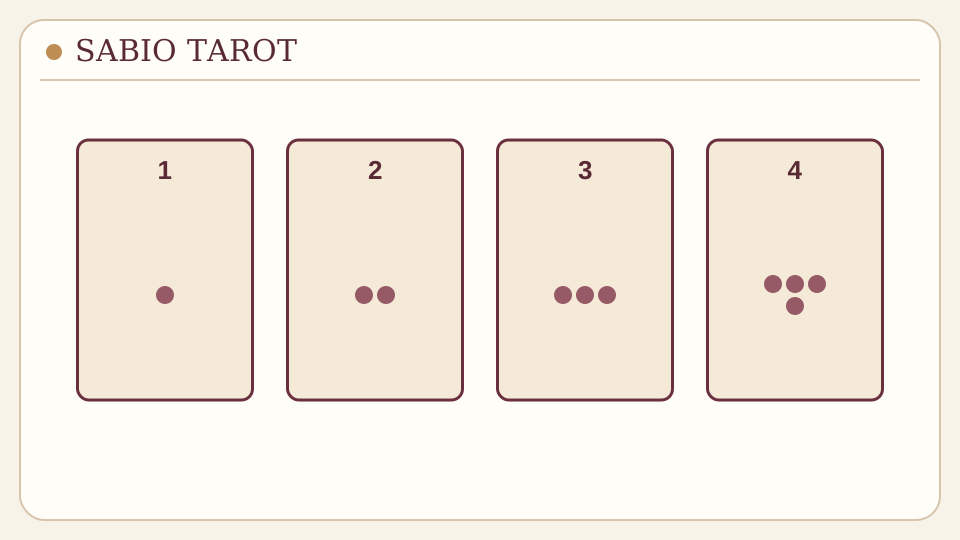
- 11
- 22
- 33
- 44
Look at the edition before telling a story
In the Rider-Waite-Smith, Waite describes a man between two wands, with a small globe in his hand, looking at sea and land from a height. The scene can suggest reach, horizon, and partial control: the man has a viewpoint, but the image does not show what he will do next. Waite's description allows us to affirm those elements of that deck. It does not allow us to say that the character is an entrepreneur, that he has bought a ticket, or that the sea represents a particular country.
A Two of Wands from Marseille presents the suit repeated and ornamentally arranged. Since there is no character looking at the landscape, the reading should not pretend that one exists. We can start from the duality of the number two and the suit of wands to formulate questions about two initiatives, two rhythms, or a tension between intention and action. That association is a proposed reading, not a visible property of every deck. The Metropolitan Museum documents the historical structure of the four suits; the V&A explains Pamela Colman Smith's illustrative contribution to the Rider-Waite-Smith minors.
Preparing is not the same as executing
The central difference of this card is temporal. A person may have designed an offer and not tested it; may be between two options without having established criteria; or may use planning to avoid facing the public's first response. The Two of Wands helps separate those states. If the question is “What is blocking me?”, it is not enough to answer “indecision.” You have to ask what information is missing and what the cost of deciding now is.
A reasonable plan needs more than an aesthetic preference. In a course, recording time, the ability to answer questions, the possible price, and the size of a first audience matter. The card can invite you to design a test that produces information: for example, a live session for twenty people with a follow-up survey. That test does not prove that the recorded course will sell; it can reveal whether the explanations are understood and what questions arise.
Position changes the hypothesis
If it comes up in “option A,” it does not make A the winner: it speaks about the type of work that option demands. In “next action,” it is usually coherent to set criteria and a decision date. In “risk,” the hypothesis could be planning without contact with reality. In “resource,” it can acknowledge perspective, room to choose, or help to prepare. None of those phrases holds up if it contradicts the facts the person reports.
A nearby card can change the nuance. The Ace of Wands brings an initial offer; the Three of Pentacles shifts attention toward collaborators and work standards; the Four of Cups could suggest saturation in the face of too many proposals. It is best to read each pair of cards according to the function of each position, not as an automatic phrase (“two plus three means success”). A spread that does not have defined positions usually gives excessive room to choose afterward the story we like best.
Fictitious example: two formats for the same idea
Invented scenario, not a testimonial from a consultation. Tomás wants to teach botanical drawing. He has a script for six classes, but he is unsure whether to publish recorded videos or teach them live. He formulates: “What should I check to choose the first format?” He uses three positions: 1) current capacity, 2) unknown, and 3) small test. He gets Two of Wands, Seven of Pentacles, and Page of Swords. The Two of Wands occupies the first position: there are two routes and initial material, but no confirmed sale.
The Seven of Pentacles in “unknown” makes him think about production time and the deadline for receiving comments. The Page of Swords in “test” translates into concrete questions for five potential students and a pilot class. Tomás writes down two criteria before asking: hours available during the month and students' need for interaction. Then he compares answers and decides to try a live class; if the test fails because of scheduling, he will revisit the recorded option. The tarot did not choose for him or certify income. It served to turn an abstract doubt into a manageable experiment.
Suppose the card had come up in “what I am avoiding.” There, the same image could invite him to review whether Tomás spends weeks imagining formats without showing a registration page. The difference is established by the question, the position, and the conversation. A fixed meaning “the world is at your feet” would have ignored the most important thing: it is still not known whether people want that course, how much time it costs to produce, and what Tomás is willing to learn from a negative response.
Four questions before deciding
First, what exactly are the two options? If only one exists and the other is a vague fantasy, the initial task is to define the second. Second, what criterion will you use to compare: time, cost, learning, enjoyment, or income? Third, what information can be obtained this week without taking on a large commitment? Fourth, on what date will you stop gathering information and make a provisional decision? These questions prevent “keep planning” from being an answer that drags on indefinitely.
In relationships, the same prudence avoids asserting what another person will do. Two possible conversations are not two known feelings in someone else. In work or investment, consult data and documents before committing money; the card does not offer a financial forecast. It is also valid to discover that neither option fits and to design a third. The visual duality does not limit real alternatives to two.
To practice, draw two columns with observable actions and a third with still-unknown data. Mark a small test for each option and write what result would make you change your mind. The numeral and suit diagram is useful for studying the two as a visual quantity, before considering what that duality represents in your question. Continue with how to read the numbers two, three, and four and with Tarot of Marseille from scratch. The value of the Two of Wands lies in choosing better the next trial, not in guessing the fate of a plan not yet tested.