Sabio Tarot · Minor Arcana
Four of Wands: A Shared Achievement with Limits

A small publishing house celebrates having printed its first collective book. The Four of Wands appears in the “what has already been achieved” position. It would be reasonable to acknowledge the milestone, the work of several people, and the right to enjoy it. It would be excessive to infer that the publishing house will be profitable for years. This card helps separate a moment of stability or celebration from the promise that nothing will ever change again.
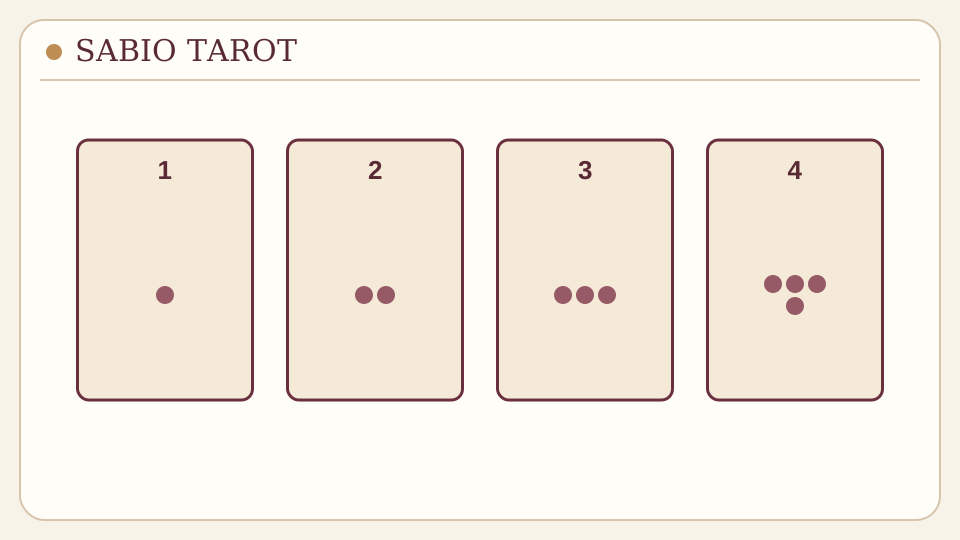
- 11
- 22
- 33
- 44
Read the Scene Without Adding an Obligatory Happy Ending
In Rider-Waite-Smith, Waite describes four wands holding a garland, figures with bouquets, a structure in the background, and a festive scene. His original description allows us to speak of a gathering and ceremony visible in that edition. We do not know from the image whether the people know each other, what they are celebrating, or how long their time together will last. Always calling it a “wedding,” a “move,” or a “signed contract” imposes an event that the card does not confirm.
The Marseille Four of Wands usually arranges four emblems of the suit in a numeral card without a narrative scene. It does not necessarily represent guests or a house. In Marseille, the structural reading relies on the repetition of four, the suit, and the position in the spread; in Rider-Waite-Smith, a scene is added that facilitates the metaphor of celebration. The Metropolitan Museum documents repeated suits in historical decks, and the V&A explains why the 1909 illustrated edition offers more scenes in the minors. Neither the Marseille arrangement nor the Rider-Waite-Smith scene forces a closed meaning.
What Constitutes a Milestone and What Remains Pending
A milestone has a date and evidence: the book came off the press, a group finished its first cycle, a family managed to settle in. A definitive outcome would imply another kind of proof: economic sustainability, lasting agreements, satisfaction of all parties. The Four of Wands can help name the first type without affirming the second. This difference matters because many people undervalue present achievements for not being perfect, while others relax too soon at an initial sign.
If it appears in “resource,” ask who contributed to the achievement and what practices could be repeated. In “need,” it may indicate setting aside a moment to give thanks or share results. In “risk,” it could point to the temptation to confuse a celebration with a stable structure. In “relationship,” it may invite one to observe a space of encounter; it does not certify marriage or a commitment from an absent person. The position and concrete facts limit the hypothesis.
Fictional Example: The Reading Club
Fictional case to demonstrate the method. A neighborhood library organizes a reading club for three months. Elena, a volunteer coordinator, asks: “What should we keep if we want to repeat the experience?” She lays out cards for 1) verifiable achievement, 2) the foundation that sustained it, and 3) an issue to review. The Four of Wands, Three of Pentacles, and Two of Pentacles come up. Ten people met at least four times; that fact belongs to the project; we do not magically extract it from the card.
The Four of Wands fits a completed cycle and a final gathering. The Three of Pentacles in “foundation” leads to recognizing the shared work: one person opened the room, another prepared questions, and another publicized the dates. The Two of Pentacles in “review” reminds us that the schedule was difficult for several participants. A useful synthesis would be: “Celebrate the cycle and ask those who attended what schedule would allow them to return; distribute tasks before announcing a new season.”
Elena could have asked another question, “Will this club be permanent?” The same card would not answer with certainty. It could speak of the value of the current format, but one would have to measure room availability, volunteering, budget, and continuity of interest. A celebration can be sincere and brief. That does not make it a failure. Allowing the Four of Wands to represent a limited achievement usually produces a more human reading than demanding eternity from it.
The Difference Between Community and Unanimity
The festive scene can suggest belonging, but it does not prove that everyone is satisfied. On a team, a closing party can coexist with disagreements about effort and recognition. If a querent asks about a shared project, they can use the card to identify what was achieved and then ask each participant what they need. Attributing identical thoughts to the whole group would be an invasive and imprecise reading.
It is also advisable not to impose joy. Someone going through a loss may experience a gathering as support, obligation, or exhaustion. If the Four of Wands comes up in a question about grief, the interpretation must start from the narrated experience, not from a mandate to celebrate. The symbol can refer to a safe place or a simple ritual. It can even show that which the person does not yet wish to attend. The card accompanies a conversation; it does not correct how someone should feel.
If a person asks whether they should attend a celebration, a careful reading can offer more than two options: go for a while, congratulate from a distance, propose another meeting, or not participate. Belonging is not measured only by physical presence. In a group that wishes to continue, recognizing who was left out of the organizing also prevents the festive image from covering up inequalities of time, money, or access.
Closing Exercise: Record of an Achievement
Write three brief lists: facts that already happened, people or resources that made them possible, and conditions necessary to repeat them. If any list is empty, avoid taking the result as consolidated. Then add a maintenance action and a date to review it. This exercise translates the possible stability of the four into verifiable decisions without dampening enjoyment of the moment.
The diagram of the first numerals helps distinguish the four as quantity from the scene that a deck may build around it. To go deeper, see the numbers two, three, and four, the suit of Wands, and Tarot Rider-Waite from Scratch. The sentence that best summarizes this card in a prudent reading is: “This deserves to be recognized; now let us see what sustains it.”