Sabio Tarot · Minor Arcana
Three of Wands: Expansion, Waiting, and Observable Signs

A project leaves the notebook and reaches other people. Someone sends a proposal, opens a shop, or announces an activity, and immediately asks the tarot whether the response will be good. The Three of Wands can help read that uncomfortable interval between having done something and knowing what the world gives back. It does not by itself inform you of sales figures, the acceptance of a proposal, or the exact timeline of a response.
- 11
- 22
- 33
- 44
What the Rider-Waite-Smith Shows and What It Does Not
Waite describes a figure seen from behind on a height, leaning near three wands, looking toward ships that sail. That image allows us to observe distance, horizon, and the movement of elements that are not in the figure's hand. It also allows a fertile question: what part of the project can the person keep working on while waiting for external information? Waite's primary description does not say that the ships return with profits or that they belong to the figure. It is prudent not to turn a metaphor of horizon into a commercial promise.
In the numerals of a traditional Marseille deck, the three of the suit is recognized by the number and arrangement of wands, with ornamental motifs depending on the edition. We do not necessarily see a coast or ships. To compare the two decks, it is more honest to say that the Rider-Waite-Smith scene facilitates the narrative of waiting and that Marseille requires formulating it from number, suit, position, and question. The Metropolitan Museum explains the structure of repeated suits; the V&A places Pamela Colman Smith's intervention in the illustrated minors. A specific edition must be observed before attributing graphic details to it.
Three Clocks in the Same Question
The reading becomes clearer if you separate three times. First, what has already been sent or set in motion: an email, a mockup, a call for applications. Second, the reasonable window for receiving signs: the agreed response deadline or the time a test takes. Third, the decision you will make when you receive them. Many consultations mix the three clocks and ask “Will it work out?” when it has not yet been defined what would be a sufficient sign of progress.
Waiting is not always passive. It can be the moment to prepare two responses: what you will do if requests come in, and what you will adjust if they do not. But neither do you have to fill every pause with frantic work. If the call for applications has just been published, checking statistics every ten minutes does not produce new knowledge. If it has been open for a month without responses, perhaps it is indeed worth changing the title, channel, or audience. The practical meaning of the Three of Wands depends on that real calendar.
The Card's Position Changes the Focus
In “current state” it can acknowledge that an action went outward. In “what depends on me” it can invite you to improve follow-up and communication. In “what I do not control” it can name time or the decision of third parties, without pretending to know them. In “risk” it can point to premature expansion: opening three sales channels without being able to handle orders. There is no universal reading of “growth” that resolves all those positions.
Compared with the Two of Wands, the three can serve to ask whether preparation has already produced a visible action. Compared with the Four of Wands, it allows separating the circulation of an offer from a specific celebration. A sequence of cards is not an obligatory chronology: two, three, and four can describe simultaneous tasks or reappear in a different order. Numerical order is a tool for thinking, not an agenda imposed by the deck.
Fictitious Example: A Translation Proposal
Invented example for learning, not a real reading. Nadia has sent a translated sample and a collaboration proposal to three magazines. Question: “While I wait for a response, what can I do to improve my position without following up inappropriately?” We agree on three places: 1) action done, 2) what is within her own control, 3) review criteria. The Three of Wands, Eight of Pentacles, and Justice appear. The first card does not guarantee that a magazine will hire Nadia; it names that the sample is already circulating outside her desk.
The Eight of Pentacles in what is within her own control suggests continuing to improve the dossier and preparing a second sample. Justice in review criteria leads to checking deadlines, rates, and conditions in writing if a response arrives. Nadia marks on her calendar a reasonable date for a single follow-up and prepares a table with the three magazines, submission date, and terms offered. If one responds, she will be able to compare. If none responds, she will have information to review the proposal before sending it elsewhere.
The verbal synthesis could be: “You have done the initial exposure part. During the wait, improve what you do control and define in advance how you will evaluate an offer.” It would be an unjustified leap to say: “Three ships indicate three contracts.” The coincidence between the number of wands and the number of magazines in the story is incidental in this example; it must not be presented as a secret code or as proof of prediction.
How to Verify an Expansion Without Inflating It
Write down four distinct facts: number of people who saw the offer, number who responded, quality of those responses, and work needed to handle them. More exposure can be useful, but it does not automatically equal sales. An enthusiastic response may not turn into an agreement. An agreement may require conditions that do not suit you. The Three of Wands invites you to observe the journey, not to erase the differences between sign, decision, and result.
If the consultation is about relationships, avoid reading the ships as people who “will return” or as inevitable messages. Another person's silence does not reveal intentions with certainty. It can be more respectful to decide how long you want to wait, what direct conversation is possible, and what boundaries suit you. If it concerns health, money, or legal matters, the card also does not allow replacing professional information or verifiable documents.
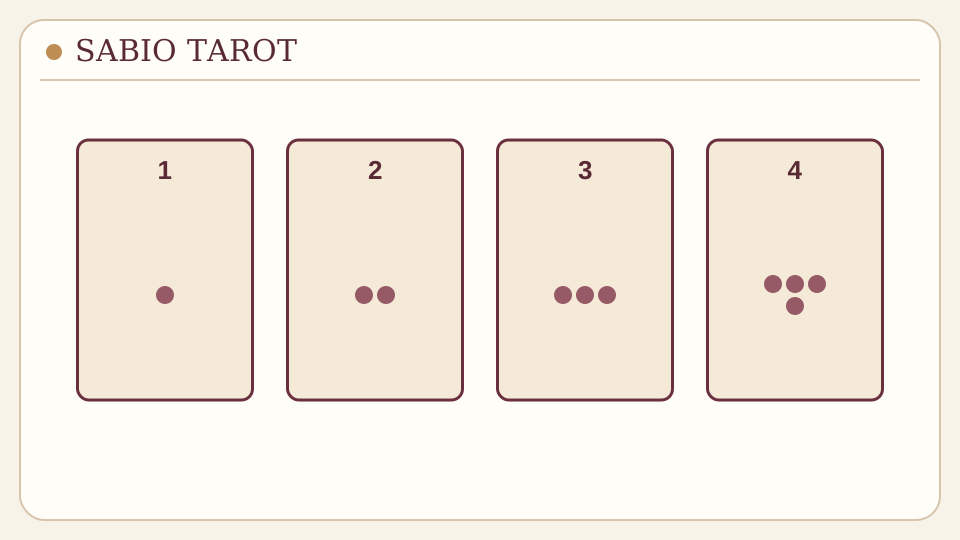
A useful practice is to design a traffic light of signs: green for responses that meet criteria, amber for interest without commitment, and red for prolonged absence or incompatible conditions. Set when you will review the traffic light and what you will do in each state. The teaching diagram of numerals helps compare two and three without pretending to represent a deck; continue with the numbers two, three, and four and Rider-Waite Tarot from Scratch. The productive question is not “When will my ship return?” but “What observable sign would change my next step?”