Sabio Tarot · Reading methods and spreads
Clarifying card: when to draw a second card and when to stop
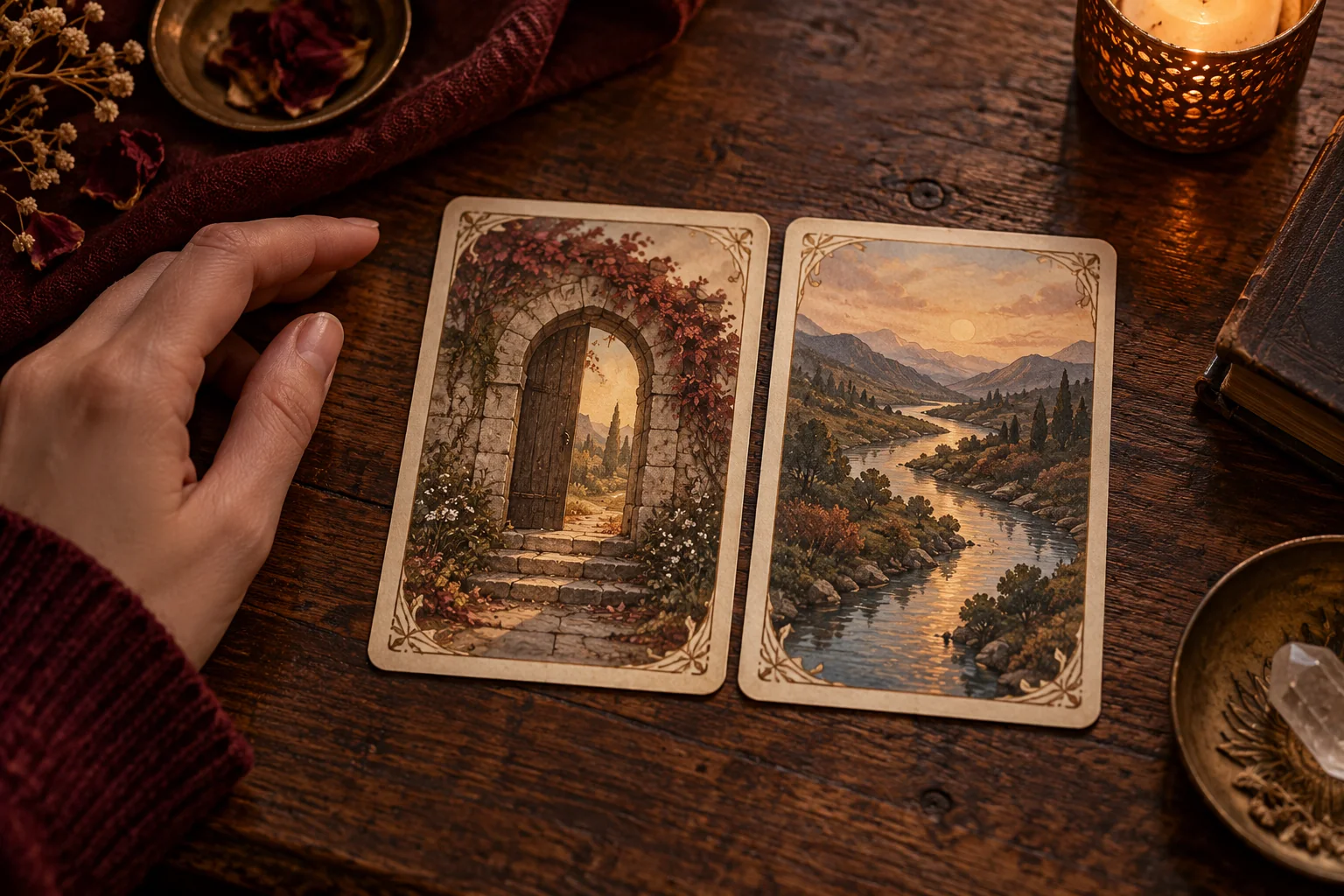
A clarifying card can resolve a reading doubt, but it can also start a chain of confirmations that ends up confusing the original question. Before drawing another card, write which precise aspect you want to clarify. If you cannot name it, return to the first card, its position, and the question. The second card does not correct the first as if it were an error; it offers a nuance that you should read in relation to it.
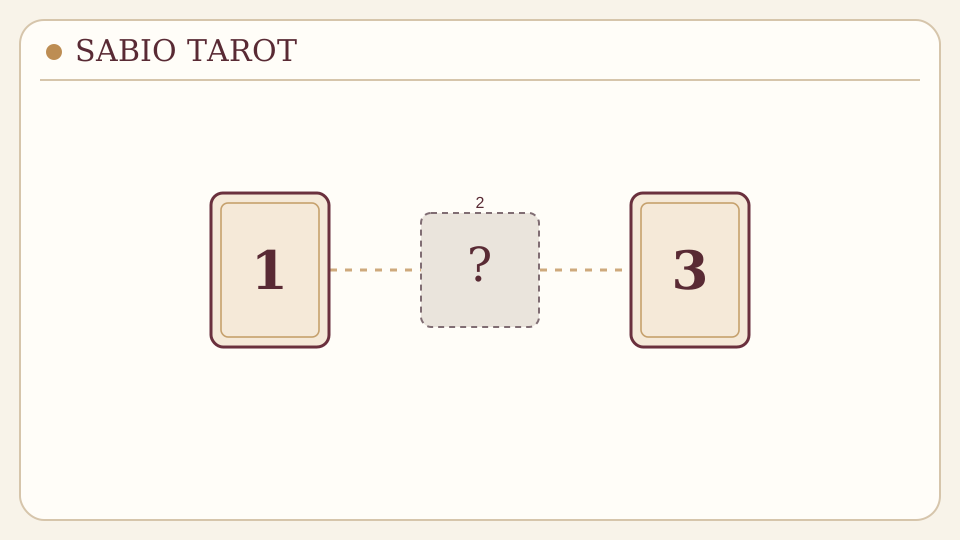
- 1Initial card
- 2Stated doubt
- 3Clarifier
Interpretive doubt or seeking reassurance
There is a difference between “I don't know whether this card speaks of a resource I already have or one I need to ask for” and “I don't like this card; I'll draw another until a better one appears.” The first doubt proposes two testable hypotheses. The second seeks a different emotion, and no number of cards can promise it. Write the doubt in one line, set the role of the second card—“which detail will distinguish the two hypotheses”—and draw only one. If it still remains unresolved, keep the “I don't know” and seek information outside the deck.
The clarifying card can reinforce, limit, or redirect the initial reading. Do not read it as an isolated answer or change the question once seen. In a Rider-Waite-Smith deck, observe the details of the printed scene; in Marseille, do not attribute to a numeral a scene that does not appear. The relationship between the two cards matters more than a long list of keywords.
Fictional example: asking for help or working alone
Invented example to teach the criterion. Clara asks “What do I need to review before submitting my project?” The first card, Three of Pentacles, suggests work that would benefit from a technical eye. But she doubts: does she need formal collaboration or just a one-off review? She sets the clarifying card as “what form of support would be useful now?” and draws Page of Swords. It proposes asking a female colleague to read the instructions and point out three unclear points. The second card specifies a review action; it does not predict the female colleague's opinion.
Clara sends a draft and asks whether the other person has time. If the colleague does not have time, Clara will look for another review route. The reading was useful because it ended in a concrete and agreed-upon request. It would have lost usefulness if Clara had drawn successive cards to ensure that the colleague would respond well.
Stopping rule
After two cards, write “The first raises X; the second specifies it as Y; I will check Z.” If you cannot do this, stop the spread and consult a manual or reread how to interpret two cards together. To study why a card does not fit, the guide I don't understand a card offers a process before adding more cards. Write in three boxes “initial card,” “concrete doubt,” and “clarifying card.” After the second card, stop the spread: do not draw any more cards and continue only with the synthesis if you can explain which doubt remained open.
Four different reasons for wanting another card
Before drawing the clarifying card, identify which of these situations you have in front of you. Position ambiguity: you do not remember what you wanted to know with the first card. The solution is to return to your notes; another card does not fix a poorly defined position. Image detail: there are two plausible readings of a gesture or a numeral. You can consult the edition and the manual before asking for a nuance. Missing external information: a response, a figure, or a conversation is missing. Obtain that information outside tarot. New and delimited question: you already understand the first card, but you need to explore a specific consequence. Only in this fourth case can a second card add value without covering up the previous uncertainty.
This classification is not a magic rule about how many cards are allowed. It is a way of knowing what problem you are trying to solve. If you write “I want to make sure everything will go well,” you are asking for emotional certainty. A clarifying card can produce a pleasant card, an unpleasant one, or also an ambiguous one; none confirms the future. You can pause the reading, talk with someone, or set a small action before returning to the deck.
A second interpretation of Clara's case
The Three of Pentacles could refer to collaboration in the process, not only to a final review. The Page of Swords, in the clarifying position, could point to questions Clara has not yet asked about the submission requirements. If the project is individual and the instructions prohibit external help, asking a female colleague to review the content might not be appropriate. In that context, a better action would be to ask the teacher what type of review is allowed or to use a public list of criteria. The clarifying card does not override the real rules of the project.
Another possible reading would be that Clara needs to read her own draft more carefully. The information that would decide between the two is not in the Page: it is in the assignment rules, the time available, and the type of comment required. Write two hypotheses and one piece of information that distinguishes them. The quality of the interpretation increases when you can explain why you rule out an option without pretending that the card contained the external information.
How to formulate the clarification question
Avoid “what does this card mean?”, which delimits nothing. Better is “which aspect of the suggested support should be examined: the type of review or the moment to ask for it?” You can also ask “what should I observe to distinguish whether this pause helps me or delays me?” The second card is placed next to the first and recorded with its exact function. Do not rearrange the order after seeing it.
Next, write a sentence where both cards keep their role: “The Three of Pentacles leads me to examine the quality of the shared work; the Page of Swords invites me to prepare a specific question about the instructions.” If the sentence speaks only about the second card, perhaps the first disappeared from the reading. Then return to the connection or do without the clarifying card. A good nuance makes the original question more precise; it does not replace it with another.
Stop signals and record
Before starting, set a simple rule: an initial card, at most one clarifying card for a written doubt, and a provisional synthesis. If the meaning remains open, write “unresolved.” Also leave a date to review what information arrived later. The stop prevents a reading from becoming an attempt to negotiate with the deck until finding the preferred answer. In a journal, note what was troubling you before drawing the second card, because that emotion may explain why you were seeking confirmation.
In no case should a clarifying card replace a safety, health, money, or legal check. If the doubt affects any of those areas, consult relevant sources or professionals. This method keeps tarot in a reflective role: it helps articulate possibilities while preserving the difference between image, inference, and fact.