Sabio Tarot · Reading methods and spreads
Five-Card Spread to Prepare for a Difficult Conversation

A pending conversation raises questions that tarot cannot answer with certainty: “Will they get angry?”, “Will they admit I'm right?”. This spread directs attention to what you can prepare. Its five positions form a sequence: preparation, message, listening, boundary, and closing. They are not five answers from the other person; they are five tasks of yours before and during the dialogue. If there is a risk of violence or coercion, safety and appropriate support take priority over any spread.
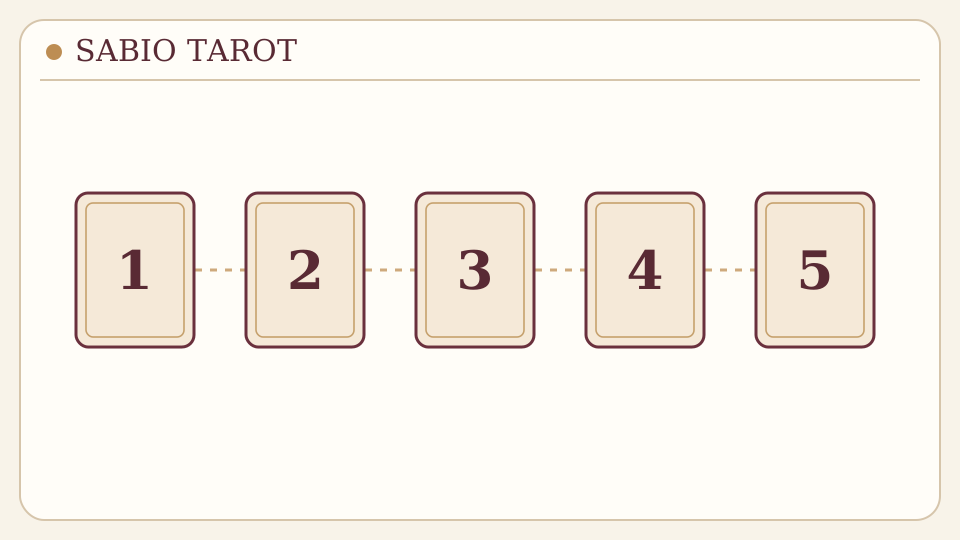
- 1Preparation
- 2Message
- 3Listening
- 4Boundary
- 5Closing
Why order matters
Preparation names your state and the real goal of the meeting. The message seeks a clear sentence you can say without attributing intentions. Listening reminds you what fact or perspective you need to understand. The boundary identifies what behavior you will or will not accept. The closing proposes a next step, even if there is no agreement. Write down each function before drawing cards and leave space to write a practical sentence under each one.
If an intense card appears in “listening,” write down what is hard for you to hear and prepare an open question to verify it with the other person. If a gentle card appears in “boundary,” do not erase the need to protect your time or privacy. The position provides context; a dictionary label does not replace the real conversation.
Fictitious example: dividing tasks
Invented scene for teaching purposes. Leo shares a project with Inés and feels that deadlines fall on him. Question: “How do I prepare a conversation about dividing deliverables?” In preparation, Four of Swords appears: choose to talk after resting, with the task list in front of you. In message, Ace of Swords comes up: draft “I need to agree on who delivers each part and when.” In listening, Two of Cups appears: its exchange of cups reminds you that listening is also receiving information before responding; leave room to learn Inés's conditions instead of assuming disinterest. In boundary, Seven of Wands comes up: decide not to accept another deliverable without a date or owner. In closing, Three of Pentacles appears: propose recording a division and reviewing it the following week.
The spread does not predict Inés's response. The dialogue may reveal that she had an unknown load or that she does not accept the division; in either case Leo will be able to adjust his decision with new facts. The closing sentence he rehearses is: “Let's review the task table next Tuesday and confirm what is feasible for each of us.”
The test away from the table
Before speaking, verify that your message describes observable facts and not personality diagnoses. Carry an open question: “What part can you take on?” Also prepare a respectful exit if the conversation does not move forward. Afterwards, compare what happened with your initial notes without forcing the cards to have “been right.” The general five-card spread explains how to avoid five separate monologues; reading for another person reminds you why the other voice keeps its autonomy. If you make an outline of the five positions, end with a review box: what the other person actually said and what agreement there was.
Two versions of a message: accusation and request
The second position does not authorize you to state that you know why Inés delivered late. Compare these formulations. “You never care about the project and you always leave everything to me” accumulates absolutes and attributes an intention that Leo cannot verify. “Last week I took on two deliverables that we had divided; I need to agree in advance who handles each one” describes facts, impact, and request. The second sentence may still be uncomfortable, but it opens a verifiable point. Tarot helped Leo prepare his tone; it did not give him access to Inés's thoughts. He can ask her about her motives and accept that she decides how much she wants to tell.
The Ace of Swords, in the message position, could be read as clarity, but it does not demand harshness. Leo can write his sentence, read it aloud, and ask himself whether another person would know exactly what change he is requesting. If the answer is no, simplify. Do not add five demands in a single conversation if the initial goal was dividing deliverables. A brief message leaves room for the third position: listening.
Listening is an action, not a prediction
To prepare the third position, Leo can write down questions such as “what part of the calendar is unworkable for you?” and “what support would you need for your section?” Then he must attend to the real answer, even if it contradicts his hypothesis. Perhaps Inés had an emergency; perhaps the division was never confirmed. None of those possibilities appears as fact in the Three of Pentacles or the Two of Cups. Leo will be able to compare them in the conversation if Inés wishes to respond.
In the fictitious reading, imagine two possible responses. If Inés explains a problem accessing files, the next reasonable step is to resolve it and set owners. If she says she does not want to participate in that part, Leo can rethink the project or his own involvement. The same spread helped prepare both routes. This is the reason to reserve an open closing position: it must admit more than one real-world response.
Boundary and closing without punishing the other
A practical boundary would be “I will not confirm a date to the client that we have not agreed on between the two of us.” It depends on what Leo will do and protects the project's reliability. It would not be “Inés has to understand my card” or “if she doesn't listen to me, tarot proves she is unreliable.” The fourth position forces a distinction between a demand and your own action. If Leo cannot fulfill the boundary he wrote, he should make it more modest.
For the fifth position, also write down how you would close if there is no harmony: A conversation can end with a clear disagreement and a date to pick it up again; that can be more honest than a rushed agreement. Leo could end by saying “Thank you for explaining; I'm going to review the calendar and send you two options tomorrow.” Afterwards, write down what was said, what remains pending, and who accepted each task. When there is a real other person, consent and shared information matter more than any inference about a card.
When to use fewer than five cards
Five positions make sense if you need to prepare several moments of the dialogue. To ask for a simple change—for example, adjusting a meeting time—one or two cards could be enough. If the topic involves harassment, threats, or a power imbalance, the priority is not improving a spread: seek appropriate support and protection channels. Tarot can help you reflect on your voice, but it does not replace procedures or professional advice. Write down the question, the positions, and the date so you can compare the preparation with the conversation without later rewriting what you thought you knew before.