Sabio Tarot · Reading methods and spreads
Three-card spread to review a week

You don't need to assign one card to Monday, another to Wednesday, and another to Friday for a weekly reading to make sense. If the week has already happened, a spread of learning, pattern, and adjustment helps you look at what you lived through without pretending you predicted it. The first card looks for something you learned; the second, a repetition you may not have seen; the third, a small modification to try in the following week.
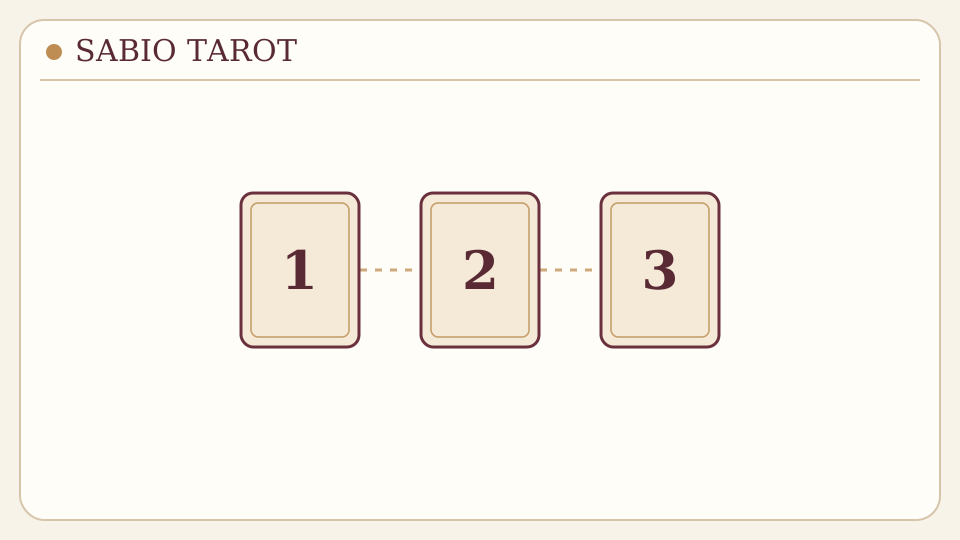
- 1Learning
- 2Pattern
- 3Adjustment
Start with a record of facts
Before shuffling, write down three facts from the last seven days: a completed task, a difficulty, and a relevant interaction. Separate those data from emotions and from your conclusions. Set the positions in that order: 1) learning, 2) pattern, 3) adjustment. The question could be “What can I learn from my work routine this week and what will I change during the next one?”. If you don't keep a journal, approximate dates are enough; avoid completing memories after seeing the cards so that they match them.
Read the cards as questions for review, not as proof that an event occurred. A card associated with rest in the second position can ask you whether you are repeating too-short breaks; it does not by itself prove an illness or a hidden cause. The third position is only useful if you can turn it into a behavior you will observe.
Fictitious example: a week of study
Invented example; it does not represent a client reading. Sara records that she finished two exercises, postponed a long reading, and studied late three nights. She asks for a review of her week. Six of Wands comes up in learning: she recognizes that the short exercises did move forward. In pattern, Four of Swords appears: she interprets that she needs real breaks, although she also considers the alternative that she used “resting” to postpone the difficult text. In adjustment, Two of Pentacles comes up: she proposes alternating a short reading session with an exercise session, instead of leaving the reading for the end of the day.
The conclusion is conditional: “The small things held; I will examine whether my pause restores me or diverts me; I will try a two-block sequence on Tuesday and Thursday.” Sara will note duration and feeling of concentration, not a “hit” score for the cards. If she discovers that the main obstacle was that she didn't have the complete material, she will modify the hypothesis.
Review without hindsight bias
Keep the question, the three cards, your initial interpretation, and the date. At the end of the following week, add a new note without erasing the first. This allows you to see what decision you made from the reading, what fact changed, and where you overinterpreted. The three-card spread serves as a general introduction; here the specific value is the comparison with an already dated journal. In the retrospective section of the journal, use three columns —fact, hypothesis, and adjustment— and leave space to write what you still don't know. The two temporal blocks organize the entire page.
Distinguish a lived week from an imagined week
This spread is retrospective in its first two positions. “Learning” and “pattern” should dialogue with facts you already wrote down, not with events you expect to happen. “Adjustment” looks toward the following week, but it does not predict how it will turn out. That boundary prevents a vaguely positive memory from later being presented as a fulfilled prediction. If you want to read the future as entertainment, you can do so with another question; here the task is to review decisions and habits without falsifying the record.
To maintain the boundary, draw two columns on the journal page: what I know about last week and what I will try in the next one. Under the first, write dates, actions, and observable results; under the second, a single behavior that depends on you. Sara knows she studied late three nights because she wrote it down. She doesn't yet know whether alternating blocks will help her. The final card serves to propose the test, not to fill in the result in advance.
How to detect a reading that seems to fit everything
A pattern like “I need balance” is easy to apply to almost any week. Ask for more precision. Balance between which two activities? What signal would show that it changed? In the example, Sara could compare the hours of reading and exercises, and note whether she finished the planned chapter before nine. The phrase “I must balance myself” has no review criterion; “I will put fifteen minutes of reading before each exercise block on Tuesday and Thursday” does.
Also test an alternative explanation. The Four of Swords could invite more rest, but Sara may already rest enough and postpone only the long reading because she has difficulty understanding it. In that case, the adjustment would not be to sleep more but to ask for clarification or divide the text into parts. To choose between alternatives, look at the journal, ask what was missing, and preserve uncertainty. A card does not diagnose tiredness or lack of discipline.
A second brief example with another question
Additional fictitious example. Pablo reviews a week of musical rehearsals. He had played three days, canceled one, and recorded an improvisation. In learning he draws Three of Pentacles and recognizes that the recording gave him concrete feedback from his teacher. In pattern, Seven of Cups appears: he kept changing pieces without finishing any. In adjustment, The Chariot comes up: he proposes choosing one piece for four sessions and recording it again at the end. The synthesis is not “tarot guarantees a successful performance.” It is “feedback helps, but I need a priority and a comparable measurement.”
Pablo notes which fragment he will rehearse and for how long. If at the end he discovers that the piece was too difficult, the review does not turn the Seven of Cups into a prophecy: it shows that the level needed adjusting. This example demonstrates that the same structure works for study, art, or work without turning the positions into “Monday, Wednesday, and Friday.” What is stable is the function of each position; the content adapts to the situation.
A reusable journal page
Date the sheet and copy seven lines: three facts; review question; learning card and the data that supports it; pattern card and alternative explanation; adjustment card and action; signal to review; later dated note. You can add a photograph of your own deck if you have the right to use it, but written names and an original outline are enough. The later note should go below, never replacing the initial sentence.
If a week was especially difficult, don't force an optimistic lesson. “I don't yet have a conclusion” is a legitimate result. A pause, a conversation, or professional help may be more relevant than another card. Regular practice improves when it allows for days without a clear answer and measures usefulness by what it helps you observe, not by a supposed ability to guess every event.