Sabio Tarot · Reading methods and spreads
Three-Card Spread for a Creative Block

“I don't have ideas” can mean that materials are missing, that there are too many options, or that an expectation that is too high is preventing you from starting. A three-card spread helps formulate a creative test of manageable size. The positions are available material, concrete resistance, and a twenty-minute experiment. No card can guarantee that you will produce a valuable work; the goal is to make an action visible and observe what happens.
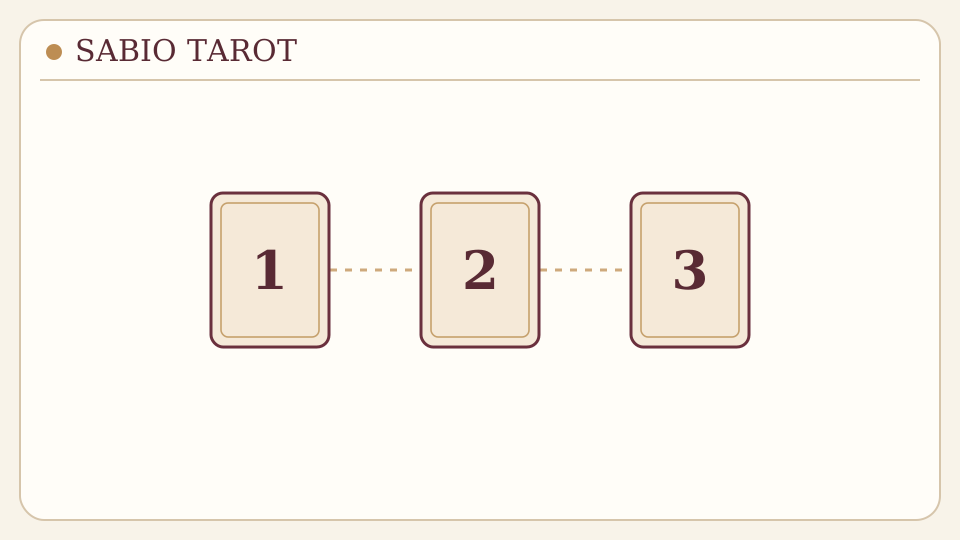
- 1Available material
- 2Resistance
- 3Small test
Positions That Do Not Repeat the Same Question
The first card asks “what do I already have?”: drafts, images, conversations, tools, or time. The second asks “what is blocking the use of that material?” Avoid turning it into a judgment about your personality: describe a condition, such as a lack of selection criteria or fear of showing a first attempt. The third asks “what can I try today without committing to the entire project?” Decide the time limit before drawing the cards so that the exercise does not become another way of postponing.
Place the cards in a line and read the third in light of the first two. If the material is abundant and the resistance is scattering, the experiment can be to choose a single piece. If the material is scarce, it may be worth gathering references before seeking an inspiring interpretation. Tarot here organizes questions; the creative result depends on the work you do afterward.
Fictitious Example: A Story That Does Not Begin
Invented scenario, not a real case. Eva has notes for a short story and asks what would allow her to begin a scene. In the material position appears the Seven of Cups; she imagines several possibilities, but when she reviews her notebook she finds five character ideas. In the resistance position comes the Four of Pentacles: she reads a tendency to protect the “good” idea and not risk an imperfect draft. In the experiment position comes the Eight of Wands: she writes an arrival scene for twenty minutes without correcting it. The synthesis is: “Options are not lacking; I need to choose one and let it move forward before evaluating it.”
Eva sets a timer and writes 350 words. Then she marks an image that deserves to continue and a confusing part. If she had only written 80 words, there would still be a useful test: she could observe where she interrupted herself. The reading did not diagnose her creativity or dictate the plot; it gave her a framework for experimenting.
From the Spread to the Notebook
Write down the real material you have located and the action taken. Review the experiment once, without drawing another spread to judge it. If the block persists for weeks and affects other areas of your life, seek appropriate support instead of demanding a clinical explanation from the cards. To go deeper into the role of positions, see position and meaning and practicing tarot for thirty days. In your notebook, leave three boxes for the positions and a blank page at the end to record the experiment performed.
Resistance Does Not Define Your Identity
The second position tends to attract harsh words: laziness, incapacity, lack of talent. Avoid them. A card does not diagnose Eva's personality, and a creative block has many possible causes. Describe the obstacle as a relationship between task and conditions: “I want to write a perfect scene before having a draft” is more precise than “I am a bad writer.” “I have five beginnings and no rule for choosing” is more useful than “I never finish anything.” That precision makes it possible to design an experiment.
In the example, the Four of Pentacles was interpreted as excessive care for the idea, but it could also be an invitation to keep a stable element of the story while Eva tries variations. To distinguish both hypotheses, look at her notebook: has she rewritten the same first paragraph for days, or does she change the plot every hour? If it is the first, she needs to write without editing; if it is the second, perhaps she needs to fix a character and a situation for a week. The card opens alternatives; the record of the work decides which one is worth trying.
Design an Experiment That Can Fail Without Harming You
The third position should not say “finish the novel.” That task is too big for a twenty-minute unblocking. A suitable experiment has a beginning, an end, and an observation criterion: “I will write a 200-word arrival scene without correcting it and mark one sentence I want to keep.” If the result is uncomfortable, you will still have discovered something about the point where you stop. An experiment can be drawing ten thumbnails, listening to three rhythms, sorting photographs, or recording a voice note. The important thing is to reduce the cost of starting.
The interpretation of the Eight of Wands in the example is not an order to always speed up. If Eva were exhausted, a better test might be to sort her notes for ten minutes and leave the writing for another day. Observe the real working condition before turning a card of movement into pressure. Tarot does not measure rest or capacity; you can review time, energy, and obligations.
A Second Fictitious Scene: Too Many References
Another invented example. Bruno is preparing an illustration and has spent hours looking for inspiring images. In the available material position appears the Three of Pentacles: he has sketches and comments from a colleague. In the resistance position comes the Seven of Cups: he accumulates incompatible references. In the experiment position appears Justice: he decides to create a matrix with two visible criteria—composition and contrast—and choose only three references. He does not need to know whether his final illustration will “succeed”; he needs a limit that allows him to draw.
Bruno makes the matrix and discovers that no reference resolves the character's pose. That finding changes the next step: he makes three pose sketches before deciding on color. The spread was useful even though the final action did not literally match a word from the manual. It helped name a selection problem and generate a test. It does not attribute to the cards a technical solution that he still has to learn through practice.
Close with Evidence of Process
After the experiment, record three things: what you did, what part produced a clue, and what new question appeared. Do not evaluate the “success or failure” of the entire work from a short session. If a test did not help, change one variable, not the whole method. Eva could move from twenty minutes without correcting to ten minutes reading aloud; Bruno could limit the search for references to half an hour. This follow-up turns the spread into a learning tool about the creative process, without promising instant inspiration.