Sabio Tarot · Reading methods and spreads
Five-Card Spread for Changing a Routine

A routine change breaks easily when it starts as a huge promise: 'Starting tomorrow, I'll do everything differently.' This spread uses five positions to prepare a two-week trial: motive, barrier, support, experiment, and review. It does not diagnose habits or guarantee that a change will last. It forces you to define a small behavior, an environment where it can happen, and an honest way to check what happened.
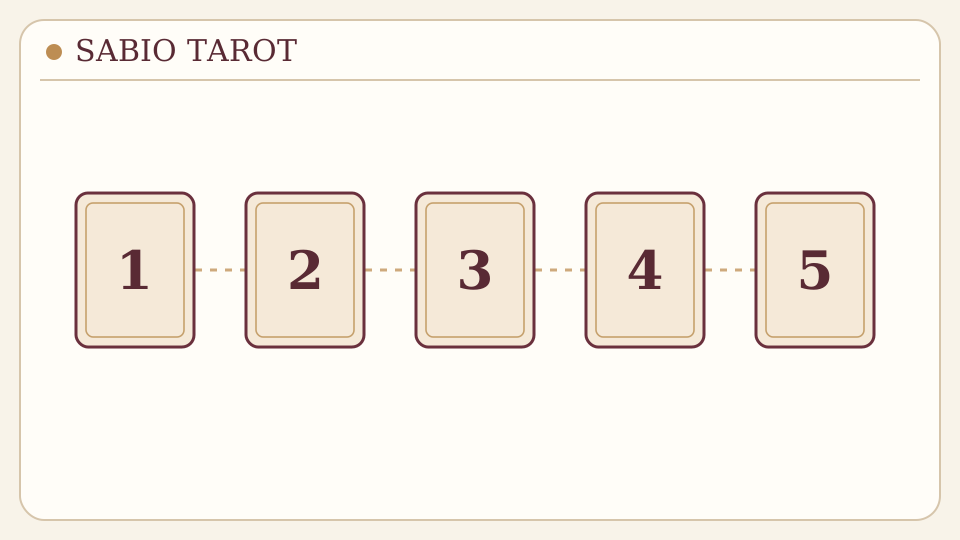
- 1Reason
- 2Barrier
- 3Support
- 4Trial
- 5Review
Choose an Observable Routine
'I want to take better care of myself' expresses a valid intention, but it does not allow you to evaluate a concrete trial. 'I want to set aside fifteen minutes to read after dinner four days a week' does. Also write down what happens now: how many days you read, what prevents you, and what material you have ready. The first card asks about the motive that matters to you; the second about an observable barrier, not a personal defect. The third points to real support or support you can ask for. The fourth proposes the minimum experiment and the fifth, the criterion and review date.
The positions can be arranged as a path with a fork: from motive to barrier; support helps you cross it; the experiment tests a response; the review looks at the results. If a card seems to suggest a grand solution, reduce the scale. A useful trial must fit within fourteen days and allow adjustments without declaring that you 'failed.' The general five-card spread teaches you not to lose the question among so many positions; here each one is linked to designing a habit.
Fictional Example: Returning to Reading
Invented case, not a reader's testimony. Sofía wants to read before sleeping, but when she gets into bed she uses her phone until late. She asks: 'How do I test a reading routine over the next two weeks?' The motive is The Star: she associates reading with a calm close to the day, without attributing a promise of well-being to the card. The barrier is Seven of Cups: she notices that she jumps between apps and content. The support is Four of Pentacles: she can set aside a physical book on the nightstand and leave the phone out of reach. The experiment is Eight of Pentacles: she decides to read ten pages or fifteen minutes, four nights a week. The review is Justice: she will keep a simple record of days and hours, without judging a single night.
The synthesis is: 'I want a different close to the day; getting scattered by the phone is the barrier I know; I will prepare the book and try fifteen minutes four nights; I will review the days actually done.' Sofía puts the book in sight and a reminder on the calendar. The spread does not explain why she uses the phone or guarantee that she will sleep better. If sleep is a health problem, she will consult a professional instead of attributing it to the cards.
Design the Trial So It Produces Information
Sofía notes each night whether she prepared the book, whether she read, and what interrupted the session. If she read ten minutes instead of fifteen, she records ten; she does not turn an arbitrary limit into a reason for guilt. At the end of the first week she notices that the phone was not the only barrier: two days she got there too late. She can change the reading time or lower the goal to five minutes on those days. The purpose of the review is to adjust the system, not to prove that a card about work demands perfect discipline.
A trial needs a success criterion and a learning criterion. 'I read four nights' is a measurable result; 'I discovered that on Tuesdays I get home late and need another time' is also a learning even if it does not meet the goal. The fifth card can suggest rigor; the record's data counts for more than a retrospective impression.
When Support Depends on Another Person
Imagine that the routine change requires someone to watch a child for twenty minutes or share a silent space. The third card does not guarantee that the person will agree. You must ask, listen to conditions, and prepare an alternative plan. Support can also be material: a place, a short list, a discreet alarm. Write whether the resource exists and is available, or whether it is only a possibility. Confusing both states creates plans that fail before they start.
In Sofía's case, leaving the mobile phone out of reach depends on her, but maybe she needs it for an important call. She can set a priority contact or choose another location, depending on her circumstances. The reading does not dictate a universal rule. The experiment must respect real needs, responsibilities, and rest.
A Second Fictional Example: Drawing Practice
Another invented scene. Mateo wants to draw three times a week. Motive: to return to an activity he enjoys. Barrier: he waits for long blocks of time that rarely come. Support: a small notebook in his bag. Experiment: ten minutes of sketching after coffee on Mondays, Wednesdays, and Fridays. Review: count sessions and choose one observation to improve, not measure 'talent.' If a session is missed, he can pick it up on the next date; he does not have to restart the whole trial.
This example shows that the structure does not belong only to nighttime reading. The difference between a reading habit and a drawing habit changes materials, schedule, and criterion, but keeps the five functions. If the barrier is a lack of a specific skill, support can be a guide or a class. If it is time, it may be worth reducing sessions. The card does not know which of those problems exists until you check it against your life.
Closing and Review at Fourteen Days
Copy a sheet with columns for date, intention, action taken, observed obstacle, and adjustment. Do not erase empty days; they are part of the information. On day fourteen, write one sentence for each position and ask what actually changed. Sofía might discover that she read five nights, but never in bed; reading on the sofa works better for her. That result does not 'contradict' the spread: it modifies the routine with new evidence. You can design a second cycle with another schedule without drawing cards until you have a different question.
Write on a sheet what habit you will test, when you will try it, and what signal you will observe for two weeks. Leave space to record the days it did not work and the reason, without turning them into a personal failure. The reading fulfills its function when it leaves you with a bounded experiment, a dated review, and permission to adjust the plan without inventing certainties about the future.