Sabio Tarot · Reading methods and spreads
When a Large Tarot Spread Stops Helping

An extensive spread can be beautiful and useful when each position answers a necessary part of the question. It can also hide the question under a mountain of interpretations. The right size does not depend on “more cards giving more truth.” It depends on how much context you have, what decision you can make, and whether each card adds a distinct function. Here we compare the same case in three, five, and many cards to show where expanding adds clarity and where it only adds noise, taking into account that the initial question can be refined as new information is incorporated.
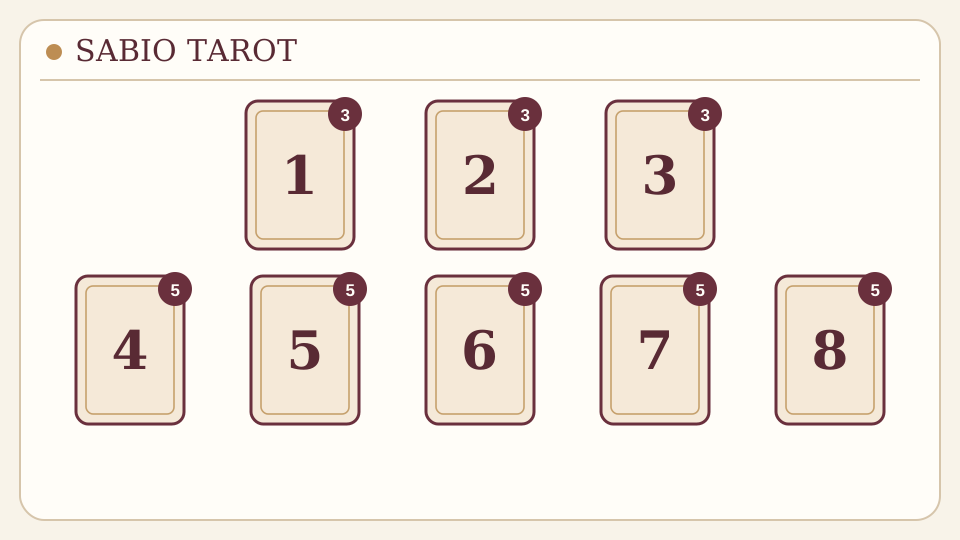
- 13: context
- 23: resource
- 33: step
- 45: context
- 55: friction
- 65: resource
- 75: step
- 85: review
The Fictitious Starting Question
All examples on this page are invented. Paula prepares a small sample of photographs and asks: “What should I review before sending my selection to a call for entries?” She has ten finished photographs, but she does not know whether the call for entries accepts a series or independent pieces. She also must confirm size, deadline, and permission for recognizable people in some images. These are facts and doubts that are real within the fictitious scenario. No card can verify the call for entries’ guidelines or replace consent and image rights.
Before choosing a spread, Paula lists decisions under her control: read the guidelines, select images, ask for a review, and send on time. The guide to choosing a spread starts from the question; here we will use it to compare sizes. A broader query is justified only if it separates tasks that cannot reasonably fit in a single position.
Three Cards: Enough for an Initial Orientation
Paula defines available material, main doubt, and next step. In the example she draws Three of Pentacles, Two of Swords, and Ace of Swords. She interprets the first as finished work she can show to someone else; the second as a lack of criteria for choosing between a series and loose pieces; the third as the need to read and summarize the guidelines before deciding. The synthesis is: “I already have material; I cannot choose a presentation without knowing the accepted format; I will read the guidelines and prepare two brief proposals.” That sentence does not need more cards to take a first step.
If Paula had asked only “what should I do today?”, three positions might even be too many. Reading the guidelines would be the obvious action without shuffling. Tarot should not replace research tasks that we already know are necessary. The spread can help when the doubt concerns how to organize work or which personal concern to address, but it does not verify external requirements.
Five Cards: Useful If There Is a Second Decision
Suppose Paula read the guidelines. Now she knows that both formats are accepted, but not which one communicates her project better. Five positions can add value: goal of the sample, strength of the series, strength of independent pieces, selection criteria, and action before sending. If in the example The Star, Six of Wands, Page of Swords, Justice, and Eight of Pentacles come up, she could read hope of communicating a coherent vision; a series with visible continuity; individual pieces that allow variety; written quality criteria; and a final technical review. They are not five verdicts. Each card answers a function chosen after obtaining the external information.
The conclusion could be: “I want the set to have a recognizable throughline; I will check whether six images sustain that line and ask someone for a second look; then I will confirm resolution and credits.” If the six do not form a set, the independent-pieces format remains open. The fifth card does not guarantee acceptance. The jump from three to five cards was useful only because, once the guidelines were read, the initial question was refined into a new question about the presentation format.
Many Cards: When Information Degrades
Now imagine that Paula lays out twelve cards and gives each one an improvised function: what the jury thinks, which photograph “wants” to be chosen, whether the competition is strong, whether she will receive an answer soon, what a silence means, and so on. Some positions ask about private thoughts or inaccessible facts; others repeat; several were invented after seeing the cards. The reading produces more sentences, but not more capacity to act. Paula can choose a favorable card and forget the ones that contradict her wish.
A twelve-card spread is not defective because of its number. It could serve in a long practice, with a well-defined question and twelve justified functions. In this case it fails because the original question asked to review a selection, and most of the new positions no longer help with that. The criterion is not “never use more than five”: it is “explain what new information each position would contribute and what you will do with it.” If you cannot answer, reduce the spread.
Signs That It Is Time to Stop
Stop when you start renaming positions so they fit the cards, when a new card only seeks to confirm an answer you do not like, or when three nearly identical versions of the same doubt appear. Also when you already have a clear action: Paula knows she must review images and credits. An additional card does not shorten the work. The guide to closing a reading can help you write a synthesis without waiting for the impossible certainty of a definitive card.
Another sign is losing the provenance of statements. “The jury prefers series” can only be sustained if the guidelines, an interview, or official criteria say so; not because a card suggests continuity. Separate on your sheet documented fact, symbolic interpretation, and proposed action. If you cannot identify a sentence’s column, postpone it until you verify it. This practice also protects against hindsight bias: if the call for entries accepts the work, you will not attribute to the twelve cards a prediction you never wrote clearly.
How to Reduce an Already Extended Spread
If you drew too many cards, you do not need to discard everything or keep adding. Return to the exact question and mark the positions that do answer it. Choose three or five, depending on the case, and put the rest in a notes section without forcing a synthesis. Write why you discarded each position: it repeated another, depended on a third party, or did not generate an action. This review can be a more valuable learning exercise than trying to build a story in which all of them fit.
In Paula’s case, she would keep available material, presentation doubt, selection criteria, technical review, and next step. The question about “what the jury thinks” would be left out. If later the jury publishes criteria or requests changes, she will have new information and can formulate another query. There is no need to reserve a card now for every imaginable event.
Practical Rule for Choosing Size
Start by writing the question and a list of tasks that are truly distinct. If there is only one, try a well-placed single card. If there is a situation, a tension, and an action, three cards may be enough. If you need to compare facets that do not reduce to one another, five make sense. A larger layout requires a prior map and an even clearer closing criterion. In all cases, the question may need documents, conversation, or experience outside tarot.
Compare the same question in three versions. With three cards, write a brief synthesis. With five, identify which new position truly changes the decision. With twelve, mark the positions that repeat what you already knew and check whether they contributed any information. This exercise shows that adding cards is not equivalent to understanding better. The reading ends when you can say what you observed, what remains uncertain, and what your next verifiable step is, even if you have cards left over.