Sabio Tarot · Reading methods and spreads
Four-card spread to regain focus

“I need to concentrate” seems like a simple need, but it can hide poorly defined tasks, external interruptions, or lack of rest. This spread separates four positions: current priority, specific distraction, available resource, and task I will be able to verify. It does not diagnose attention difficulties or promise productivity. Its value lies in turning a feeling of being scattered into a small action within an environment you can also adjust.
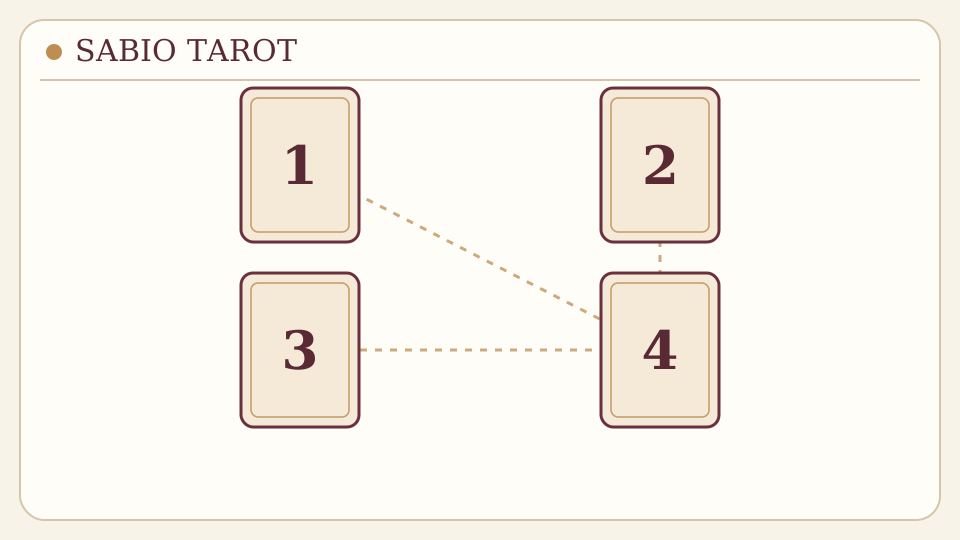
- 1Priority
- 2Distraction
- 3Resource
- 4Concrete task
From the huge project to a unit of work
Before drawing cards, write down what project you are trying to move forward and what could be finished in a short session. “Make progress on the website” is too broad; “review three links in the catalog” has a beginning and an end. The first card helps choose what matters today. The second asks what pulls your attention away: a notification, another urgent task, uncertainty about the criterion, or tiredness. The third identifies a real resource you can use. The fourth suggests a concrete task that leaves evidence: a paragraph, a reviewed list, a prepared email.
Place the priority at the top, the distraction to one side, the resource to the other, and the task below. Draw an arrow from resource toward task and another from distraction toward a concrete action to reduce it (for example, closing tabs or silencing the phone). Do not interpret “distraction” as moral weakness. If there is an urgent call or a person in your care, you may need to adapt the plan instead of pretending you can eliminate that interruption. The card position specifies the function; the same image could be read differently in a different place.
Fictitious example: preparing a product page
Invented case to explain the layout. Irene needs to review a page for a product that already exists, but she jumps between images, price, and description without finishing anything. She asks: “What completed task can I get done today in forty minutes?” For priority, the Ace of Swords appears: she decides to first check whether the description clearly says what the product includes. For distraction, the Seven of Cups appears: she has opened too many image variants. For resource, the Three of Pentacles appears: she has a previous list of questions from a colleague. For task, the Eight of Pentacles appears: she proposes correcting the description and marking three ambiguous sentences for review.
The synthesis is: “Today I prioritize clarity of the text; I close the image tabs; I use the list of questions; by the end I will have a corrected description and three noted questions.” Irene silences her phone for forty minutes and sets a timer. Tarot does not prove that she will concentrate or that the description is commercially effective. The result is verified at the end: does a revised text exist? Are the questions marked for someone else?
If the distraction contains useful information
The Seven of Cups could reflect too many visual options, but perhaps Irene needs to compare two photos because one shows the product poorly. She should not close all the images out of obedience to the card. She can choose a rule: keep open only the two photos needed to check a sentence; postpone the rest to the design phase. That way she reduces task switching without losing important evidence. The reading does not prescribe a universal concentration technique; it helps distinguish which part of exploration serves the priority and which replaces it.
If the main interruption is external, the fourth task may need to be smaller. A ten-minute session to write a heading can be a valid unit. What matters is that the action is realistic under the day's conditions. If you are exhausted or ill, resting and asking for help may be more pertinent than imposing another round of work on yourself. The cards do not measure your health or your cognitive capacity.
How to review the result without punishment
When you finish, compare the plan with the artifact produced. If Irene corrected the description but did not mark the three questions, record both things. Ask why: perhaps the text was clearer than she expected; perhaps she spent time looking for references. Adjust the next session with that information. Do not do a second spread immediately to judge the first. The useful review is “what was I able to finish in forty minutes and what variable do I need to change.”
An honest reading admits that the initial priority can also be wrong. If a client reports a price error, that real data can displace the description. The Ace of Swords does not prohibit changing the order in the face of new information. Record the reason for the change and avoid rewriting the spread as if it had foreseen the notice. The method teaches you to hold a priority while it is pertinent, not to ignore context.
One-page sheet to repeat the method
Divide a sheet into four boxes. In priority, write one sentence and the reason for choosing it; in distraction, an observable interruption; in resource, something that already exists or that you can request; in task, a result someone else could verify. Add at the bottom a start time, an end time, and a review note. If the task is still “do it better,” reduce the scope until you can name a file, a paragraph, or a conversation.
You can practice the synthesis with how to combine meanings of several cards. On a reusable sheet, note the priority task, the first step, foreseeable distractions, and the review moment. Tarot here occupies the place of a reflection guideline. The finished task, or the clear reason it was not finished, is the evidence that allows learning.
If the task advances but you still feel scattered
Do not use the feeling as the only measure. Irene may have corrected the text and still remember several interruptions. That does not cancel the work done; it indicates that she may need to modify the environment for the next session. She can note how many times she switched tabs and why: a necessary search, an urgent message, or an unrelated distraction. Then she decides on a single proportional measure, such as preparing beforehand the references she needs. She does not have to set out to “never get distracted,” a standard that does not help understand the process.
The opposite can also happen: Irene felt concentrated for forty minutes but worked on something different from the agreed priority. Then it is worth reviewing whether the first position was well chosen or whether she avoided a difficult part. The spread does not reward a pleasant emotion or penalize an uncomfortable one. Ask what output resulted, whether it was the one needed, and what new information appeared. That distinction allows learning from the session without turning concentration into a moral identity.