Sabio Tarot · Reading methods and spreads
Three-Card Spread to Clarify an Emotion

An emotion that is difficult to name can become a question too large for the deck: “What is happening to me?” This spread narrows the scope. The positions are image of what I feel, need worth examining, and way of expressing it. It does not identify a disorder or establish clinical causes. It can help you find words for an everyday experience, but if the distress is intense, persistent, or you are worried about your safety, seek appropriate professional support. No card replaces that care.
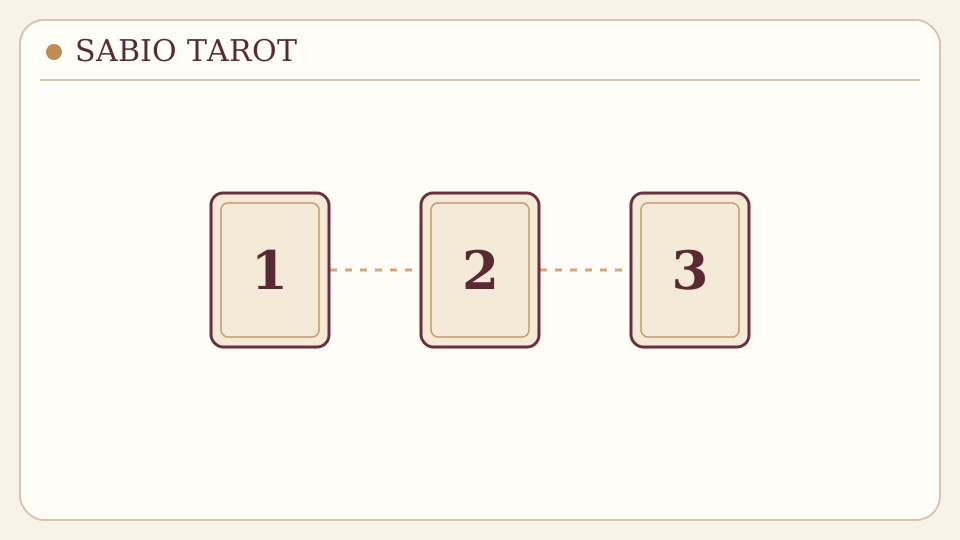
- 1Image
- 2Need
- 3Expression
Start by Describing, Not Labeling
Before shuffling, write down what happened and what you notice now without diagnosing yourself: “After the meeting I feel tense and I don’t know what to say.” The first card works as a provisional metaphor. If you see a figure turning away, you can ask whether you need distance; do not conclude that “the tarot says you always avoid conflict.” The second position asks about a concrete need: information, rest, respect, time, or companionship. The third seeks a sentence or action that expresses that need without requiring another person to guess it.
Lay the three cards in a line and leave a space below for three levels of language: I observe, I suppose, and I can say or do. This separation matters because an emotion is real for the person feeling it, but the interpretation of its cause may be incomplete. “I feel uneasy” is a fact of your experience. “My colleague wanted to humiliate me” is a hypothesis about her intention that requires more information. Tarot does not resolve that difference by itself.
Fictitious Example: After a Meeting
Invented scene, not a clinical or real consultation. Elisa leaves a meeting with a project postponed. She notices frustration and shame, but does not know which weighs more. Her question is: “How can I understand what I feel and explain it without accusing anyone?” In the image position appears the Five of Cups from a Rider-Waite-Smith deck: she observes a figure focused on a loss and uses that scene as a metaphor for the disappointment over the postponement. In the need position comes Justice: perhaps she needs to know the criteria for the decision. In the expression position appears the Page of Swords: she prepares a concrete question for the person responsible.
Elisa writes: “I was discouraged that the proposal was postponed. Could you tell me which two changes would be most useful for revising it?” That sentence acknowledges her emotion, asks for information, and leaves room for a response. It does not claim that the meeting was unfair or that a card revealed a hidden intention. After speaking, Elisa will be able to know whether the postponement was due to budget, schedule, or content. Only then will she update her interpretation of the fact.
When the First Image Allows More Than One Emotion
The Five of Cups is often associated with loss, but Elisa might also feel relief at having more time. If the card does not capture the mix, do not force the whole experience to fit into one label. Write two words: “disappointment and relief.” Ask when each one appears. Perhaps shame arises when she remembers that she presented a rushed version, while relief appears when she knows she can correct it. A card can start the inner conversation, but it has no authority to reduce a complex experience to a single emotion.
The need can also be twofold. Elisa may want information and recognition for the work done. The second card does not have to choose between the two; it can help you order what to ask for first. The revision criteria are a concrete request. Recognition can be addressed at another time, if it still matters to her after understanding the reasons. Separating needs prevents writing a message so long that the other person does not know what to answer.
Form of Expression and the Right Not to Share Everything
The third position does not oblige you to communicate the emotion to the person who was in the meeting. Elisa can write privately, talk with a friend, or wait until she is ready. If she decides to speak with the person responsible, it is worth distinguishing a clear request from venting that could complicate the relationship. If the environment is unsafe or there is a power imbalance, she can choose a formal channel or ask for support. Tarot does not determine which of those paths is safe: the real context must be assessed.
A useful sentence combines first person, fact, and request: “When the proposal was postponed, I was left with doubts; I need to know what criterion we must meet before resubmitting it.” Avoid “You made me feel useless” if you do not know that this was the intention and if what you want is to obtain information. Acknowledging the emotion does not require assigning blame. Sometimes the appropriate action is to rest before writing and review the message the next day.
A Second Fictitious Example: Joy with Caution
Another invented example. Raúl receives an invitation to show his work and feels joy mixed with fear of not being prepared. In the image position comes The Sun: he recognizes enthusiasm. In the need position appears the Two of Pentacles: he needs to check how much time he can dedicate to preparing the exhibition. In the expression position comes the Three of Pentacles: he responds by thanking them for the invitation and asking about requirements and dates. The reading does not diagnose anxiety or promise that the exhibition will go well. It allows him to hold two emotions at once and ask for information before committing.
The contrast between the two examples shows that this spread is not designed only for uncomfortable emotions. The first position names an experience; the second turns that experience into a question about needs; the third proposes language or action. If the need does not have an immediate answer, you can keep it open. Do not draw successive cards to find a “correct” feeling.
A Brief Worksheet and Its Limit
Write: “The fact was…,” “I feel…,” “The image suggests to me… but it could also…,” “I need to check or ask for…,” “I can express it as….” Review the final sentence after a few hours. If it remains honest and respectful, it may serve you; if it no longer fits, change it without pretending that the card changed. Closing a reading also means recognizing what we do not know.
To close, prepare a table with three columns: emotion you recognize, possible need, and small action you can choose. Leave a blank line if you still do not know what to write. The reading serves to broaden vocabulary and room for action. An emotion does not need to justify itself before the deck, and a cause is not considered proven because a card seems to illustrate it.