Sabio Tarot · Reading methods and spreads
Five-Card Spread for Listening to Several Voices in a Conflict

When two people disagree, a spread can easily turn into a symbolic court: one card for “who is right” and another for “who is lying.” That use confuses images with evidence and can intensify the conflict. This layout proposes five distinct positions: known facts, my perspective, another perspective I should ask about, shared boundary, and possible conversation. The third does not read anyone’s mind; it shows what question is worth bringing to the dialogue and what assumption we should not take for granted.
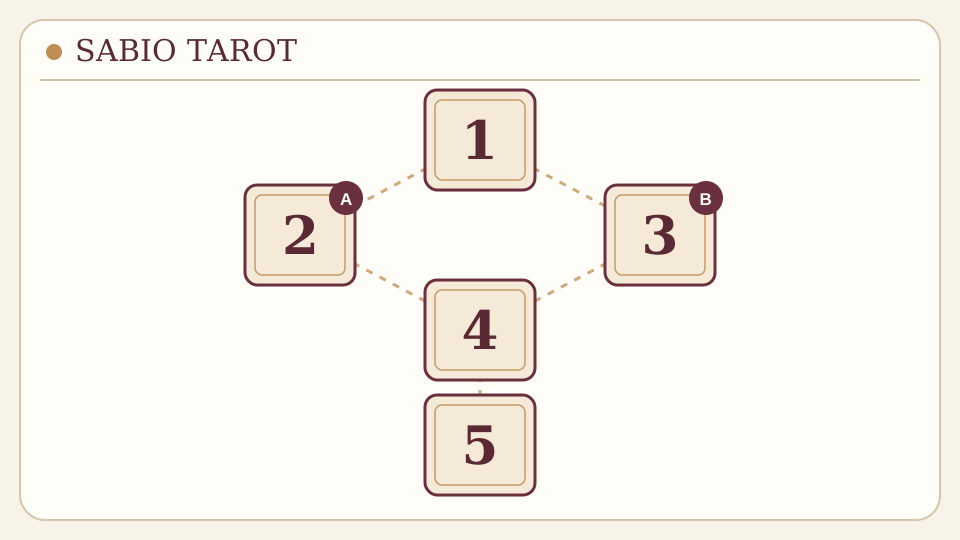
- 1Facts
- 2Perspective A
- 3Perspective B
- 4Shared boundary
- 5Possible conversation
Before Shuffling: The List of Facts
Write only what both parties could verify: dates, messages, a task that was or was not completed, a decision that was communicated. Mark your emotions and interpretations separately. If you have not heard the other person, state explicitly that you do not know their point of view. Choose a working question: “How do I prepare for a conversation about how this project is divided up?” Do not ask “what does he or she really think?” or “who is to blame?” The spread is oriented toward your preparation, not toward obtaining private information from someone who is absent.
Lay out the five cards in a V and number the positions: 1, known facts at the top; 2, my perspective on the left; 3, the perspective to ask about on the right; 4, shared boundary in the bottom center; 5, possible conversation below. You can draw five boxes with their names before drawing. The facts position does not turn a card into a document; it reminds you to review the list you already wrote. If the image seems to contradict a verified fact, the fact prevails. The symbolic reading must work with it, not erase it.
Before interpreting the fifth card, draw two columns in your notes: “facts I can verify” and “each person’s perspectives.” Place what you know about each voice without turning it into a certainty about their thoughts. Only afterward formulate a question for the shared conversation. That way the fifth position gathers what was worked through in the previous four. For a general method of synthesis, see how to bring several cards together.
Fictitious Example: A Shared Exhibition
Invented example; it does not reproduce a real consultation. Lucía and Omar are preparing a small exhibition. Lucía believes she ends up taking on the printing of materials; Omar believes decisions about design were made without him. The noted facts are: the budget was sent on Monday, the print shop needs an answer by Friday, and they still have not signed off on the division of tasks. Lucía asks how to approach a conversation.
In facts, Justice appears. Lucía uses it as a reminder to read the budget and the task list, not as proof that she is right. In her perspective, Nine of Wands appears: she feels she is carrying the final phase and needs rest. In the perspective to ask about, Two of Swords appears: she does not conclude that Omar is blocked; she formulates “what information were you missing in order to take part in the design decision?” In shared boundary, Four of Pentacles appears: both must keep spending within the approved budget. In possible conversation, Three of Cups appears: it proposes meeting for twenty minutes, acknowledging what each person did, and agreeing on the response to the print shop.
The synthesis does not assign blame: “There is a date and a real cost; I need to distribute the printing work; I do not know what information Omar was missing; let’s agree on a maximum spend and a person responsible before Friday.” Lucía sends an invitation with the budget attached. Omar’s reaction, when it comes, will be new information that the cards did not foresee.
If the Other Perspective Changes the Story
Imagine that Omar responds that he had already offered to prepare files, but Lucía did not see his message. Inviting him to listen was a good move, although the hypothesis of missing information loses strength. They must review the communication channel and confirm who decides what. Another possible response is that Omar did not have the time or resources to prepare the files. In both cases, the third position did its job if Lucía asked instead of asserting. There is no need to reinterpret the Two of Swords as if it had retrospectively shown the specific answer.
The shared boundary must also be verifiable. “Respecting each other” is desirable but too broad to resolve the printing. “Not authorizing spending above the budget without both parties’ agreement” can be applied. If disagreement continues, it is advisable to stop purchases or use the agreed-upon procedure. Tarot can help formulate the rule; it does not create contractual authority or replace a written agreement.
What to Do with a Card That Seems Accusatory
If in the other-perspective position a card appears that unsettles you, avoid translating it as “the other person is hiding something.” Write two neutral questions: “What part of the process did you see differently?” and “What do you need in order to continue?” Also ask what evidence exists for any suspicion. The card may reflect your fear or a general tension; it does not by itself identify intention, deception, or blame. Readings for another person require respect for their autonomy even when that person is not present.
If the conflict includes threats, harassment, or a power relationship that prevents speaking safely, do not use the fifth card to force a meeting. Seek support, documentation, and appropriate channels. The “possible conversation” may be a formal message, a mediation, or the decision not to address the matter in private. Real safety takes priority over the pretty symmetry of a diagram.
Closing the Reading and the Dialogue
Before speaking, write down one sentence per position and review what comes from facts, what is your experience, and what you will only be able to know by asking. After the meeting, add the answers received and the agreement, without erasing the original hypotheses. If there was no agreement, note what remains pending and what action does depend on you. Do not call a spread that helped you avoid attributing thoughts without evidence a “failure.”
A Short Script Before the Meeting
Lucía can prepare three sentences based on her notes: “The budget arrived on Monday, and the print shop is waiting for an answer on Friday”; “I am worried that the printing will be left without someone responsible”; “How did you see the design decision, and what can you take on this week?” The first statement is verifiable, the second belongs to her experience, and the third opens the floor for Omar’s voice. If she starts with “The spread says you don’t want to help,” she will have turned a symbolic question into an accusation without evidence.
After hearing Omar, Lucía should summarize what she understood and ask for correction: “So, were you missing access to the file before the meeting?” That step does not appear magically in a card; it is a concrete conversational technique. If he corrects the hypothesis, the new information must go into the plan. A position for an absent perspective only makes sense if we let the real person complete or reject what is assumed. The spread helps prepare that humility, not avoid it.