Sabio Tarot · Reading methods and spreads
Four-card spread for a long-term goal

A goal spanning months or years is not resolved by a “final success” card. The path depends on practice, changing conditions, and other people’s decisions. This spread uses four positions —resources, routine, risk, and review— to design a process you can observe. The fourth card does not give a prophetic date: it helps you decide when and by what criterion to review the plan. If the goal depends on health, funding, or rights, check those matters with professionals and responsible sources.
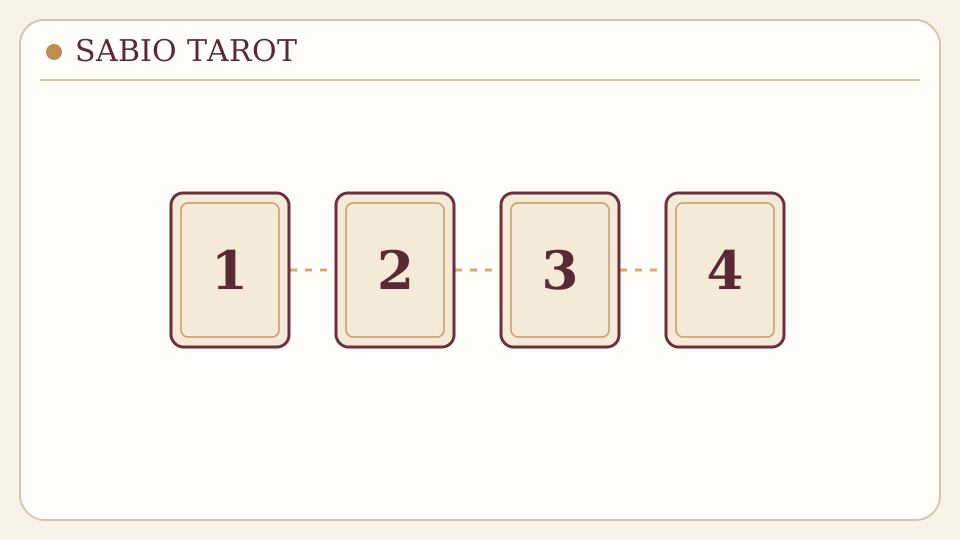
- 1Resources
- 2Routine
- 3Risk
- 4Review
Narrow the horizon without pretending to see all of it
Write the goal as a behavior or project, not only as a wish: “Prepare a portfolio of illustrations over six months” is more useful than “be an artist.” Divide that horizon into a first cycle of two to four weeks. The resources card points to what you already have: time, materials, knowledge, help that has been agreed to. The routine card asks what repetition will move the work forward. The risk card looks for a condition that could interrupt it, without turning it into a catastrophe. The review card proposes an indicator and a moment to adjust the plan.
Place the four cards around a calendar page. Under each one, write a verifiable sentence. If the routine remains “try really hard,” ask how much, when, and with what material. If the risk remains “something bad will happen,” ask what concrete fact you should watch. A useful spread reduces vagueness; it does not manufacture certainty about a distant future.
Fictitious example: preparing a portfolio
Invented example; it does not describe a real person. Aina wants to prepare twelve selected illustrations to apply for an internship in six months. She draws Three of Pentacles in resources and notes that she has eight previous works and a teacher who agrees to comment on some. In routine appears Eight of Pentacles: it proposes two drawing blocks per week, plus a short review session. In risk comes Seven of Cups: she observes that she tends to open too many new ideas before finishing one. In review comes Justice: it sets a monthly check with written criteria of clarity, variety, and requirements of the calls for applications.
The synthesis is not “Aina will get the internship.” It is: “I already have pieces and possible feedback; I need a production routine; I will limit simultaneous ideas, and each month I will compare the portfolio with real requirements.” Aina checks the current calls, asks her teacher whether she remains available, and marks four initial sessions on the calendar. If conditions change, she will modify the routine. No card by itself certifies a deadline, an acceptance, or the level of her work.
A risk does not always require avoiding the path
The Seven of Cups could represent fertile exploration, not only dispersion. To distinguish it, Aina counts how many sketches turned into finished pieces during the last month. If opening ideas helped her find two powerful approaches, perhaps she should not suppress it, but rather reserve exploration time separate from finishing time. If instead she abandoned all the works halfway through, it is better to limit simultaneous projects. The card names a hypothesis; the work history allows testing it.
In another project, the risk card could point to dependence on a third party, lack of material, or an external date. Do not turn “risk” into “blame.” Write its approximate probability only if you have data; if not, describe what early signal you will observe. For example, “if I miss three sessions in a row because of scheduling, I will review the routine” is more useful than “if a difficult card comes up, I should not try.”
How to choose the moment of review
The review position does not mean waiting passively until the deck speaks again. Choose an interval short enough to detect a problem and long enough to have done real work. In Aina’s case, one month allows comparing pieces and requirements. For a daily habit, a week may be enough. For an extensive training program, it may be worth reviewing at the end of each module. You choose the date according to the project; the card can help you think about what criterion to include, not guess the optimal day.
In the monthly review, Aina keeps three versions: the initial goal, what was actually produced, and the explanation of the change. She may conclude that twelve pieces were too many, that she needs to improve six, or that a call for applications requires another format. Changing the goal because of new information does not mean the spread failed. It means the plan was adjusted to reality. The synthesis guide helps you unite the four positions without reading them as four disconnected sentences.
A tracking sheet that avoids triumphalism
Write down: six-month goal, first cycle, confirmed resources, minimum routine, risk signal, review date, and external source you must consult. At each review, mark what you did and what you learned. Avoid saying “the resources card guaranteed help” if the teacher ultimately could not comment. Note that the help was pending confirmation. The difference between “available” and “possible” matters when a project depends on people.
Draw a tracking calendar without marking a “predicted” date. Reserve four boxes for the spread positions and a fifth for the indicator you will review: pages written, practice sessions, or a pending response, depending on your goal. The spread helps sustain attention during a long process and accept adjustments. An outcome still unknown is not hidden in a card.
Difference between goal, process, and indicator
Aina’s goal is to present a portfolio to apply for an internship. The process includes drawing, receiving comments, selecting pieces, and reviewing requirements. The indicator for a first month could be “I finished two pieces and received observations on one,” not “they will hire me.” This separation prevents the review card from being read as final destiny. If the indicator depends on another person — for example, a teacher responding — add an indicator under your control: “I sent the request for comment with a concrete question.”
The minimum routine must also allow for difficult weeks. Aina can define an ordinary version of two drawing blocks and a reduced version of one twenty-minute block. If the second becomes the usual one, she will review whether the goal or the calendar is still realistic. That is better than declaring that she lost a card’s “energy.” A long-term plan is a sequence of adjustable decisions, not a single bet sealed on the day of the spread.
If the risk card seems positive
A pleasant card in “risk” does not have to mean there is no risk. It may ask whether an excess of interesting projects disperses time, whether promised help is not yet confirmed, or whether current comfort prevents trying something new. But these are hypotheses, not hidden warnings. Always write the signal you would observe and an alternative explanation. If you do not find a specific risk, leave the box open and review the project with real data. Do not fabricate a threat to justify the position.